Disclosure, Discernment, and the Age of Ambiguity
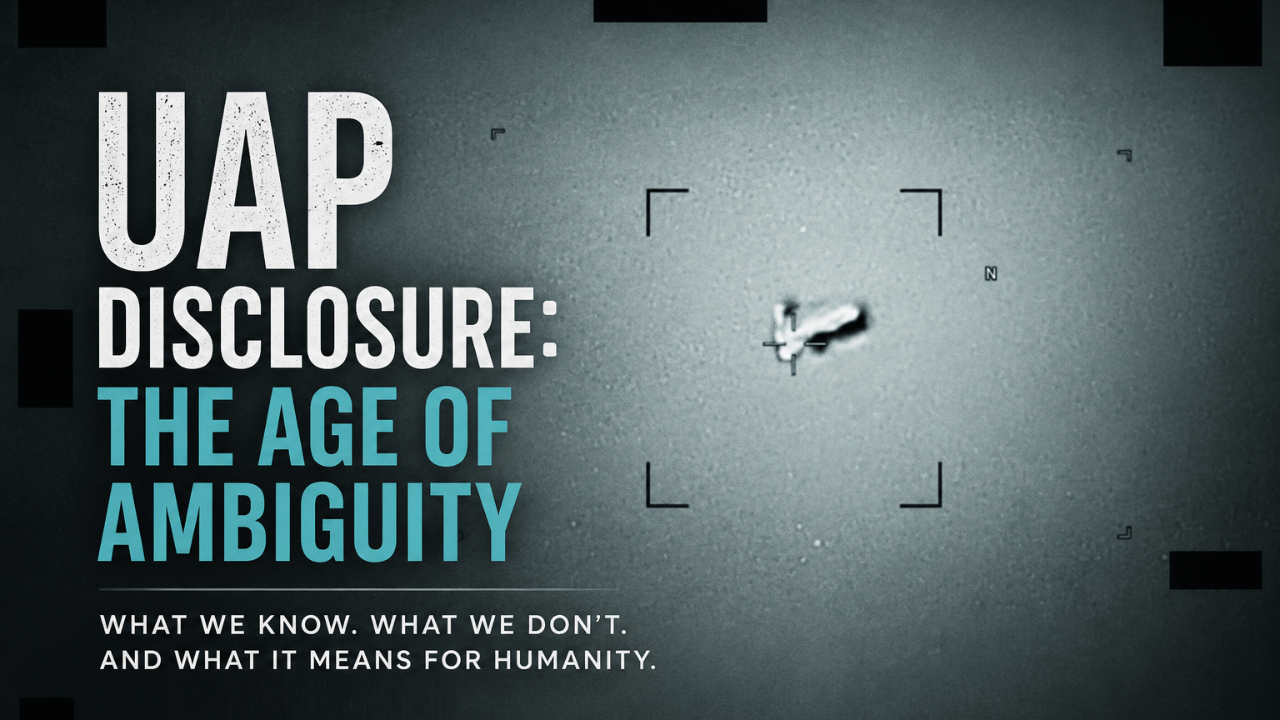
UAP files reveal more about us than they do the UAPs
When governments release information once held behind institutional walls, the public response is often imagined in cinematic terms. Revelation arrives. The truth emerges. The world changes.
That is not what happened.
On May 8, 2026, the Pentagon released more than 160 declassified files on unidentified aerial phenomena through a new public portal called PURSUE, the Presidential Unsealing and Reporting System for UAP Encounters. [Go to portal] The records span decades of military encounters with aerial objects that investigators were unable to identify. They include State Department cables, FBI documents, NASA transcripts from crewed space missions, and video footage from military sensors. Within hours, the documents had been mirrored, screenshotted, captioned, and refracted across every platform that hosts attention.
Within days, the public had already divided into recognizable positions. Vindication. Dismissal. Suspicion. Transcendence. Ridicule. Anticipation.
The striking feature was not disagreement. Disagreement is ordinary.
What was striking was the speed.
People appeared to arrive at certainty before arriving at understanding.
That observation may tell us something more important than the content of the files.
 Actual site photo with an FBI-rendered graphic depicting corroborating eyewitness reports from September 2023 of an apparent ellipsoid bronze-metallic object materializing from a bright light in the sky, 130-195 feet in length, and disappearing instantaneously. (U.S. Government Photo from war.gov/ufo)
Humans Fill Space
Christopher Mellon, former deputy assistant secretary of defense for intelligence and a central figure in the long campaign to surface this material, named the dynamic plainly. "Data alone is not disclosure. Releasing raw files without context may confuse more than clarify." The institutions that finally surrendered the documents did not surrender the documents' meaning. That work was outsourced to the public, in real time, at internet speed.
Perhaps disclosure events are not simply moments where hidden information enters public awareness.
Perhaps they are moments where ambiguity enters public awareness.
And ambiguity does something to consciousness.
Not because ambiguity is harmful.
Not because uncertainty is inherently destabilizing.
But because ambiguity leaves open space.
Human beings do not relate to open space neutrally. We fill it.
The primary directive of the mind is to make and navigate meaning. We are walking tree and our fruit is meaning. The behavioral science here is unusually clean. For three decades, the social psychologist Arie Kruglanski and his collaborators have studied what they call the need for cognitive closure (NFCC): the motivated desire for a clear, firm answer rather than continued ambiguity. The pressure intensifies when uncertainty feels costly. Under time pressure, the reach for structure accelerates. Under saturated conditions, it accelerates again.
In other words, precisely the conditions inside which the PURSUE files appeared.
But closure does not end thought. It directs it.
People do not stop wondering when ambiguity appears. They begin wondering from inside a conclusion. Once a provisional certainty lands, the mind keeps moving, but now it moves in defense of what has already been decided. It gathers evidence, memory, fear, identity, and narrative around the answer that arrived first.
This becomes especially important in periods where the baseline assumptions of society are moving. Institutions once regarded as authoritative now compete with distributed networks of interpretation. Expertise coexists with algorithmic amplification. Information appears in volumes that exceed any individual’s ability to metabolize it.
Under these conditions, ambiguity becomes fertile.
This is where much of the public conversation misses something.
We often assume uncertainty reveals what was already present.
There may be another possibility.
Ambiguity Breeds Shadow
Not in the sense that ambiguity creates distortion from nothing. It creates conditions in which awareness cannot immediately orient, and what enters that opening is rarely our most developed thinking. The mind does not meet the unknown as a blank slate. We come to it preloaded with deep conscious assumptions and beliefs that allow for advanced and complex thought. It meets it through prior fear, prior identity, prior worldview, prior meaning. All of this meaning yearning for expression...
It calls to the blind spot.
It calls to the places filled with our biggest fears.
It calls to survival-rooted programming.
It calls to what exceeds the current structure of self to comprehend.
The result is not irrationality. It is not weakness.
It is the mind doing what minds do when confronted with something too large, too incomplete, or too unresolved to organize immediately. Projection of assumed meaning.
Meaning arrives.
Orientation arrives.
Certainty arrives.
Not because certainty was earned, but because consciousness rarely tolerates open loops for long.
This helps explain why disclosure conversations become emotionally charged so quickly.
The object itself becomes secondary.
What matters becomes what enters the space around the object.
Consider a single record from the PURSUE archive. A 1994 State Department cable from the U.S. Embassy in Tajikistan describes American and Tajik pilots witnessing an aerial object executing sharp turns and high-speed maneuvers over Kazakhstan. The cable itself is brief, technical, and undecided. Within hours of its release, that one document could be read as proof of a cover-up, as evidence of expanded reality, as an obvious sensor artifact, as Cold War fog, as a revelation worth rewriting physics for.
One cable. Six worlds.
The same event becomes multiple worlds.
This should not necessarily alarm us.
But it should humble us.
Communication scholars, influence researchers, and media theorists have warned for decades that environments shape interpretation before content is consciously evaluated. Attention is contested terrain. Fear narrows possibility. Narrative organizes perception. Identity stabilizes uncertainty.
Those explanations stop one layer too early.
Underneath communication is orientation.
Underneath orientation are the prior meanings through which new information must pass.
The challenge of our era may not ultimately be misinformation.
It may be recalibrating and holding space for our certainty.
It may be the speed with which human beings recruit old meaning to finish new sentences.
"The quality of your life is in direct proportion to the amount of uncertainty you can comfortably live with."
-Tony Robbins
The inability to remain present long enough for reality to reveal more of itself before we hand authorship to fear, identity, ideology, or inherited meaning.
Discernment, then, is not skepticism.
It is not detachment.
It is not intellectual superiority.
Discernment may be the increasingly rare ability to remain centered while the baseline moves.
To investigate without collapsing.
To encounter ambiguity without immediately mistaking reaction for revelation.
To let reality remain larger than the current explanation.
If that is true, then disclosure is not fundamentally about what governments know.
It is about whether human beings can remain conscious when they do not know.
Because the defining question of this century may not be whether the unknown exists.
It may be whether we can meet it without becoming possessed by what we bring into it.
Go Deeper
If this piece speaks to the challenge of meeting ambiguity without collapsing into inherited meaning, these essays expand the deeper architecture beneath that problem.
Mental Projection
How hidden meaning organizes perception before you realize you are looking through it.
The Construct
A map of how identity, belief, emotion, decision, and action shape the way reality gets translated into experience.
Turning Within Practice
A practical framework for meeting charge, ambiguity, and patterned reaction without immediately handing authorship to them.