Identity Foreclosure: The Hidden Power of Identity

Developmental psychology says identity foreclosure happens when we commit to an identity before fully exploring it. But beneath the label is a deeper invitation: to see how identity has been quietly shaping the life you are already living.
There is a kind of suffering that does not announce itself as suffering.
It looks like being responsible.
It looks like being loyal.
It looks like being "the strong one," "the good daughter," "the provider," "the spiritual one," "the successful one," "the problem child," "the one who never needs help."
From the without, it can look like personality.
From within, it often feels like reality.
You do not usually say, "An identity orientation has been activated."
You say, "This is just who I am."
Or, "This always happens to me."
Or, "I have to be the one who handles it."
Or, "If I stop proving myself, everything will fall apart."
For a long time, that identity may have worked. It gave life shape. It helped you belong, succeed, stay coherent, or avoid a pain you were not yet ready to meet.
But somewhere along the way, the identity starts to squeak.
The same relationship pattern returns. The same urgency to prove. The same guilt when you rest. The same resentment beneath being useful. The same ache whispering that if you are not chosen, seen, or needed, something about you may not be enough.
Nothing has fallen apart.
But something is calling for your attention.
You may not know what needs to change yet.
You may not know what the pattern means.
You may not even be ready to call it a pattern.
But something in you is no longer willing to pretend it is nothing.
This is the threshold where identity begins to reveal itself.
Psychology has a name for one version of this: identity foreclosure.
What Psychology Means by Identity Foreclosure
The term comes from developmental psychologist James Marcia, who expanded Erik Erikson's research on identity formation. Marcia described identity development through two movements: exploration and commitment.
Exploration means a person questions, tests, and lives their way into who they are.
Commitment means a person takes on a role, a worldview, a direction, or a way of being.
Identity foreclosure happens when commitment arrives before enough exploration. A person begins living from an identity before fully exploring whether that identity is true, useful, or consciously chosen.
It can look obvious.
A child becomes "the responsible one" because someone had to hold the family's emotional weather.
A teenager becomes "the achiever" because achievement was the safest way to be seen.
A daughter becomes "the good one" because belonging depended on being agreeable.
But foreclosure can also look beautiful.
A person becomes the helper. The conscious one. The successful one. The healer. The one who always knows what to do.
This is what makes it hard to recognize. The foreclosed identity is not always the obvious wound. Sometimes it is the role that got applauded.
Identity gives life continuity. It helps the mind answer the questions it must answer to keep moving:
Who am I here?
What matters?
What threatens me?
What can be done?
So developmental psychology gives us the first glance at the map. It helps us see that we make up our mind about who we are long before we understand the power of what we are making.
But that only takes us to the shoreline.
Leveraging Foreclosure to Reclaim Authorship
If we stop at the psychological definition, we might assume identity foreclosure is simply a developmental limitation. A distortion to correct. A sign that something went wrong.
At one level, yes. A foreclosed identity can absolutely limit a life.
But look more closely.
The mind is not merely damaged when it forecloses. It is demonstrating one of its most advanced capacities: the mind's ability to organize experience around identity.
Identity gives meaning orientation.
It tells awareness where it stands inside the meaning being made.
Without identity, the mind has no stable position from which to interpret, anticipate, decide, or act. The whole system would unravel.
This is why identity is not optional, and it is not decorative. It is a facet of how awareness is generated, oriented, and presented through the Construct, the architecture by which meaning becomes lived experience.
So a foreclosed identity is not simply a bad idea about who you are.
It is a location inside meaning. An address we leverage to know where to come from.
Somewhere you learned to stand. Whether the view from the window is spectacular or not.
And from that place, life begins to organize and because we are programmed to orient first awareness external, we validate the source by the projection.
When Identity Presents as Reality
Take one of the most common identity orientations:
I am not enough.
At first, it sounds like a thought. A painful one, but still a thought.
In lived experience, though, "I am not enough" rarely stays at the level of thought. It becomes an orientation. The person does not merely think they are not enough. They begin to experience life from the position of not enough.
From there, the world appears to ask:
Are you chosen yet?
Are you successful yet?
Are you useful yet?
Are you healed yet?
Are you finally enough yet?
This identity does not merely create insecurity. It organizes pursuit.
Enoughness gets sought from the without: through relationships, approval, achievement, visibility, service, and becoming the person no one can reject.
Because awareness is trained without before it is trained within, we naturally look outside for what is being signaled inside.
This is not stupidity.
It is an expected misorientation.
The system feels an internal signal and searches the external world for the answer.
But the world cannot permanently solve an internal identity orientation.
It can soothe it. It can mirror it. It can decorate it.
It cannot author it.
But an evolved mind that continues to orient from not enough will simply adjust the story. We will do anything, consciously and unconsciously, to stay consistent and persistent with the identities that we leverage to make meaning of our world.
We either require a bigger external validation, or we give ourselves an asterisk, "This was a fluke, I got lucky," or "They are just being nice."
That is why the same pattern repeats even after a person gets what they thought would finally resolve it.
The outcome is reached, but the fear remains. The charge remains because the foreclosed identity has more confirmation. So an evolved mind simple makes adjustments to maintain coherence. This is important because:
The success arrives, but the pressure increases.
The praise arrives, but the relief fades.
The healing identity arrives, and the deeper assumption survives:
There is still something wrong with me.
The without matters. Relationship, work, community, and the world matter.
But the world cannot do the work of Turning Within. Only you can.
Learn how to Turning Within
The Squeaky Wheel Reveals the System
There is an old saying: the squeaky wheel gets the oil.
Most people hear that as a complaint about attention. The loudest problem gets handled first.
But in this work, the squeaky wheel does something more important.
The squeaky wheel reveals that we have wheels.
The painful identity gets attention because it disrupts life.
The anxiety. The resentment. The over-efforting. The collapse. The repeating relationship pattern. The ache of not being enough.
Most people hear the squeak and conclude:
Something is wrong with me.
But what if something is trying to become conscious?
What if the identity showing up is the system trying to recalibrate or release an orientation that no longer serves?
The identity that helped you survive may no longer be able to carry the life trying to emerge.
The identity that helped you belong may now be blocking intimacy.
The identity that made you useful may now be preventing you from being known.
The identity that protected you from shame may now be preventing you from receiving love.
The identity is not evil.
It is not proof that you are broken.
It is an outdated orientation inside a powerful system.
The mind did not fail. It created coherence before conscious authority was available.
Now the work is not to shame the identity.
The work is to study what it has been creating.
In the language of this work, identity foreclosure is projection manifesting at the identity facet of the Construct. It happens when an identity formed from early, survival-rooted, or immature meaning is triggered and activated in lived experience.
You do not experience it as, "An old identity is active."
You experience it as, "This is what is happening."
The identity presents as reality.
And once that becomes visible, you have something to work with.
How to Begin Working With It
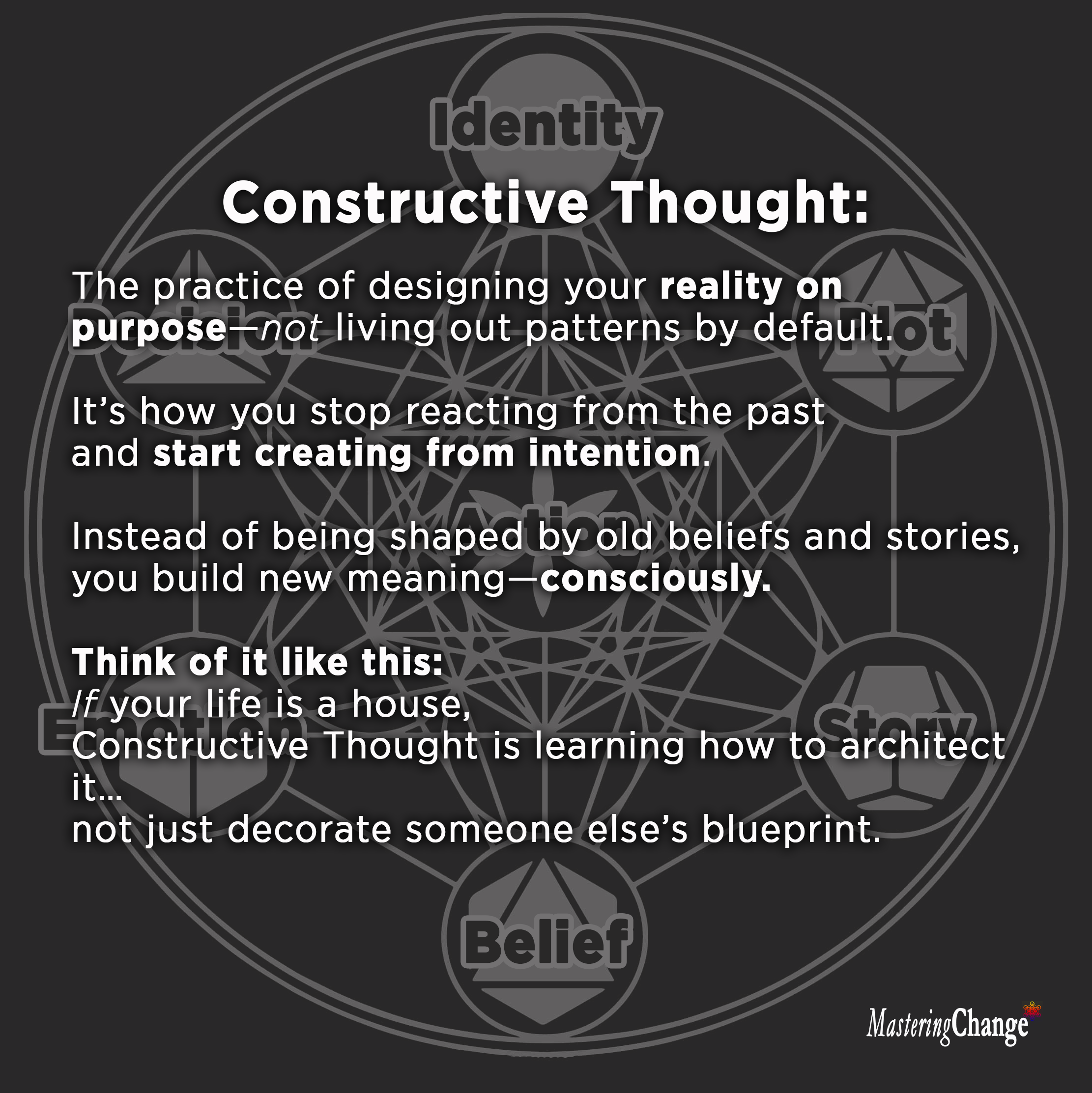
The deeper path is the Constructive Thought Process, a way of studying how identity, narrative, story, belief, emotion, decision, and action work together to construct lived experience. It gives you a way to see how meaning becomes the life you are living.
But when an identity is active, when you are inside the moment rather than analyzing it from a safe distance, you need a doorway you can actually walk through.
Learn about Constructive Thought
That doorway is RAIN.
RAIN stands for Recognize, Allow, Investigate, and Nurture. In Turning Within, RAIN is not a generic mindfulness exercise. It is an in-theater integration process for holding space when the pattern is active.
R: Recognize
Recognize that an identity has come online.
Not the whole story. Not the entire pattern. Just the active identity and how it orients us in our story.
I am not enough.
I am the one who has to handle this.
I am unwanted.
I am only valuable when I am useful.
I am the one who gets left.
Recognition is the first return of authorship.
A: Allow
Allowing does not mean agreeing.
It does not mean the identity is true.
It does not mean the pattern gets to run your life.
It means you stop pushing the identity back into the dark long enough to feel what has surfaced.
You cannot heal what you do not feel.
The instinct is often to suppress, fix, perform, explain, or avoid the discomfort. Allowing interrupts that reflex.
It is acceptance of our humaning and how we got here. That pause matters.
It is where awareness stops being a passenger.
I: Investigate
This is where RAIN meets Closing the Circuit.
This is the fruit-to-root movement.
You begin with the fruit, the visible pattern, the recent charge, and follow it back toward the root where the identity was first stabilized.
The goal is not to think your way out of the identity.
The goal is to bring awareness to the place where the identity became charged.
Awareness arriving at the root is what begins to loosen the grip.
N: Nurture the Need
The investigation will reveal a need underneath the identity.
Often something simple and ancient.
Nurture means meeting that part of you with the care it once sought from the without.
Then practice one action from a truer identity.
Not a dramatic reinvention.
It is practiced into the world.
For a deeper dive, read The RAIN Process: Holding Space in Shadow Work.
Where This Leads
Identity foreclosure is not just a psychological concept.
It is a doorway into seeing how identity has been shaping the life you are already living.
When an identity formed from early, survival-rooted, or immature meaning is triggered, it can present through life as if the world is proving it true.
That does not mean you are broken.
It means something is active.
Something is asking to be seen.
And here is the quiet revelation underneath all of it:
If identity has been organizing your experience without you realizing it, then identity is also where authorship returns.
You made up your mind about who you were long before you understood your power.
That power did not disappear.
It kept building, automated, carrying the meaning it was given.
Now you can begin to author consciously.
Not to fix who you are.
To learn how identity has been shaping where you stand, and to begin standing somewhere truer.