
What is Depth Work?
Any practice or discipline of examining and recalibrating the deeper architecture that generates your experience of reality.
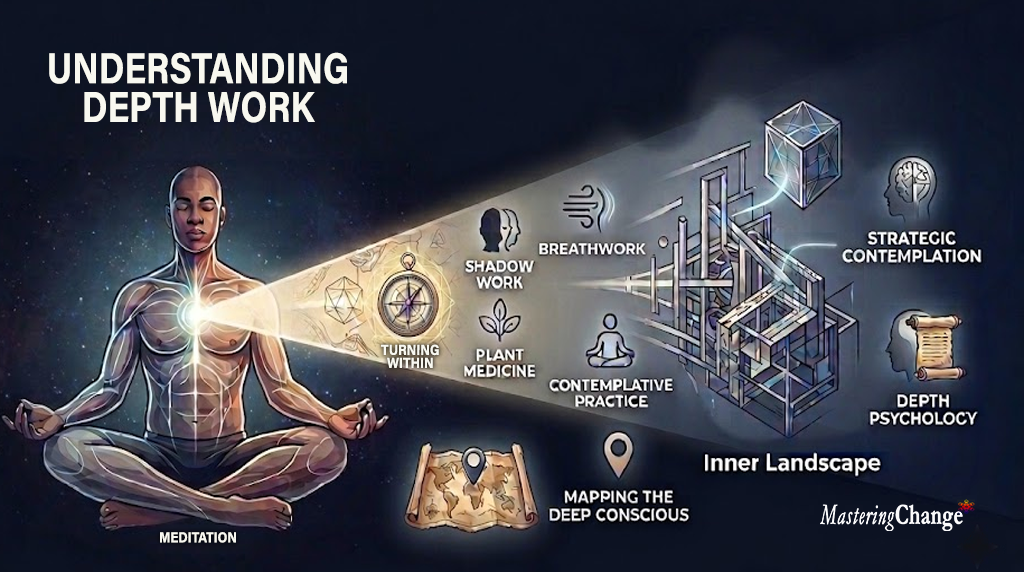
Depth work is not a single method. It is a category. Turning Within, meditation, shadow work, breath work, dream work, plant medicine, contemplative practice, and strategic contemplation all belong to it. What they share is a common target. And that target is not on the surface.
Contents
-
What Is Depth Work?
-
Depth Psychology and the Inner Landscape
-
Why Depth Work Matters
-
How Depth Work Works
-
Modalities of Depth Work
-
Why Depth Work Matters Now
-
Real-World Examples
-
Misconceptions
-
Where Depth Work Leads
-
Frequently Asked Questions

What Is Depth Work?
Depth work is any practice or discipline of examining and recalibrating the deeper architecture that generates the human experience of reality. Not the symptoms that architecture produces. The architecture itself.
Every pattern you repeat, every ceiling you keep hitting, every reaction that feels larger than the situation warrants has a source.
These are outputs.
They are generated by something deeper.
Something organized below the reach of ordinary awareness, running without conscious participation.
Depth work goes to that level. It examines what is generating the output. And it creates the conditions in which that deeper architecture can be seen, engaged, and changed.
This is why depth work is sometimes called spiritual technology. Not because it requires mystical belief. Because it is a precise set of instruments for working with the deepest architecture of human experience.
Depth work is a vital form of mental hygiene for the modern mind.
Depth Psychology and the Inner Landscape
Depth Psychology
Depth work shares its orientation with depth psychology. Both begin from the recognition that consciousness has depth, and that the most powerful forces shaping human experience operate below the surface of ordinary awareness.
The central insight of that tradition is simple but profound: the most significant forces shaping human experience operate below the surface of ordinary awareness. Not as pathology. As the normal condition of the human mind.
That tradition used the word unconscious to describe this territory. This framework uses a different term: the deep conscious.
Not because the earlier language was wrong, but because the part of the mind operating below ordinary awareness is not inactive or absent. It is the most active part of the system, organizing meaning, shaping perception, and generating experience continuously beneath the surface of conscious participation.
Contemporary depth work inherits the essential insight of that lineage and extends it.
The question is no longer only what is hidden.
The deeper question is what structure is generating the hiding.
And what becomes possible when that structure is consciously engaged.
Ancient Territory, Contemporary Practice
Many people who do depth work describe the experience as spiritual.
Not because the practices themselves are religious.
Because the inner landscape has qualities that ordinary psychological language does not fully capture.
When we explore the mind deeply enough, we encounter something that feels larger than personal history. Wisdom traditions across cultures have been mapping this territory for centuries.
The practices may be contemporary. The territory is ancient.
Modern depth work combines contemporary psychological insights with practices designed to engage the deeper structures shaping human experience.
Why Depth Work Matters
The mind is not broken. It is elegant. What appears as dysfunction is the deep conscious doing exactly what it was designed to do: preserving meaning, automating interpretation, protecting the structure it was built to maintain. The problem is not the mind. It is that we were never taught how to work with it at this level.
Most approaches to change work at the level of output. The behavior is addressed. The thought is interrupted. The emotional response is managed. These approaches produce real results. And they leave the source untouched.
The source is the construct. The organized structure of meaning that keeps generating the same interpretations, the same emotional responses, the same patterns. You can spend years changing what the construct produces without ever addressing what is producing it. The pattern returns. The ceiling reappears. A different relationship, the same dynamic.
Depth work matters because it addresses the structure, not just the output. It is mental hygiene.
The mind is not the obstacle. It is the instrument. And inside every pattern that has caused suffering, inside every limitation that has felt permanent, there is innate genius waiting to be reclaimed. Depth work is the practice of exploring and recalibrating our deep consciousness, bringing what runs beneath awareness back into conscious use.
How Depth Work Works
Every depth practice creates access to what is normally running below conscious participation.
Ordinary awareness keeps the architecture operating invisibly. You experience the output. You feel the emotion, make the decision, repeat the pattern. The structure generating all of it stays out of view. Depth work creates conditions in which that structure becomes visible.
The method differs by modality. The target is always the same.
What all depth practices share is this: they create a window into the deep conscious. The part of the mind that is not inactive. The part that is generating your experience of reality, below the level of ordinary participation. Depth work is the practice of looking through that window with enough skill to work with what you find there.

Modalities of Depth Work
Depth work is not a single practice.
It is a field.
Across cultures and disciplines, different practices have emerged that open access to the same territory: the deeper structures of meaning operating beneath ordinary awareness.
These practices use different methods and enter through different doors.
But they are working with the same level of the human system.
Below are some of the most established modalities through which people encounter depth work.
Depth Psychology
The intellectual lineage that first mapped the inner landscape.
Before the modern modalities existed, there was depth psychology.
The work of Freud, Jung, Adler, and Hillman established the central insight that reshaped psychology:
The most powerful forces shaping human experience operate below the surface of ordinary awareness.
Not as pathology.
As the normal condition of the human mind.
Depth psychology provided the original map of this inner landscape. It revealed that engaging what lies beneath the surface does not simply change behavior.
It changes the structure of the self.
Depth psychology is not a practice you perform.
It is the intellectual and philosophical lineage that explains why depth practices work at all.
Understanding that lineage makes everything else in this section more legible.
Shadow Work
Using emotional charge and projection as signals pointing to deeper constructs.
For many people, shadow work is the doorway into depth work.
It does not require altered states or specialized conditions. It works through signals that appear in ordinary life.
Emotional charge.
Projection.
Repetition.
Shadow work teaches a simple but powerful skill: learning to read those signals instead of reacting from them.
When approached with awareness, what once looked like a problem becomes a doorway into the constructs operating beneath the surface.
Breath work
Accessing deeper material through physiology.
Breath work creates access through the body.
A 2025 study published in PLOS One confirmed that high-ventilation breath work can reliably induce altered states similar to psychedelic experiences.
Changes in oxygen and carbon dioxide levels temporarily suspend the ordinary narrative the mind uses to organize experience.
When that narrative loosens, material that normally stays out of reach becomes visible.
For many, breath work becomes one of the most accessible gateways into depth work because the body itself becomes the entry point.
Plant Medicine
Creating cognitive flexibility that reveals hidden structures of meaning.
Psychedelic research consistently shows significant increases in cognitive flexibility following these experiences.
Cognitive flexibility is the capacity to hold multiple perspectives simultaneously and question frames of meaning that normally feel fixed.
In depth work terms, the constructs generating experience become temporarily more malleable.
Not dissolved.
Malleable.
That window of flexibility can reveal patterns, meanings, and structures that were previously invisible.
But the experience itself is not the transformation.
What matters is what happens after the window opens.
Dream work
Reading the nightly signal from the deep conscious.
The deep conscious does not stop working when you sleep.
Dreams are not random. They are one of the ways the deeper mind discloses what it is already generating.
What appears in a dream as a figure, a scene, or an emotion is the deep conscious doing what it always does: moving meaning toward expression.
Dream work is the practice of learning to receive that signal.
Not to analyze it. To listen to it.
"What does this dream long for?"
—Toko-Pa Turner
Meditation
Training awareness to observe the mind generating experience.
Meditation is one of the oldest depth practices in human history.
Across cultures and traditions, meditation trains the same essential movement:
Turning attention toward the workings of the mind itself.
Focused attention practices stabilize awareness.
Open monitoring practices reveal the patterns that normally operate unnoticed.
Over time, meditation develops a capacity that is essential to depth work:
The ability to observe the construct generating experience instead of being unconsciously run by it.
Contemplative Practice
Developing the stable observer needed to work with deep material.
Contemplative practice builds something altered states alone cannot produce.
A stable observer.
Meditation, strategic contemplation, and related practices develop the capacity to remain present with what the deeper mind is generating without immediately reacting to it.
The goal is not relaxation.
The goal is perspective.
Contemplative practice develops the ability to see the construct operating from slightly outside it.
That shift alone changes what becomes possible.
Turning Within
The navigational framework that integrates the modalities.
Turning Within is a shadow-informed depth work practice developed specifically for the modern mind navigating this territory.
It can be used as a stand-alone practice or as a framework for integrating every other modality into a single navigational structure.
Many depth practices create access to the deep conscious.
Turning Within goes one step further.
It provides the architecture for working with what that access reveals.
It is both a practice and a map.
The Entourage Effect
Why multiple modalities compound their impact.
In pharmacology, the entourage effect describes how compounds working together often produce a stronger result than any compound produces alone.
The same principle appears in depth work.
Each modality develops a different capacity:
- Shadow work → pattern recognition
- Turning Within → pattern navigation
- Breath work → physiological access
- Meditation → the observing mind
- Plant medicine → cognitive flexibility
- Contemplative practice → sustained presence
Each modality strengthens the others.
Over time, many practitioners discover this compounding effect naturally.
Turning Within is designed with this effect in mind.
Rather than treating the modalities as separate practices, it integrates them into a single framework.
The result is not additive.
It is multiplicative.
What They All Have in Common
Every depth modality creates access to what normally operates below conscious participation.
Each produces insight, memory, or experience that reveals the deeper structures shaping life.
But access alone does not produce transformation.
The experience is not the work. Integration is.
Insight without integration fades like a daydream.
Why Depth Work Matters Now
“The privilege of a lifetime is to become who you truly are.” - Carl Jung
The Environment
- Rates of anxiety and depression have continued rising even as access to information, therapy, and self-help has expanded
- The most widely used approaches to mental health address symptoms. The constructs generating those symptoms are rarely examined
- Powerful depth experiences are more accessible than ever. Breath work, plant medicine ceremonies, and intensive retreats reach more people each year
- Most people walk away changed for weeks. Then the old patterns return
The Gap
- Insight does not equal integration. You can understand a pattern completely and still repeat it
- A powerful experience without a framework for working with what it reveals does not produce lasting change
- The question is not whether a depth practice is powerful. They all are. The question is what happens in the weeks and months after
The Opportunity
- The person who has both the practice and the framework for working with what it reveals has something most people do not
- Depth work done with a map produces integration. Not just experience
- The interior practices that were once found in monasteries and medicine traditions are now available to anyone willing to engage them seriously. The practices exist. What most people are missing is the map
Real World Examples of Depth Work
In Personal Growth
You have read the books. Done the therapy. Understand the pattern intellectually. And it still shows up. Depth work is what becomes possible when you stop addressing the output and start examining the structure generating it. The question stops being what is wrong with me and becomes what construct is producing this.
In Relationships
The same dynamic appears with different people. Different names, same charge, same outcome. You are not unlucky. You are operating from a construct that keeps generating the same interpretation. The faces change. The pattern does not. Depth work helps you examine the construct driving the experience.
After a Powerful Experience
You return from a ceremony, a retreat, or a breath work session knowing something shifted. Life resumes. Three months later you cannot locate what changed. Depth work is the practice of engaging what opened. Not just being grateful it did.
In Leadership and Business
The ceiling keeps appearing. It is not a strategy problem. It is not a skills gap. The construct organizing your relationship with authority, visibility, or worth is operating in plain sight. Depth work addresses it at the source.
Misconceptions About Depth Work
You think it requires a ceremony or a substance
You think the experience is the transformation
You think depth work is the same as therapy
You think more intensity means more depth
You think depth work is only for people in crisis
Where Depth Work Leads
Depth work leads to a question most people have been asking for so long, they forgot they were asking.
Not what is wrong with me. Not what happened to me. What is generating this experience. And what becomes possible when it is consciously engaged rather than survived.
That question is what Turning Within is built to answer.
Turning Within is not another depth modality. It is the navigational framework for all of them. The map for understanding what you encounter in any depth practice, what to do with what you find, and how to move from the first phase of depth work, examining and clearing what is distorted, into the second: consciously recalibrating the constructs shaping your reality.
Most people doing depth work are in the first phase without knowing a second phase exists.
Turning Within is the framework that makes the full territory navigable. By reaching for the third.
Some people encounter depth work and are changed by it. Others encounter it and feel called to carry it. If you are in the second group, there is a path.
Learn about Turning Within
Frequently Asked Questions
What is depth work?
What is the difference between depth work and shadow work?
What is depth psychology?
Why does depth work sometimes feel spiritual?
What does cognitive flexibility have to do with depth work?
How is depth work different from regular self-help or personal development?
Do you need a guide for depth work?
Turning Within
Reclaiming authorship over meaning
Shadow Work
Where depth work begins

The Construct
The structural model of experience
Mental Projection
How shadow becomes visible