The Hero Needs a Better Story
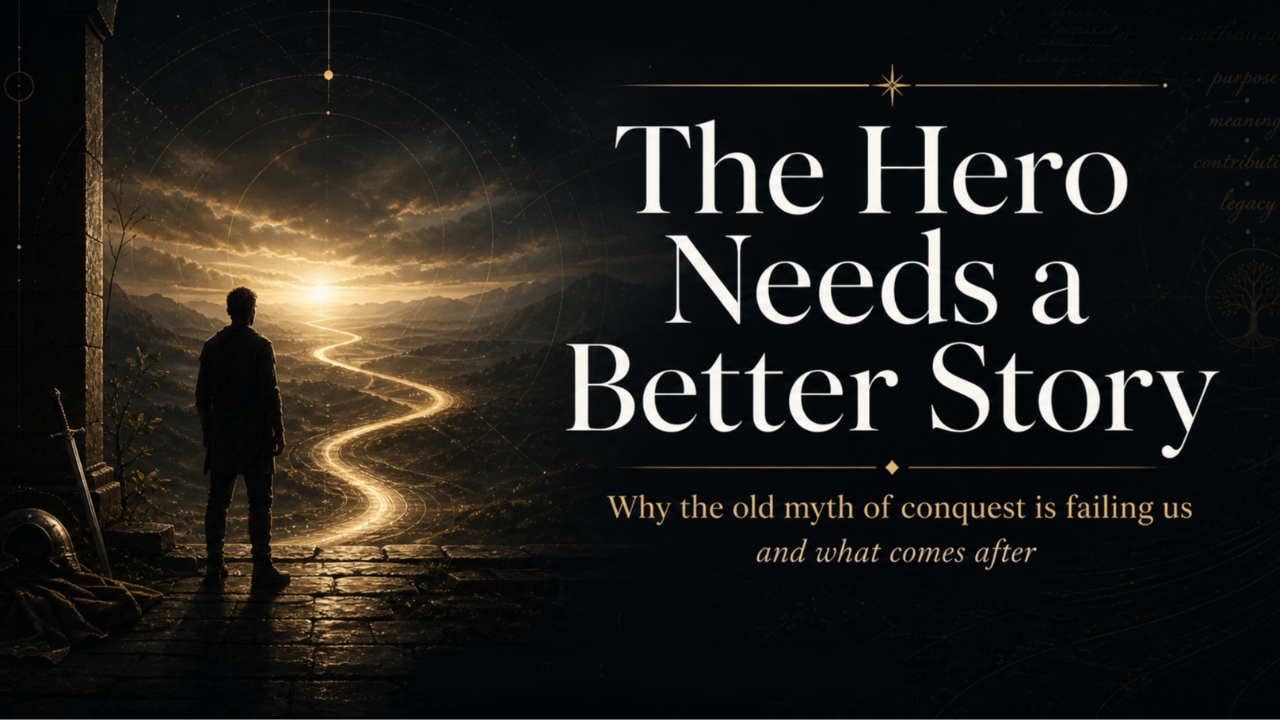
Why the old myth of conquest is failing us,
and what comes after
The modern hero is exhausted. Not because the archetype is dead, but because we have been living only one face of it.
For a long time, we have been sold one version of the hero. He is usually alone. Usually wounded. Usually chosen. Usually carrying a sword, a gun, a destiny, or a very expensive leather jacket. He walks away from home, descends into danger, faces the monster, wins the battle, and returns with the prize.
It is a good story. A necessary one.
But somewhere along the way, the Hero archetype, the center of every journey, got flattened into a Warrior story. We began to assume the hero's job was to fight, conquer, dominate, survive, prove. Win the game. Beat the villain. Slay the dragon. Get the girl. Save the world. Roll credits.
What is an archetype article

In 1985, a Disney story consultant named Christopher Vogler wrote a seven-page memo, A Practical Guide to The Hero With a Thousand Faces, that distilled Joseph Campbell's mythological architecture into twelve commercial stages. It became the dominant blueprint for cinema, television, and self-help.
That version of the hero now shapes nearly everything. Blockbuster movies. Business culture. Self-help seminars. The way a teenager secretly imagines becoming someone important. It is the story behind grind culture. Behind no pain, no gain. Behind the assumption that transformation must always look like a war.
Pause for a moment. Notice where in your life you have been operating from this version of the hero. Not the obvious places. The quiet ones.
But what if the Hero was never really about conquest? What if conquest was just one face, one way the hero shows up?
The Hero is the way you experience life. Story is one of the facets through which you construct and experience reality. Without story, all meaning dissolves. You are not wired for data. You are wired for story.
All awareness is first person. Life is experienced subjectively, through awareness, always.
Stop here. Check in. Notice that you are reading this article from your first-person perspective. I wrote it from the same place. Everyone, from the beginning of awareness, experiences life in first person. All objective knowing began as someone's subjective experience.
What if the Hero is the archetype that forms around consciousness experiencing life from a first-person perspective?
What if the Hero is not the one holding the sword, but the one holding the story?
Learn about Construct Theory
“Story, as it turns out, was crucial to our evolution -- more so than opposable thumbs. Opposable thumbs let us hang on; story told us what to hang on to.” - Lisa Cron, Wired for Story
In the Turning Within Wheel of Life, the Hero archetype sits at the level of purpose and first-person perspective. It is the container through which awareness is directed. It says: I am here. This is happening. This is my life. The Hero turns the raw river of experience into story and song. Purpose is not found somewhere else. It is authored from within the act of living.
That changes everything.
Now the Hero is not just the one who enters the fight. The Hero is the center of awareness through which every archetypal energy is experienced. The Lover becomes a love story. The Warrior becomes a protection story. The Sovereign becomes a legitimacy story. The Magician becomes a mystery story.
The immature Hero makes all of these stories about itself. At this level, you are unconscious to the illusion created by first-person experience. A byproduct of an evolved mind that can now remember history, imagine futures, and simulate possible worlds.
The mature Hero begins to see the story is not only about the self. It is being lived through the self. We are all floating down the river of the story called me. Through that awareness, another layer of story begins to present itself.
This is the deeper truth sitting right in front of us.
You are a conscious being with a first-person perspective, living inside a universe that has been learning, adapting, perceiving, and becoming more conscious for billions of years. You arrived as a tiny window where reality looks back at itself and asks: What is this? What does it mean? What am I here to become?
That is the Hero.
Not the fighter.
The one through whom meaning becomes personal.
The Programming of the Warrior-Hero
To be fair, the Warrior story has its place.
Life requires boundaries. There are moments when you have to protect what is sacred, say no, leave the room, end the relationship, build the thing, defend the garden. The Warrior brings certainty, discipline, action, and clean force. Without Warrior energy, the rest of the psyche collapses into theory, fantasy, longing, or resentment.
The problem begins when the Hero becomes trapped inside the Warrior. Because awareness requires story to orient and make meaning, you become unconsciously typecast in roles that always orient around a battle.
Then every life problem becomes a battle. Every disagreement becomes an enemy. Every healing process becomes a war against yourself. Every ambition becomes a test of whether you are strong enough, special enough, worthy enough.
This is the immature Hero wearing Warrior armor.
It sounds noble. Underneath it is usually terrified.
"I have to win so I matter."
"I have to overcome so I can be loved."
"I have to become extraordinary so I can finally feel real."
That story is everywhere.
It is in the student trying to prove they are not invisible. The founder who cannot stop working because stillness feels like death. The healer saving everyone else to avoid the silence in their own body. The man who calls himself disciplined but is running from grief. The woman who calls herself strong but has never been allowed to be held.
Read that list again. Slowly. Which one was you?
The Warrior story is not wrong. It is just not enough.
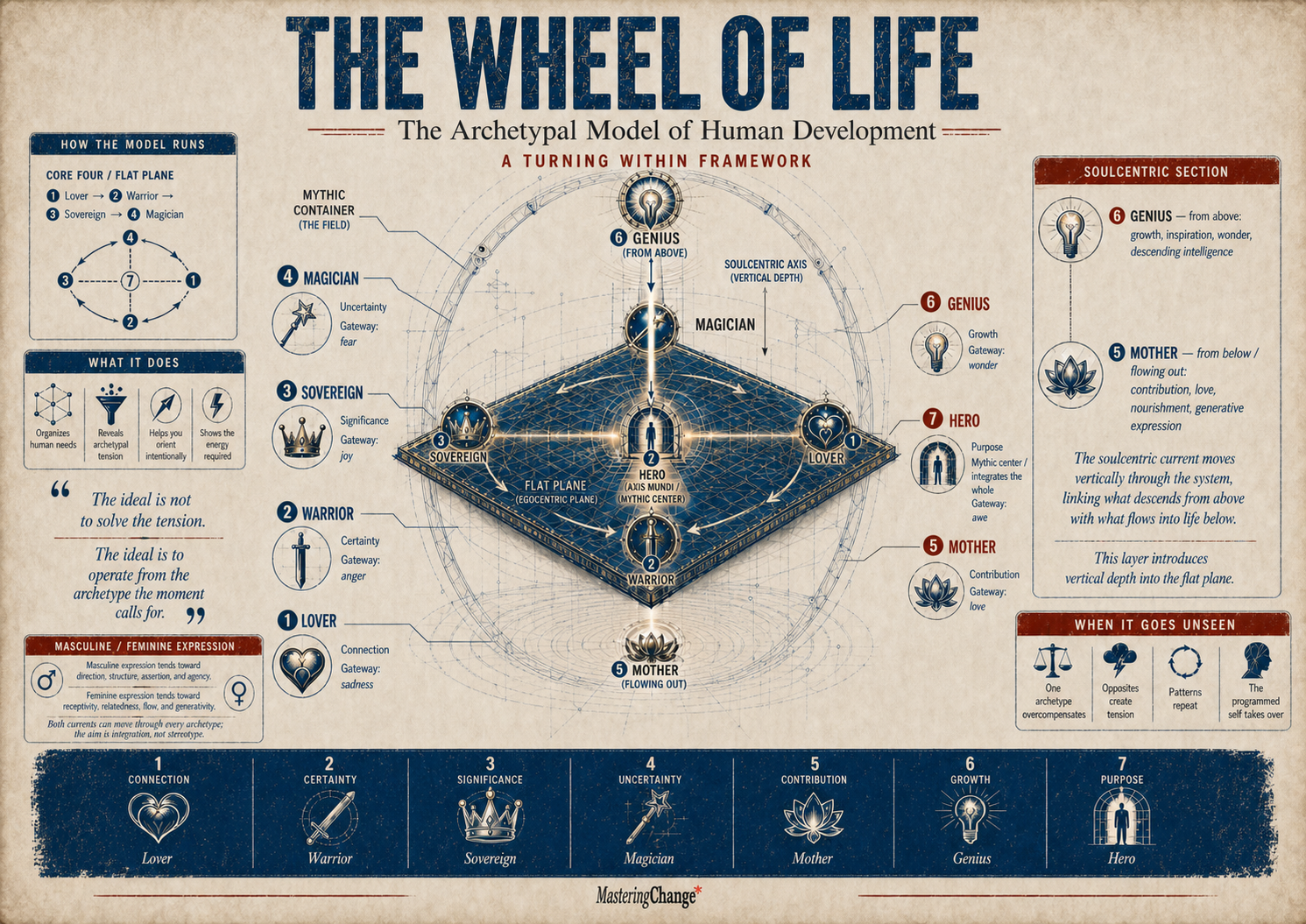
The Wheel of Life
The Wheel of Life offers a wider map. A three-tier nested system practitioners use to explore, recalibrate, and reorient to their inner landscape.
At the surface are the Core Four, the archetypal energies most of us use to navigate daily life.
The Lover seeks connection, intimacy, resonance, and belonging. The Warrior seeks certainty, action, discipline, and boundaries. The Sovereign seeks significance, blessing, legitimacy, and discernment. The Magician seeks uncertainty, insight, interpretation, and transformation.
These four are the primary compass points of the egoic life. They help you survive, relate, protect, interpret, and organize yourself in the world. You begin unconscious to how you make meaning, unaware that your perspective is myopic. That is a natural and understandable entry point for a soul.
Take the Archetypal Quiz
But most people live and die on that flat plane.
Trying to get enough connection. Trying to feel safe enough. Trying to be significant enough. Trying to understand enough.
That is okay. It does not make you incomplete. A person can lead a fulfilling and amazing life on the surface. But at some point, if you are lucky, something cracks.
Maybe through love. Maybe through grief. Maybe through failure. Maybe through success that somehow still feels empty.
That crack opens the deeper axis.
Below the surface sits the Mother, the archetype of contribution, care, nourishment, and life beyond the self. This energy carries both feminine and masculine expressions. The feminine appears through deep embodiment, nurture, birth, receptivity, and the sacred act of sustaining life. The masculine appears through servant leadership, protection, provision, and the building of structures that allow life and community to flourish.
Above the surface sits the Genius, the archetype of growth, inspiration, imagination, and unique calling. The Genius is not performance. Not IQ. Not impressive. It is expansion. It is the daemon within, the spark of vocation, the pull toward what only you can bring. You swam in Genius as a child, creating meaning rich and horrifying you unconsciously orient from today.
And at the center sits the Hero, not the loudest archetype, but the first-person carrier of the whole thing. The Hero is the one through whom every other archetypal story is lived. The container through which the meaning called life is presented and experienced.
Stop here. Which archetype runs the show in your daily life right now? Not the one you wish ran it. The one that actually does.
This is where the old Hero's Journey starts to evolve.
The question is no longer, "Can I defeat the dragon?"
The question becomes, "What story am I living, and what wants to come through me now?"
From the Hero’s Journey to the Genius Story
Joseph Campbell gave the modern world a tremendous gift by articulating the monomyth: departure, initiation, return. His Hero's Journey helped generations recognize that human beings carry a shared mythic architecture. We leave the known. We face the unknown. We are changed by ordeal. We return with something of value.
Even Campbell's map was simplified by the culture that inherited it. Hollywood turned it into a formula. Business turned it into branding. Self-help turned it into personal conquest. Somewhere between the cave and the keynote stage, the Hero became a mascot for individual achievement.
Michael Meade points toward something deeper. Each person enters life with unique gifts and a purpose waiting to be discovered. Genius, he says, is born, not manufactured. It is an intuitive guide and guardian of destiny, seeded within each of us, waiting to awaken and serve life.
That is the move.
Past the immature Warrior story.
Into the Genius story.
The Genius story does not ask, "How do I prove myself?" It asks, "What is trying to live through me?"
It does not ask, "How do I win?" It asks, "What gift am I responsible for bringing into form?"
It does not ask, "How do I become somebody?" It asks, "How do I become who I actually am?"
“When a person becomes aware of their genius and they live it and they give generously from it, they change the world, they affect the world. And when they depart everyone knows something is missing.” Michael Meade
Meade's language around personal myth is useful here. He says we are mythic by nature, and each of us carries a unique plotline trying to unfold from within. Myth, in this sense, is not an escape from reality. It is a way to understand the deeper story moving through reality.
That is exactly where the Hero matures.
The immature Hero wrestles with being the main character.
The mature Hero understands the implications of being the center of its own experience, but not the center of all existence. We are all living inside our own journey. Somehow these stories align to co-create the reality we share.
That recognition humbles the ego without destroying the person. It allows life to become mythic without becoming narcissistic. You step beyond the surface not through magical or wishful thinking, but through living mythically, awake to the fact that you are both the author and the actor in your own play. And the play must go on.
The Mature Hero Is Not Trying to Save the World
This may be the most important distinction in the whole article.
The immature Hero wants to save the world because it needs the world to confirm its importance.
The mature Hero contributes to the world because its Genius has become too alive to remain hidden.
That is a completely different movement.
You can feel the difference in your body. The first is tight, performative, anxious, always checking for applause. The second is quieter. Stronger. Stranger. It feels less like ambition and more like alignment. An authentic source for your true being.
This is why the Hero has to mature through the Mother and the Genius.
Without the Mother, Genius becomes ungrounded, dissociated, and self-important. Without Genius, the Mother becomes duty without authentic life. Together they balance spark and soil. Inspiration and contribution.
When the Hero can hold both, the story changes.
The Lover does not seek connection to prove worth. It becomes capable of intimacy.
The Warrior does not fight to prove strength. It protects what is sacred.
The Sovereign does not demand significance. It blesses life into legitimacy.
The Magician does not manipulate mystery. It interprets meaning with humility.
The Mother does not overgive to be loved. It contributes from overflow.
The Genius does not perform brilliance. It gives form to the unique signal of the soul.
And the Hero no longer has to be heroic in the old sense.
It becomes awake inside the story.
Read those again. Which one have you been performing? Which one is ready to mature?
Why We Need to Evolve the Story Now
Our society can no longer survive on one face of heroism.
The Warrior-coded Hero gave us courage, discipline, and the power to confront danger. But when conquest becomes the only model, everything becomes a battlefield. Work becomes survival. Love becomes performance. Healing becomes self-attack. Leadership becomes domination. Growth becomes another way to prove you are enough.
You can feel it everywhere. In the addiction, despair, anxiety, loneliness, burnout, and numbness running through modern life. These are not personal failures. They are signals from a culture oriented around survival, achievement, and egoic proving.
The next evolution of the Hero asks for something deeper.
Not less strength. More soul.
We need a Hero that can protect without dominating. Create without extracting. Grieve without collapsing. Lead without controlling. Serve without disappearing.
This is where the Hero matures.
It moves past the egoic question, "How do I prove myself?", into the soul-centered question, "What is life asking to become through me?"
The old Hero fought to win the story.
The new Hero wakes up inside the story, remembers who is telling it, and begins to live from the Genius trying to come through.
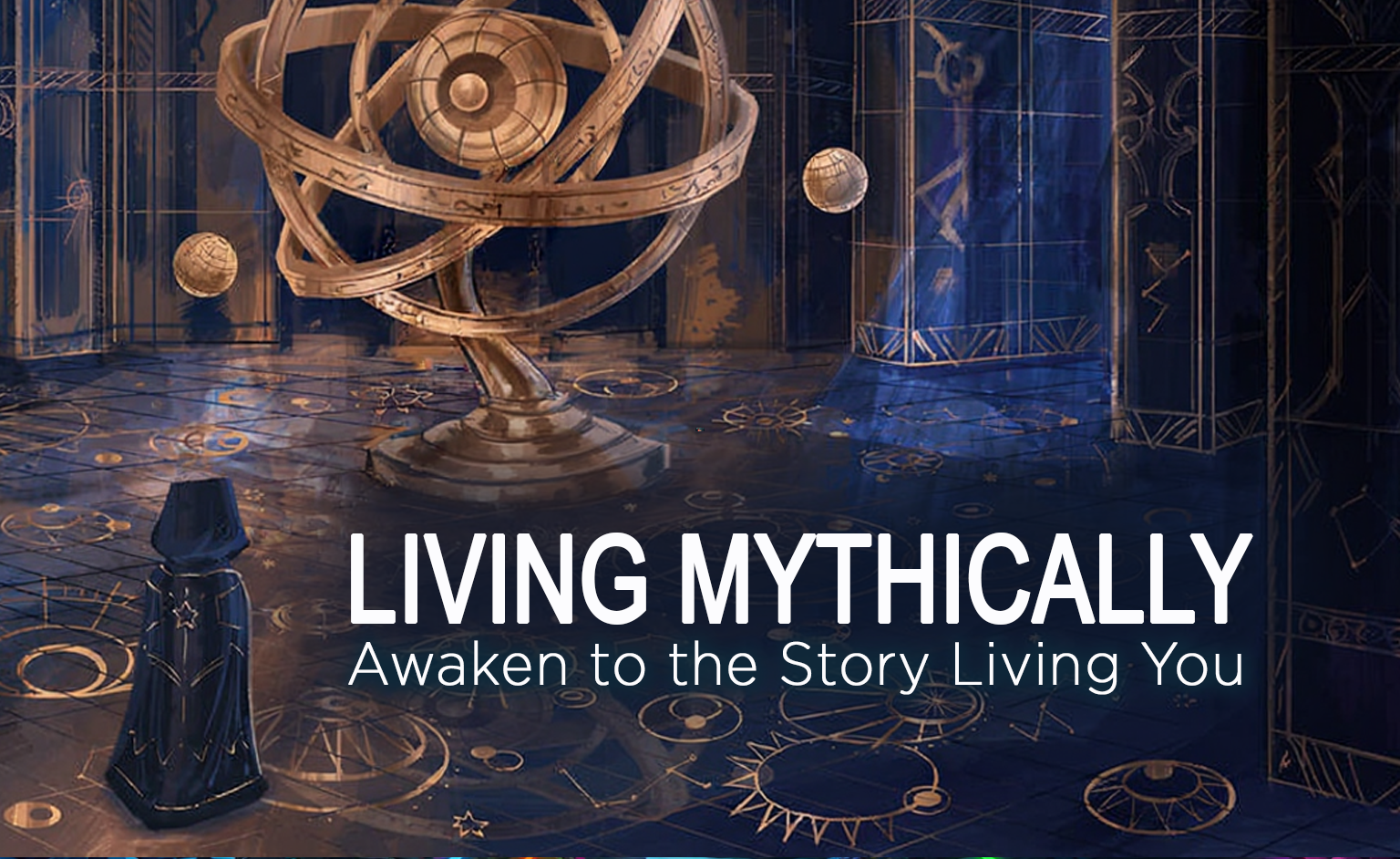
Living Mythically
To live mythically is not to pretend your life is a movie.
It is to recognize that your life is already structured by archetypal energies, whether you know it or not.
You are already living inside a story. You are already shaped by longing, fear, ambition, grief, wonder, and awe. You are already interpreting the world through invisible patterns of meaning.
The only question is whether you are conscious of the story you are living.
The Wheel of Life reveals which archetypal energies shape how you think, feel, decide, love, protect, create, and suffer.
Most people do not need another productivity hack. They need to know which story is running their life.
Whether your Warrior is protecting something sacred or just picking fights.
Whether your Lover is creating intimacy or chasing intensity.
Whether your Sovereign is blessing life or withholding legitimacy.
Whether your Magician is revealing meaning or hiding behind analysis.
Whether your Mother is contributing from love or martyrdom.
Whether your Genius is expressing through you or sabotaging you from exile.
Whether your Hero is maturing into authorship or still trying to prove it deserves to exist.
Read that list one more time. Which line did you stop on?
That stop is not random. That stop is the beginning of the work.
Not by escaping your life.
By entering it more consciously. By standing in the present with one hand on history and one hand reaching toward the next step. By learning the difference between the story you inherited and the song that wants to come through you.
Begin Living Mythically Now
Take the Quiz
The old Hero story taught us to look for the dragon.
The deeper work teaches us to ask who is looking, what story they are looking through, and what part of their Genius has been waiting underneath the fight.
That is the beginning of Living Mythically.
Take the Wheel of Life Archetype Assessment and discover the core archetypal layout shaping how you think, feel, act, love, protect, create, and choose.
Twenty-eight questions.
One mirror.
A first step toward recovering who you really are, and beginning the journey from survival story to Living Mythically.