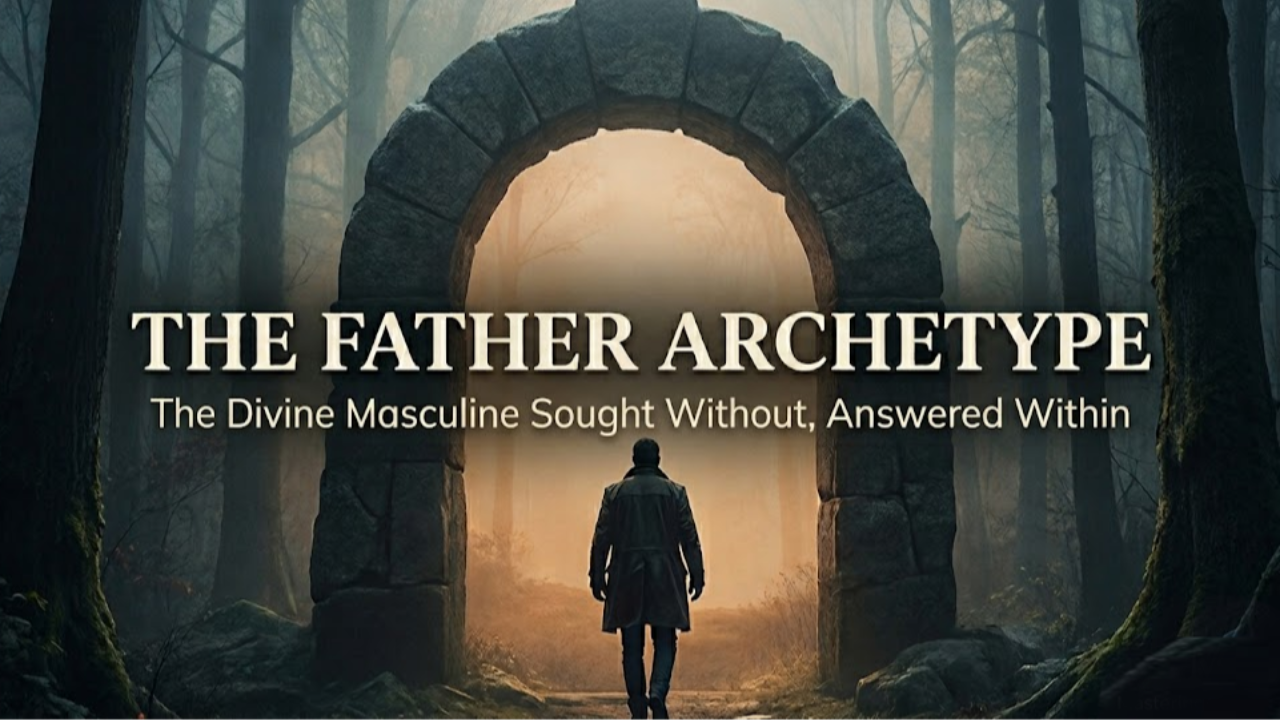
The Father Archetype: The Divine Masculine Sought Without, Answered Within
The father archetype is one of the most deeply woven, elusive and yet influential patterns in the human mind. A mother is made by her body. A father has to choose.
Only One of Them Was Carried
In the first hour after a child is born, two people in the room have crossed a threshold. Only one of them was carried.
For nine months, her body has been doing the work without asking her opinion. It rearranged her organs, rewired her chemistry, turned a single life into a container for another. By the time the child arrives, the woman has already been changed at a level beneath choice. The initiation was administered. She did not have to believe in it for it to take. Her payment through the passage was the sacrifice of her very body. Make no mistake, this is a soul-centric initiation. The contribution floods love through the mother as she holds her child. A bond is formed.
The man standing beside the bed has been through none of that. Nothing has happened to his body. He is handed a warm, unfamiliar weight, and underneath his feet the oldest question in the world quietly opens: now what am I supposed to be? In my work men disclose again and again, “I had no understanding of what it meant to be a man much less a father.” We seem to stumble into the darkness searching for something that can’t really be found out here. The bond must be earned.
We rarely notice the strangeness of this. We assume mother and father are two versions of the same thing, two parents, two halves of one pair. They are not. One of them is made by the body. The other has to be built by hand and can be consciously and unconsciously refused. The lack of awareness around the difference seems to be aligned with the fatherhood wound.
Older Than Any Father
What we are circling has a name. Beneath the man, and beneath the role, there is a pattern older than any single father and alive in all of us, regardless of gender. It is this pattern, not the person, that we mean by the “father archetype”. It is not a man. It is a current that moves through a life, rising from the deeper masculine that older traditions named the “divine masculine”. We meet it first in the projection we place on our own fathers, which is why it carries their name. It was never theirs alone.
This asymmetry is not a moral failing of men, or a quirk of modern life. Because of the depth of the father archetype in our being, it exists across our lived experience and in every relationship. It runs deep, and it can be seen everywhere.
In many early spiritual traditions, the divine masculine was personified as the Sky Father, complementing the Earth Mother. Figures like the Proto-Indo-European Dyeus Phater, the Greek Zeus, and the Egyptian Osiris represented providence, the establishment of law, and cosmic order. In Eastern traditions, this duality is famously expressed through the Hindu concepts of Shiva and Shakti. Shiva represents pure, still, absolute masculine consciousness, while Shakti is the dynamic, creative feminine energy. When referring to masculine/feminine, we aren't referring to man or woman. These are archetypal energies that have been around since before modern psychology was developed. The masculine provides the secure container and the awareness; the feminine provides the movement and form.
A Man Becomes, a Woman Arrives
The anthropologist David Gilmore spent years comparing how cultures around the world make men. He found something close to universal: manhood is treated almost everywhere as a status that must be earned and can be lost, "a precarious state," in his words, that has to be won against long odds.
Across cultures, womanhood is often treated as something that arrives on its own. After childbirth, she is expected to assume the primary caregiving role (mother), whether she feels ready or not. A boy, by contrast, must become a man, and may never fully do so.
The biology runs the same direction. In most mammals, even our closest primate relatives, fathers do little or no parenting at all. Human fatherhood, as the evolutionary literature now describes it, is not a dependable instinct but a capacity that has to switch on. The Jungian analyst Luigi Zoja put it more starkly still: “the father,” he argued, “is less a fact of nature than a social invention.” The father role is something we have had to construct and reconstruct across history, and something we are currently watching come apart.
Hold these together and a quiet truth surfaces. The mother is delivered to her threshold by her body. The father is delivered to nothing. He must find the doorway himself, build it, and choose to walk through, and a great many never do.
This is why we have the phrase “a real man,” and why it would sound absurd to demand that someone be a real woman. Being a father, in the deepest sense, was always going to have to be worked for.
The Mirror, Not the Maker
For most of the last century, the people who studied this drew a single conclusion from it. If manhood must be made, then someone has to make it. And they decided that someone was other men. But this is a half-truth.
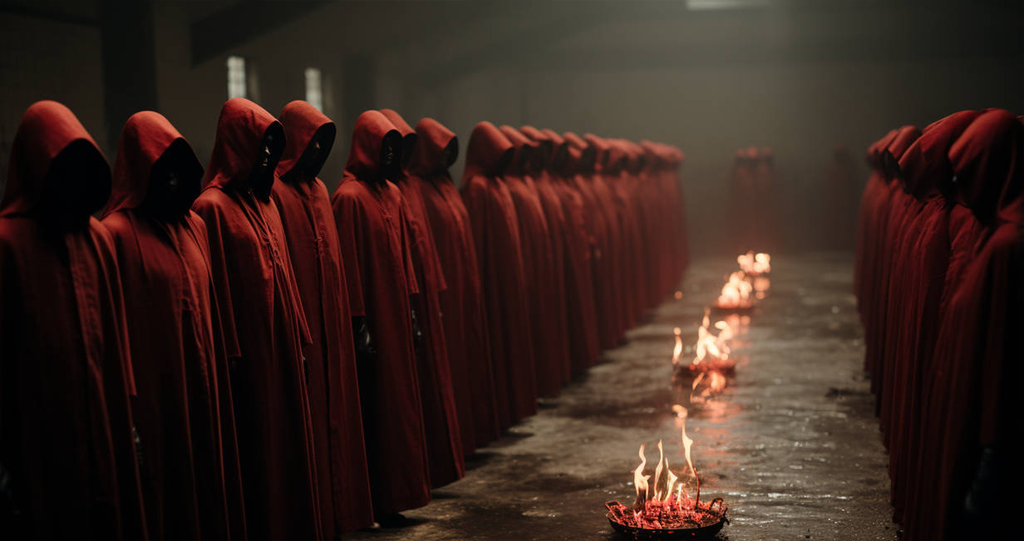
The poet Robert Bly built a movement on the idea.
A boy, he wrote, "cannot change into a man without the active intervention of the older men."
A girl ripens on her own, carried by her body; a boy has to be taken in hand, initiated, welcomed by the fathers of the world. And where that does not happen, Bly warned, you get men who rage or sulk their way through life, never quite arriving.
There is something true in it. Men can, and in many cases do, initiate other men.
A good elder, a hard mentor, a circle of fathers:
these resources build a powerful threshold for a younger man to walk through.
But the conclusion hides a mis-orientation, and the orientation matters. It puts men at the center of the story instead of the reflection of it. It implies that without the right men, a man cannot be made, and that the journey itself, the life itself, holds no power to do the work.
That is not so.
A man can pass through every circle of elders and never cross. He can also be broken open and remade with no man anywhere in the room:
by a child,
by a loss,
by a weight that lands on him and will not lift.
The initiator was never the men. The initiator is the conscious engagement with life. Men are simply the clearest mirror we have, the surface on which this current is most visible as it moves through our lived experience. We watched men make men and concluded that men were the makers. Father is the maker, the archetype being projected and reflected on men. The representation of the divine masculine showing up in our lived experience. We mistook the mirror for the source.
This is the subtle shift, and it changes everything that follows.
Life presses the invitation, constantly, on everyone.
The person answers the call, or doesn’t.
Projected, Performed, Answered
So how does this pattern actually live inside us? Watch it move, and it tends to move in three stages.
At first it sleeps.
We do not feel the father archetype as something within us; we see it out there, in the world without. We project it onto bosses and judges and presidents, in God, on the law, and mostly onto our own fathers. We hand the whole weight of it to figures outside us and then react to them, trusting, defying, longing, resenting, without ever suspecting that the pattern is ours. It is cast onto the mirrors, and the mirrors take the blame and the worship.
- What were some of the projections you placed on your "father figures"?
- Where, or in what relationships, do you still wait to be blessed or given mattering from the outside world?
- Where do you hand off your power to things?
Then, often, comes a clumsier stage:
We try to perform it. This is the most painful one, because it is an attempt to become something that is already there. We posture. We provide and call it love. We control and call it leadership. We demand the respect we have not yet earned from the inside. Two Jungian writers, Robert Moore and Douglas Gillette, had a phrase for the whole condition: "boys pretending to be men." The pretending is not a lack.
- Where are you still feeling the immaturity regarding masculinity (self or projected)?
- Where do you find yourself proving your mattering?
- Where do you feel lost regarding your purpose or meaning?
It is a real thing reaching for itself and grabbing the costume instead of the substance.
And then, ideally, the performance comes to an end, and something quieter takes its place.
We stop trying to get the father (from other men, from approval, from the world without) and begin to feel it pressing through from within. It was never outside us, waiting to be installed. It was inside, all along, pressing toward the light, asking to be lived.
This is the turn the whole pattern had been bending toward: from the father sought without, to the father answered from within.
- What relationships do you provide support for others to live on purpose?
- When are you most in touch with and aligned with your inner vision?
- How do you hold boundaries with compassionate responsibility?
The Invisible Wound
There is one more thing, and it is the hardest to see, precisely because it is woven so deep.
Think about where the father usually stands in a family.
Not at the warm center; that place is almost always the mother's.
The father stands more often at the edge.
Necessary, but not held. Relied upon, but not run to.
The one who provides the structure and stands slightly outside the warmth of it.
Present, and somehow also without.
This is the most invisible wound a person can carry, and it belongs to the pattern itself, not only to any one failed father. Man or woman, father or not. It whispers a single sentence underneath everything: “I am necessary, but I am not wanted. I am expendable.”
And when that wound goes unseen, it does not stay quiet. It leaks into a life and shapes it. The same wound wears different masks, because the current it distorts runs through all of them:
→ Protection gone hard and rigid.
→ Blessing withheld, the approval that never comes.
→ A bond held at arm's length, love that won't quite land.
→ Courage curdled into something to prove.
One wound, many faces.
You do not find it by digging for where it lives.
You recognize it by its fingerprint, repeating across a life.
What you resist most is often what you return to most.
The Current of the Mind
To see the whole of it clearly, it helps to name what the father current is, and here we have to set down a habit. We tend to assume the father is a male thing, a man's department. It is not.
A century ago, Carl Jung described two currents running through every human being, regardless of sex. One he called the “principle of relatedness, the heart's work”: connection, warmth, the force that binds people together. The other he named "the paternal principle": the work of structure, of naming, of building, which he tied to language and to order. The first is the current of the heart. The second is the current of the mind.
The father, in this older and deeper sense, is the second current, the part of us that builds the form. It names things. It draws the lines. It forms and holds the structure inside which a life can stand. The mother current fills that structure with warmth and relationship; the father current raises the walls, sets the boundary, and says this is what matters.
It is why the father so often feels like the form itself,
and why his wound is nearly impossible to see.
It is not a wound in our feelings.
It is a wound in the very architecture by which we build meaning.
And because it is an expression and not a gender, it belongs to no one body. The analyst Andrew Samuels gave it the truest name: what a child needs, he wrote, is "the good-enough father of whatever sex." A single mother carries this expression. A grandmother, a mentor, an older sister can carry it. The man who never had a father can still become one. The fathering current was never the property of men. Men are only where we have learned to look for it most easily.
Sought Without, Answered Within
Put all of this together, and a different picture of the father comes into focus, one we are only beginning to be able to say out loud.
We have spent most of our history looking for the father without. In other men. In God. In the boss, the law, the institution, the strong figure who will finally tell us we belong, bless us, give us permission to exist. We have waited at the edge of the field to be called in. And the waiting itself became the wound: the conviction that the father is somewhere out there, and that until he arrives, or approves, or makes us, we are not yet whole.
The shift is to turn around. The orientation we kept hunting for outside was pressing from within the whole time. To become the father is not to find one, and not to be manufactured by a roomful of men. It is to stop standing at the edge waiting to be admitted, and to answer the life that has been pressing the invitation all along, to become, deliberately and by choice, the structure through which another life can safely enter the world.
It is not done once. The body carries the mother across a single threshold; the father has no single moment, which means he must be re-chosen, daily, and can fall out of it tomorrow. The doorway has to be walked through again and again. The heel keeps getting bruised. That is not failure. That is the proof you came.
Somewhere right now, a person is holding an unfamiliar weight and feeling the floor open beneath them: now what am I supposed to be? Nothing in their body will answer. No circle of elders is required to. The answer was never going to be administered, or installed, or handed down by someone with more authority.
It was always going to have to be lived, from within. Because here, the insight is not the destination. Your lived experience is the lesson.
CONTINUE THE WORK
The father is one pattern among the archetypal energies you author every day. See where yours run resourced, and where they run in exile.
→ Find Your Top Archetype (Archetypal Energy Quiz): find where your energies are blocked, and begin.
→ Mental Projection: how the father gets cast onto the people and powers around you.
→ The Construct: the architecture of meaning the father current builds.
→ Turning Within: reclaiming authorship of the pattern from within.
→ Shadow Ceremony: the initiation, met in the room rather than on the page.