Insight Without Integration: Why Knowing Yourself Isn't Enough
Meeting the Construct
The Quality of your life is a direct reflection of the conscious awareness you bring to it. Any relationship you have is just one thread in the tapestry of meaning your orient through.
-Steven Twohig
You are already cultivating reality. Every moment, whether you know it or not, you are authoring the world you walk through. The question has never been whether you are doing it. The question is whether you are doing it consciously.
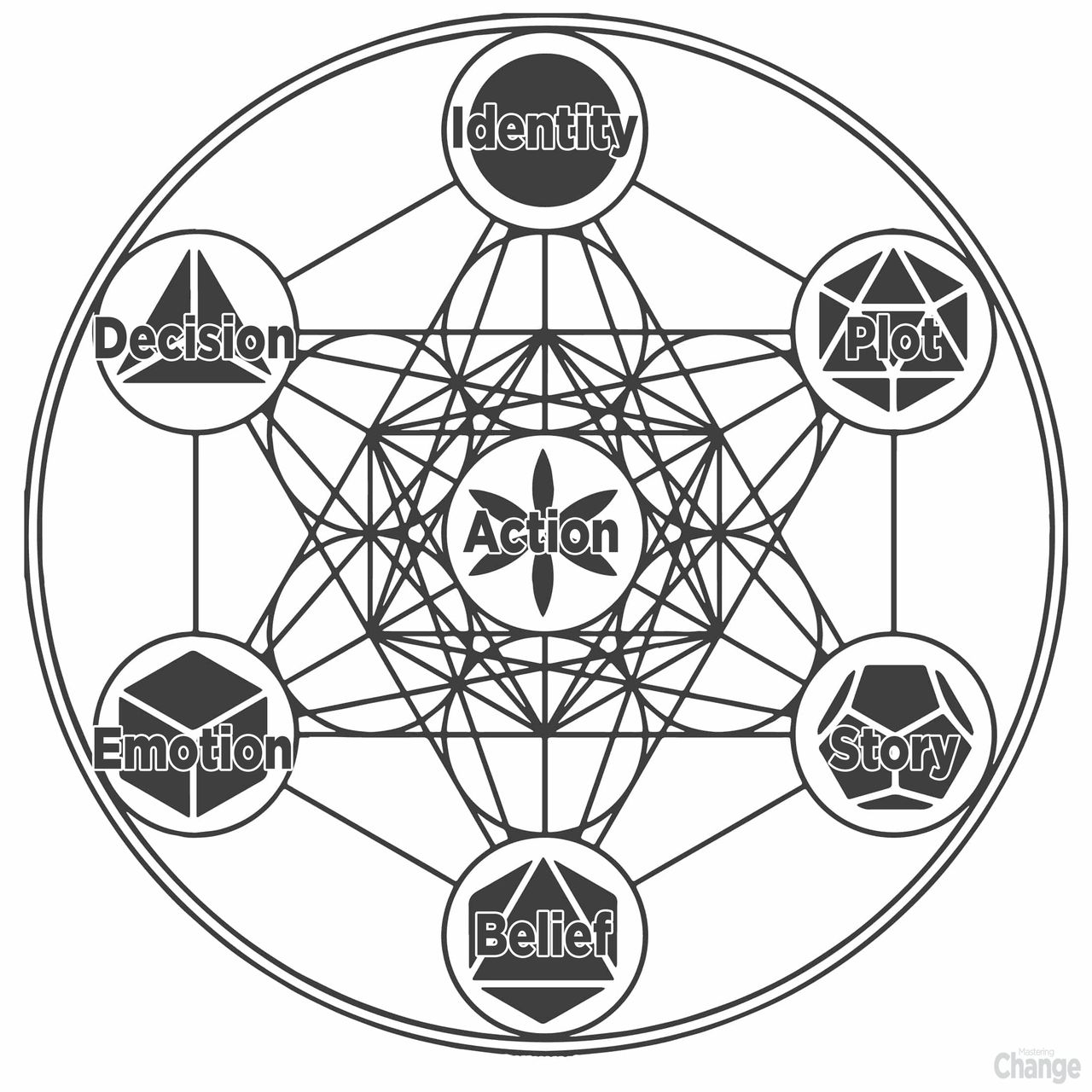
The seven facets of the Construct co-arise in every moment of experience. Identity, Belief, Narrative, Story, Emotion, Decision, and Action all participate simultaneously in how meaning takes shape. None leads. None follows. They are a gestalt, each facet mutually constituting the others in real time.
But here is what most people miss: knowing about the Construct is not the same as inhabiting it. You can map every facet, name every pattern, trace every thread of meaning back to its origin in the deep conscious, and still walk through your day on autopilot. Understanding is not participation.
This is where the 4E+1 model becomes essential. It is the action lens of the Construct. It answers the question that understanding alone cannot: How do I actually live this?
Just Like Driving a Car
Think of your awareness like driving a car. Imagine you were reviewing your week, and the quality of your experience was the neighborhoods you found yourself in.
What has been the quality of the neighborhoods you drove around in?
Did you find yourself spending much of your time in overwhelm?
Are there parts of you that are always scared that the bottom line won't add up?
Do you feel lost? Found? Loved, but unliked? What has been your default way of identifying with your world?
We all have default programming orienting us. Most of the time it's been unconscious and rarely with intention.
But what if you had an idea you wanted to show up differently than what you've been programmed to? How do you turn around and start to move from who you want to be, instead of how you've been conditioned to?
Think of a time when you showed up in a way that you even admire. Maybe it's a way you stood in your power. Perhaps it was being able to be more compassionate, impactful, grounded. It doesn't matter, only that you choose and remember a moment when you were orienting from a self you want to experience more of in your life. Now the question is: How do we get this you driving the bus?
What Does it Mean to be Cognitive
There is a thesis gaining ground in cognitive science that should stop you in your tracks. Any living system that orients, adapts, and makes sense of its environment is, at some level, a cognitive system. Not metaphorically. Structurally. As philosopher Evan Thompson argues in Mind in Life:
"Where there is life there is mind. Life and mind share common principles of self-organization, and the self-organizing features of mind are an enriched version of the self-organizing features of life." The nervous system does not passively process information. It creates meaning.
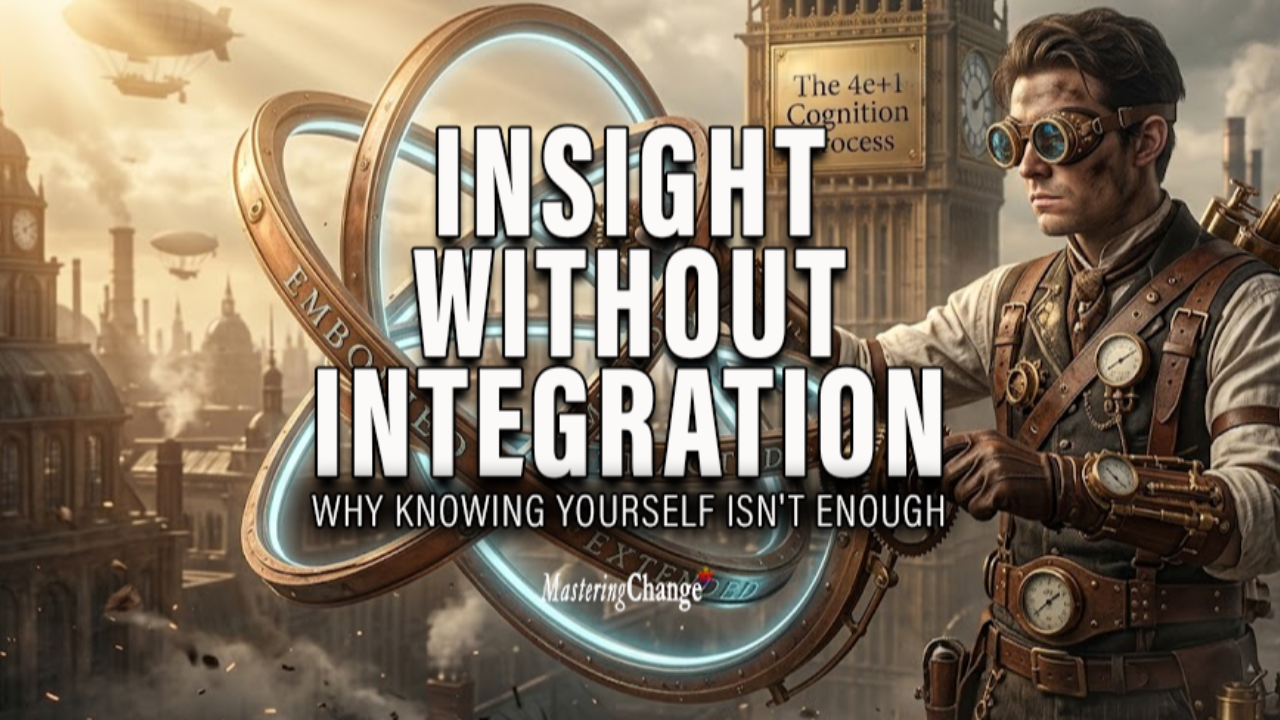
The 4E cognition framework (Embodied, Embedded, Enacted, Extended) was built from this insight. It describes how any meaning-making system orients through its body, its environment, its actions, and its tools. Cognition is not something that happens inside a skull. It happens across an entire living system in dynamic relationship with the world it inhabits.
If you have spent any time with the Construct, this should sound familiar. The seven facets do not just describe what meaning is made of. They describe a living system that is always already making meaning, whether you are participating consciously or not. The question the Construct raises but does not answer on its own is: how do I move from seeing the pattern to actually living differently?
That is the gap most people feel when they come to this work. They can name what is running them. They can trace the narrative. They can feel the charge. But the lived experience does not shift. They want to show up with more presence but keep defaulting to control. They want to stop the overwhelm spiral but cannot interrupt it once it starts. They want to stop proving and start practicing. They have a felt sense of who they are when the Construct is not running them. They just cannot seem to stay there.
The practice of Turning Within gives you the map. The 4E+1 model gives you the vehicle.
Think of some way of being that you know is available to you but that you cannot seem to sustain. The version of you that responds instead of reacts. The one who holds the room without needing to fill it. The one who trusts what is emerging instead of managing it. Hold that.
Now think of that like a car.
Embodied: Get in the Car
Embodied means you are in the car. You are not reading about driving. You are not thinking about driving. You are inhabiting this way of being somatically, in your body, in the room, in the moment. Embodiment is the felt sense of that orientation living in your posture, your breath, your presence. If you are not in the car, nothing else matters.
This is the foundational insight of embodied cognition: thought is not confined to the brain. It is shaped by the body, by sensation, by physical interaction with the world. We only know what we can sense. We sense only a tiny fraction of what is. If we did not have hands, rational thought itself would look radically different. The limitations of the body are not obstacles to cognition. They are the conditions of it.
In the practice of Turning Within, embodiment is where insight becomes lived. The body is not a vehicle for the mind. The body is how the mind participates in the world.
Enacted: Steer, Accelerate, Brake
Enacted means you are steering, pressing the gas, working the brake. These are the behaviors aligned with who you are practicing being. Enactment is not running scenarios in your head. It is what you actually do. How you order coffee. How you respond to your teenager. How you show up in the meeting. Every action either reinforces the construct you are consciously authoring or defaults to the one that was authored for you.
Each enactment solidifies the Construct, further embedding patterns in the deep conscious and strengthening confirmation. Your perception of reality is both a product and a producer of your cognitive activity.
Here is the warning: enacting from a position of wanting something only strengthens the construct of wanting. The difficulty is in the authentic and conscious engagement, not in the yearning pattern you are rooted in. Believing is seeing, not the other way around.
Embedded: The Signs on the Road
Embedded means you have placed cues in your environment. Speed limit signs. How far to the next exit, signs telling you which road is right... These translate as sticky notes on the mirror. A bracelet on your wrist. A wolf on your t-shirt. These are not decorations. They are environmental architecture, deliberate cues and signals that interrupt automation and call you back to your inquiry and practice.
One of the most effective moves in this work is building your embedded field with intention. Your environment is either reminding you who you are authoring yourself to be, or it is reminding you who you were.
Embedded cognition tells us that thought does not happen in isolation from context. Our interactions flow through relationships, spaces, and social contracts that align with the constructs we operate from. Left unchallenged, this collaboration becomes a way of life that is anticipated, expected, and defended from the deep conscious, whether it serves us or not.
Extended: The GPS Is Running
Extended means there are tools and processes doing cognitive work on your behalf, even when you are not actively attending to them. The GPS is routing you while you focus on the road. A calculator is solving the equation while you focus on the problem. The Constructive Thought Process itself is an extended cognition tool. It externalizes meaning-making so you can work on patterns that would otherwise remain below conscious participation.
The distinction matters: embedded cues require your attention. Extended tools process without it. As these tools are shared and collaboratively refined, they gain legitimacy and become part of the fabric of how a community makes meaning together. This is one reason depth work in groups carries a different weight than depth work alone.
Engaged: Hands on the Wheel, Eyes on the Road
Engaged is the +1. And it changes everything.
You can be in the car, steering, surrounded by signs, with the GPS running, and still not be present. You can drive across an entire state and arrive with no memory of the road. The factory worker on a CNC line is embodied, enacted, embedded, and extended. But the awareness is absent. The system is running, and no one is home.
Engaged means your hands are on the wheel and your eyes are on the road. It is chosen, present-moment participation. Not automation. Not habit. Not the deep conscious running its familiar constructs while you sleepwalk through the day.
I added the fifth E after years of watching people who had every other element in place but could not sustain follow-through. They understood the framework. They had the tools. They had the cues. They were taking action. And still, nothing was shifting. What was missing was them. Their conscious participation. Their willingness to stay in the seat and remain present to what they were cultivating.
Think of the movie Click. Adam Sandler's character fast-forwards through every uncomfortable moment of his life. He gets to the other side, but he has not lived any of it. Life quality is directly proportional to engagement.
This is where the 4E+1 model meets mental hygiene. The practice of tending the mind is, at its core, the practice of staying engaged. Automation is the default. Engagement is the discipline.
Curious where you fall in this work? The Archetypal Assessment maps the patterns you are already running and reveals which facets are driving your experience from the deep conscious.
A Practitioner Technology
The 4E+1 model is not a theory to study. It is a technology to practice. On any given day, you can ask yourself five questions:
Am I embodied right now? Am I actually inhabiting this identity, or am I thinking about it from a distance?
Am I enacted? Am I behaving in alignment with who I am authoring myself to be, or am I defaulting?
Am I embedded? Have I set up my environment to support this identity, or is my environment still calibrated to the old pattern?
Am I extended? Am I leveraging tools and processes that do the cognitive work I cannot hold alone?
Am I engaged? Am I here? Am I choosing this? Or has the system gone on autopilot?
These five questions turn the Construct from a map into a practice. They move identity work from insight to integration. And they reveal, with uncomfortable clarity, where you are still cultivating a reality you did not consciously choose.
The genius pressing from within does not need you to understand it. It needs you to participate with it. That participation is what the 4E+1 technology makes possible.
FAQ: 4E+1 Cognition and Depth Work
What is 4E cognition?
4E cognition is a framework from cognitive science that describes thought as embodied, embedded, enacted, and extended. It challenges the assumption that cognition happens only inside the brain. The 4E model recognizes that the body, the environment, our actions, and our tools all participate in how we think and make meaning.
What is the +1 in 4E+1?
The +1 is Engaged. It is the addition that turns the academic 4E model into a practitioner technology. Engagement is chosen, present-moment participation. Without it, the other four Es can run on autopilot. You can be embodied, embedded, enacted, and extended and still not be consciously present to what you are cultivating.
How does 4E+1 relate to the Construct?
The Construct is the seven-facet model of how meaning takes shape: Identity, Belief, Narrative, Story, Emotion, Decision, and Action. The 4E+1 model is the action lens of the Construct. It answers the question of how to actually inhabit and practice the identity work the Construct makes visible.
What is the difference between embedded and extended cognition?
Embedded cognition involves environmental cues that require your attention: a sticky note on the mirror, a bracelet, a symbol placed deliberately. Extended cognition involves tools that process without your active attention: a GPS, a calculator, or a structured transformation process that externalizes meaning-making. Both are essential. They serve different functions.
Can you have all four Es and still not change or grow?
Yes. This is exactly why Engaged was added. Years of facilitation revealed that people can be embodied in their identity, enacting aligned behaviors, embedded in supportive environments, and extending through tools, and still not sustain transformation. What was missing was conscious participation. Engagement is what makes the difference between a life that runs you and a life you are authoring.
How do I practice 4E+1?
Start by asking yourself the five questions daily:
- Where am I embodied?
- What am I enacting?
- How am I embedded?
- What extends me?
- Am I engaged?
These questions turn the model from a theory into a self-assessment you can run in any moment. Turning Within is a mental hygiene practice grounded in this kind of conscious self-examination.
About the Author
Steven Twohig is the founder of Mastering Change and the Evolving Mind Project, a 501(c)(3) nonprofit dedicated to evolving collective consciousness. He spent 11 years alongside Tony Robbins, 10 of those as Senior Business Strategist, and 5 years as Director of Integration for a large plant medicine practitioner community. He is the author of Turning Within: Reclaiming Your Soul from Shadow and the creator of the Construct Transformation Process (CTP). His work bridges cognitive science, depth psychology, and lived facilitation into a practitioner path for those ready to author their own experience of reality.