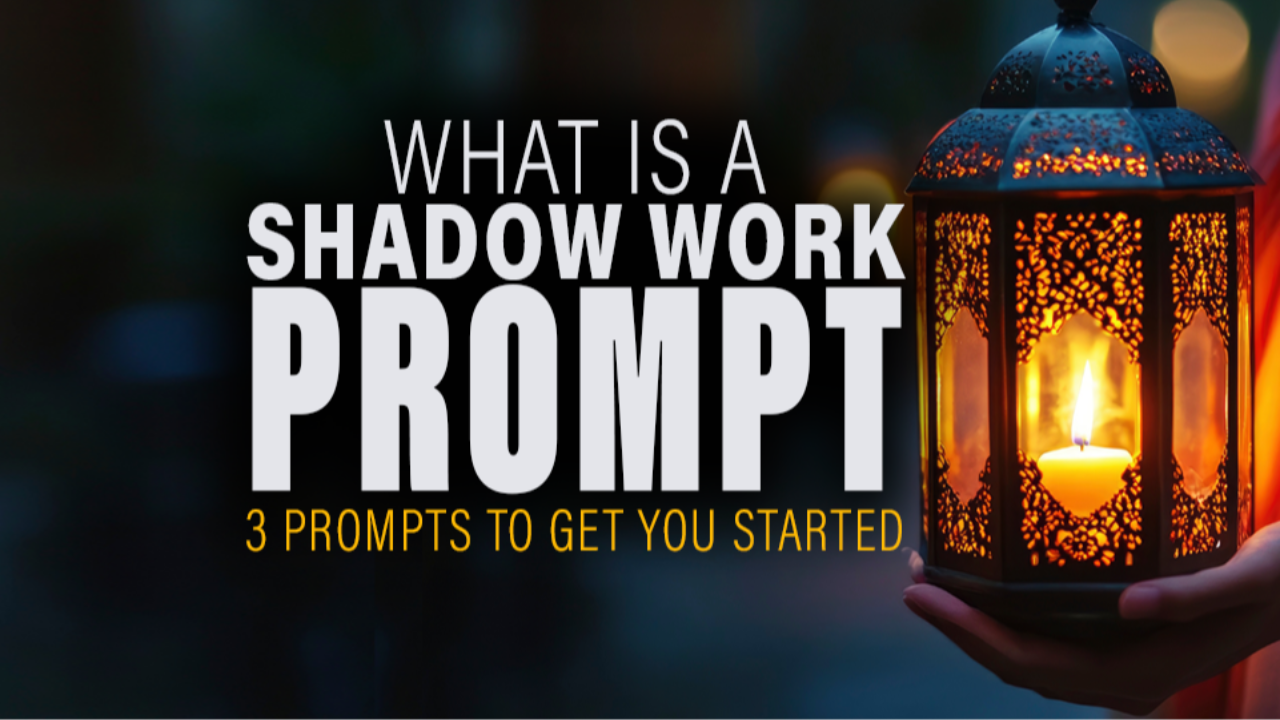
What Is a Shadow Work Prompt? 3 Prompts to Get You Started
Search "shadow work prompts" and you will find beautiful lists of journaling questions, and the good ones genuinely work. Here is the insight that makes them work, and makes everything in this article possible: the lever was never the journal. The lever is the prompt. A journal is one technology for acting a prompt out.
There is another technology, older and always with you: your life itself, as it is happening. This article teaches you what a prompt actually is, why it works on the mind the way gravity works on water, and the three prompts I start people with in the theater of the real world.
What Is Shadow Work, in One Minute
Shadow work is the practice of turning toward what you have learned to push away. The shadow, a concept descending from Carl Jung, is not your dark side. Shadow is meaningful resistance: feelings, needs, and truths that were once too costly to feel, so they were banished from awareness instead of lived. They are resisted in some fashion. Shadow is the projection of banished meaning that is hidden, repressed or even denied.
Banished meaning does not disappear. It settles into your deep conscious, the vast ocean of meaning working beneath your conscious participation, and it keeps expressing itself from there: as the overreaction you could not explain, the pattern that repeats across jobs and relationships, the judgment of others that carries a strange amount of heat. Shadow work retrieves that meaning so it can be felt, understood, and re-authored. The fuller teaching lives in our complete guide to shadow work. What follows is the tool to begin with.
What a Prompt Actually Is
First (in your mind), try not to answer these questions as you repeat these prompts:
Ask yourself: "What is 2+2=__."
Or, ask yourself, "What color is the sky? ______"
"What is the opposite of up? ______"
"Hey, What's your name?"
Notice what just happened. You did not decide to answer. The answers arrived. Or more accurately entered your awareness. Became available.
Four. Blue. Your name, before you could stop it, the information just arrived didn't it?
That is the property of an advanced modern mind this entire practice is built on: when a question is placed in the mind, the mind must answer.
Your mind sings songs, plays games, answers questions,
and tells stories all day long,
regardless if anyone is consciously steering.
In fact, most of your advanced system is moving underneath your conscious awareness. It has to. You are moving at the speed of light and in a world that is only getting faster.
Stop for a moment, and repeat with me, "Thank you, mind, for keeping me safe."
A prompt is simply a question placed in the mind on purpose.
Ask, and it answers. Every time. Therefore (and hear me now and believe me later): Any response you can't hear should be suspect. Your mind is simply advanced intelligence that helps you orient and make meaning
Now, just for a moment, hold your breath... count to three... now breathe. Notice, right there, you took control of your breath, then let automation take over again. Just like right now you will notice your mind is just thinking. You're floating down a river of meaning in the story called you. Meaning is always being presented. Just like your lungs automate breath, the mind automates mind. This is the reason breath and thought are so intrinsically tied together. Learning to cultivate a life of conscious awareness and not unconscious resistance can take a lifetime. But the results are always worth it.
Most people live their whole lives cultivating awareness unconsciously and by accident: By headlines, by other people's moods, and many times, by the loudest charge in the room. Their focal point of awareness gets directed for them, all day, and they call the result "my life."
Leveraging a prompt means taking the wheel.
You begin directing that focused consciousness, compassionately, but more deliberately, so it works for you and with you instead of against you and resisting you. Or, a better way of explaining it is that you come into greater harmony with a greater part of your being. It is a different way of orienting the vehicle called you. Instead of holding yourself back, you start angling yourself forward.
Two Theaters: The Page and the World
The world you experience does not arrive carrying meaning. The world is made of information. We turn that information into meaning. You make up your mind, moment after moment, and you live inside the meaning you have made.
A journal meets that meaning in reflection. You sit down in the evening, run a prompt across the day's replay, and the slowness is the gift: contemplation, pattern recognition, the long view. That is real work, and if you keep a journal, keep it. The prompt inside it is doing exactly what prompts do.
Life itself is the other theater, and it changes consciousness differently. A prompt deployed in the live moment catches the throw of meaning mid-air, while it is still being made: in the conversation, in the conflict, in the surge of charge itself. Same engine, different theater, different depth of experience. The page gives you understanding of the pattern; the live moment gives you authorship inside it. That is why we call this work in-theater, and it is the operating principle behind our Transformation Integration Programs, which leverage prompts the way a journal can't, but with whole lived experiences as the backdrop.
The 3 Prompts to Get You Started
Each of these is deployed the same way: in the moment, silently, the instant you notice charge rising. Not after. Not tonight. Now, while the scene is still running.
Prompt 1: "Isn't that interesting?"
This is the master key, and you will use it for the rest of your life. The instant you feel the heat rise, the defensiveness, the sting, the urge to argue or flee, place this question in the mind:
Isn't that interesting?
Try it in every situation you can think of. Wonder packs a powerful punch. Watch what it does. Wonder stretches the mind, it opens us up. When we learn to a A moment ago you were inside the reaction, looking out through it. Now the reaction is in front of you, and you are looking at it. The mind, ordered to find the interesting, must stop defending long enough to observe. You have just become the witness without leaving the scene, while the moment is still alive. The charge does not vanish; it changes jobs. It stops being the lens and becomes the object of study. If your mind resists moving to curiosity, the block might need a guide or a circle.
Prompt 2: "What am I making this mean?"
Deploy this one when a moment lands hard: the unanswered text, the tone in their voice, the look across the table. The event was an event. Everything else, the slight, the threat, the proof of what you always feared, is meaning you are throwing over it in real time. Ask the mind:
What am I making this mean?
Remember, the mind is built to answer questions, so, it must answer, and the answer is the work. That I don't matter. That it's falling apart. That they're leaving. You have just caught yourself in the act of authorship. Which means, for the first time, the authorship is available for revision while the moment is still alive: not reprogramming, because you are not a machine, but re-authoring, because you are the one holding the pen.
Prompt 3: "Where have I felt this before?"
When a charge feels old, bigger than the moment, oddly familiar in your body, place this question in the mind: Where have I felt this before? Then let it work. Do not strain. The mind retrieves what it believes you are ready to.
"Thank you mind for keeping me safe."
What returns is often not a memory of an event but the recognition of a thread: this exact feeling, in this exact place in the chest, running back through years of different rooms and different faces. You have just traced a live charge to exiled meaning, in the field, while it is active. That thread is what shadow work follows home. The qualities in others that reliably ignite you are part of the same retrieval system; what has not been witnessed within is met without, which is why every charged encounter is a map. The deeper mechanics of that are mental projection.
When a Prompt Becomes an Inquiry
A prompt answers and closes. You ask, the mind responds, the moment turns. But some questions are too large to close in a single moment, and they are not meant to be. Carry one of them, the same question, across days and weeks, and it stops being a prompt and becomes a Living Inquiry: a question held open, not to solve it, but to steep in it.
You do not force it. You hold the space, and over time the mind begins to reflect itself, revealing layers of meaning that were shaping you all along. This is strategic contemplation: carrying an inquiry into the theater of your life, paying attention to what life is teaching you, and integrating the lesson while it is still live.
The prompt is the strike.
The inquiry is the sustained tone underneath it.
Here is the whole arc in one breath. The moment is the prompt: isn't that interesting? The practice is the Living Inquiry, the question carried over time, and this is what our Transformation Integration Programs are built on. The path is the lesson lived in-theater, integrated until it holds. This is how we move our lived experience toward the enchanted result it can become, the place where the life that was fighting to survive becomes a life capable of expression, and genius can finally come through.
What to Do With What the Mind Answers
A prompt opens the door; do not just stand in it. Three instructions:
Stay in the scene. The untrained instinct is to exit, process, and return when composed. Stay. Don't continue to abandon this part of you. Hold space for it. Recognition and acceptance are essential for any evolution of thought. The recalibration that happens while the theater is live is the one that holds, because it is being authored in the same conditions the old meaning was authored in.
Learn to close the loop. Closing the loop, or what we call fruit to root is the term we give to learn to give yourself the thing this part of you is desperately looking for. Because you are the only one who can reach it. Only you can tend to the part of you kept in shadow. No one else will ever be able to reach that part.
Build the rhythm. One prompt, deployed at one live charge per day, compounds quickly, and it deepens whatever you already do on the page; journalers who add live prompting tend to find their evening reflections arriving already half-written. This is mental hygiene: the daily tending of meaning before it compounds. The Shadow Work App delivers this prompting practice daily, so the wheel stays in your hands. And because the meaning that runs you was made in relationship, it recalibrates fastest in relationship: live integration groups meet throughout every month to practice exactly this, together.
One boundary, plainly stated: this practice is powerful and it is not a substitute for mental health care. If what surfaces is more than you can hold, work alongside a qualified therapist, not instead of one.
Where to Go From Here
These three prompts are the beginning of steering. When you are ready to see the full architecture they are operating on, the structure that generates the reactions, the meanings, and the patterns in the first place, start with the Construct. And if you want to know which pattern is most active in your life right now, the Archetypal Energies Assessment locates you on the map in minutes, which makes every prompt sharper.
The next time the charge rises, you have the wheel. Isn't that interesting?
Steven Twohig has practiced shadow-informed depth work for twenty-five years. He spent eleven years alongside Tony Robbins, ten as Senior Business Strategist, served five years as Director of Integration for one of the largest plant medicine communities in the United States, and is the author of Turning Within: Reclaiming Your Soul from Shadow. He is the founder of Mastering Change and the nonprofit Evolving Mind Project.