Shame Is Not a Problem, It's an Invitation
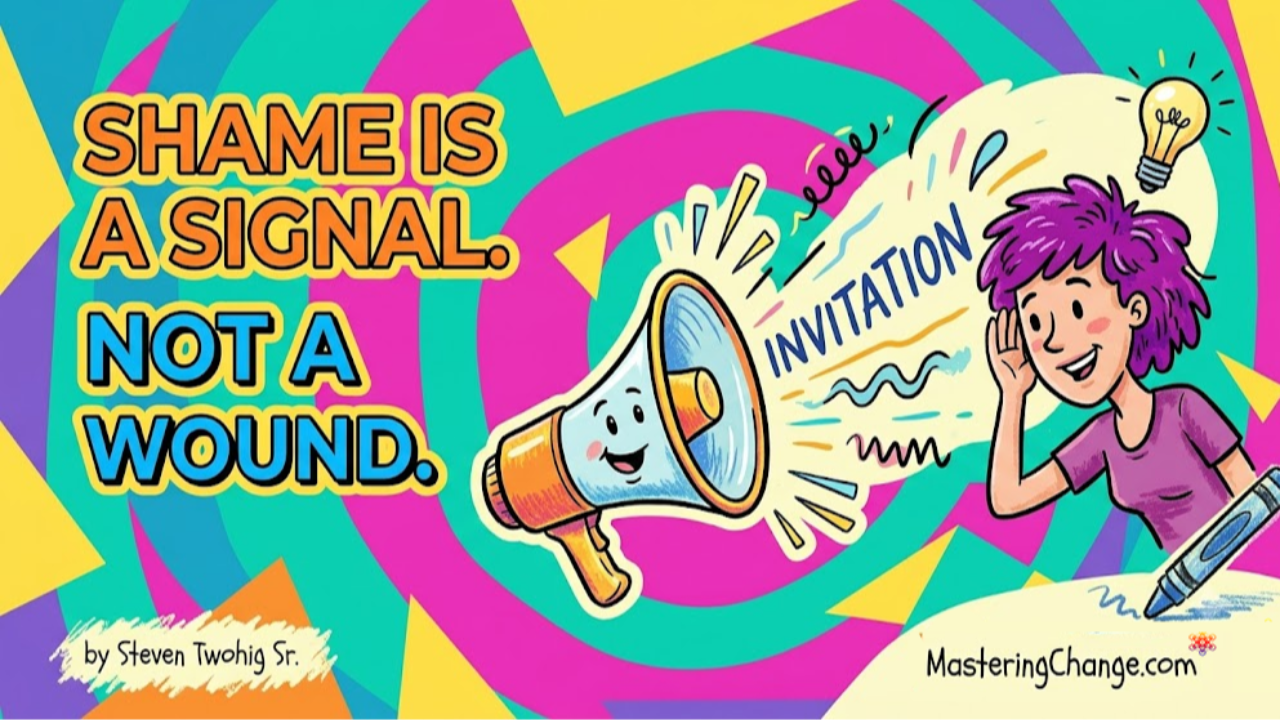
Why It Is a Signal, Not a Wound, and How to Read It.
There may be no signal in the human body we have misread more completely than shame.
We treat it as a malfunction. Something to avoid, to overcome, to manage, and in the gentlest rooms, to heal. Across therapy, religion, self-help, and the whole wellness economy, the instruction is the same underneath its different accents. Shame is bad. Get out of it. Get rid of it. Become a person who no longer feels it.
That instruction is the miscalculation. And because we built it into the sub-floor of how we translate it, almost everyone is now fluent in fleeing the one signal that was trying to show them where they were growing.
Shame is not the wound. Shame is a signal.
It is the felt registration of an edge, a report from the growing edge of our value, capability, and experience.
It fires when a living being meets a perceived or believed boundary of its current capacity.
The place where it stands short of some expectation or vision it carries.
That is the entire content of the signal.
Not, you are wrong. Not, you are bad.
Only, here is the edge between where you are and what you are reaching for.
We’ve layered intelligent and automated translation over it and hardcoded it to mean defect or wound. Then we spent centuries trying to fix the defect and could not understand why the people we were fixing kept feeling broken.
The Signal and the Vision
Let’s start with an insight, Notice: You never feel shame about something you do not care about.
Sit with that, because it overturns the whole picture. Shame requires care and concern. There has to be something you wanted, some excitement that was moving, some vision of who you meant to be, some standard alive in you. The signal only fires where the desire to fulfill a vision meets a perceived limitation. No care, no edge, no shame. Indifference never blushes.
Which means shame is not evidence of how wrong you are. The feeling marks the gap between your current capacity and a vision that runs ahead of it. And that vision is not noise. It is the in-dwelling intelligence of a life pressing from within toward what it could become, what it feels like it must be to experience enoughness.
A mom who continually beats herself up trying to reach her impossible vision of the ideal Mother.
A dad who suffers under the ever-moving vision of an ideal Father always larger than his capabilities.
The moments where we fail to live up to any cherished checkpoint of how we should show up and who we should be…
The signal we call shame is what it feels like to sense more than you are showing up. Not a signal of identity or even a confirmation of woundedness. A signal that has been pigeon-holed through mis-calculation and mis-orientation.
This is why fixing it is a category error. You do not heal the edge of your own becoming. You read it. Treat it as a defect and you will spend your life trying to amputate the part of you that knows you are not finished.
The experts have nearly all of the mechanism. What most of them are missing is this one turn: that the thing they are trying to relieve is a transmission, not a tumor.
The Experts Are Pointing at the Same Moon
They are not wrong. That has to be said plainly, because what follows is not a dismissal. Each of them has spent a life mapping a real layer of the same structure. The trouble is only that the layers were studied apart, and the deepest interior question, what the being makes of the signal and why, was rarely allowed in the room.
Silvan Tomkins gives us the reach. Shame does not appear in a dead system. It needs aliveness first, interest, excitement, connection, a hand already lifting. A soul already connecting. Then the movement gets impeded without being put out. Shame lives exactly where aliveness meets a boundary. He found the edge.
Helen Block Lewis and June Tangney give us the self. They showed that guilt stays near the act, I did something wrong, while shame moves to the whole person, I am wrong. The self enters the room. But that the signal touches the self does not make the signal a verdict about the self. It means identity has come close enough to the edge that the mind will start making meaning right there, at the most expensive possible spot. An identity is foreclosed and we become typecast in a role we never asked to play.
Learn about Constructive Thought
Paul Gilbert gives us the threat. Shame can route through the survival system and tie itself to rank, rejection, and the fear of being cast out. A body in threat does not get curious. It braces, hides, submits, attacks. And a braced body cannot read a signal. It can only flee one. This is why how we hold shame decides everything about what it becomes.
Brené Brown gives us the container. She named what secrecy and judgment do to shame, and she made it speakable in kitchens that would never open a journal article. Shame alone calcifies. Shame met with contempt becomes proof. Shame safely held in a container can finally be read.
Lisa Feldman Barrett gives us the construction. Emotion is not a coin found under a cushion. The brain takes raw bodily sensation and gives it meaning through learned concept, context, and prediction, and it reaches for old concepts first because old thought is cheap and new thought is expensive. The sensation is one thing. The meaning made of it is another.
Joseph LeDoux gives us the signal before the story. The body orients before the mind narrates. The alarm fires, and only later does the cortex arrive to say, here is what that meant. In the gap between the firing and the story is where a human being gets lost.
And the wider social-emotion field, Scheff, Herman, Tracy, Robins, gives us the theater, the gaze, the exposure, the legitimacy negotiated in the eyes of others. We are relational creatures who read ourselves through the world long before we learn to turn within.
Tomkins sees the reach. Lewis and Tangney see the self. Gilbert sees the threat. Brown sees the container. Barrett sees the construction. LeDoux sees the signal before the story. The social field sees the theater.
All of them are pointing at the same moon from different windows. And here is the thing said with respect rather than triumph. Most of them are standing exactly where every human being starts, looking outward for the source of an inward thing.
That is not a failure of intelligence.
It is the human condition before the turn.
They have mapped the outward arc with extraordinary precision, and they are living inside it.
The finger is real. The finger saves lives. The finger is not the moon.
Turning Within asks a question the finger cannot reach. When the signal of the edge arrives, what does the being make of it, where does that meaning go, and why does it keep coming back.
Every Meaning Is a Half-Truth, and Making It Is Genius
The moment the signal fires, the mind does what minds do. It makes meaning. Fast, under pressure, before language. It takes the raw fact of the edge and builds a story about what the edge means. It creates a smattering of mattering and layers it on top of what it already knows.
That act of making is genius. Not because the meaning is right. Because making meaning at all, instantly, in a body that needs to survive the next moment, is the most remarkable thing the mind does. Genius is the act, not the accuracy. Hold that, because it is easy to confuse the two and the confusion flattens everything. The meaning a frightened child builds in a flash is a work of genius and a half-truth in the same breath, and there is no contradiction in that, because every meaning is a half-truth. True from some angle. Partial from all of them. That is not a flaw in this person's particular story. It is the nature of meaning itself. No made meaning is ever the whole.
So we are not here to catch the child in an error. The child was brilliant. The meaning was the best available reading of an unbearable moment, made to keep love coming or to stay alive in a place it felt threatened. That it was partial is not its failure. It is simply what it always was, the way every meaning any of us has ever made is partial.
The problem is never that the meaning was made. The problem is what we then do with the signal that made it. We were trained to flee.
I was blessed to work with a wise quiet old practitioner who was the salt of the Earth. He came to our work because he found himself feeling angry and snapping on those he loved. He reported his inner state as judgmental and quick to shut down. Through the Closing the Circuit Process we tracked the signal down to a moment when he was very young. He remembered it like it was yesterday. A loved one was talking about writing their life story. He announced, “I’m going to write my life story.” The loved one looked at him and said, “Oh sweetie, you don’t have a life story, you’re only 6.”
He saw in that moment that some part of him picked up the message, “No one wants to hear what you have to say.” He now saw how some part of him remained back there. No matter how amazing the story (he had lived quite a life), he was never able to fully experience it. As he got older, bitterness grew and was projected on everyone and everything he saw. The mind projecting and reflecting in an attempt to recalibrate being misunderstood as confirmation and not reclamation.
A Jacket Received
Somewhere small, you were told a certain jacket was the only one you could wear. You are too much. You are not enough. You are the disappointing one, the difficult one, the one who ruins things. It does not matter whether the room truly said it or whether you translated it in the eyes of a tired face at the end of a long day. The signal of an edge arrived, the mind made meaning, and the meaning became a jacket. And then you did the strangest, most faithful thing. Some part of you became alive inside of it… and built a life around it.
Maybe, you kept yourself small enough to fit it. You chose the rooms, the work, the partners, the ceilings that let the old jacket keep fitting, because a self that confirms its own story feels safer than a self set loose. You did not keep the jacket because it was true. You kept it because someone important to you sent you a message confirming it was you. You kept it because it was yours, and we live from what is ours.
Or maybe, just maybe, you’ve spent your life trying to take the jacket off, but no matter how much success, story, enoughness you experience, the jacket seems to be stuck on some part of you. The key here is identifying where you find yourself feeling the same translation presenting itself on the edge of your experience.
Learning The Two-Step
Here is the part that looks like madness and is closer to genius.
The flight runs in two directions at once. With one hand you keep yourself small so the jacket fits, confirming the old story. And with the other hand you set up the very scene that will let you prove the jacket is not real. You pick the fight that ends the way the fight always ends. You almost skip the wedding to confirm you were never wanted, and some part of you aches for someone to come and pull you there anyway. You set yourself up to feel the sting of the same shameful feeling, over and over. You find yourself deflated after what should be an expansive win or experience, only looking at how small you still feel.
That second hand is the one nobody taught you to recognize. The hook that keeps finding you is not the wound recurring. It is an appointment you keep making with yourself. Because the charge is too large to hold and look at directly, the deep conscious does something merciful and strange. It casts the unbearable thing outward, onto a partner, a room, a stranger who says the wrong sentence, so that a being who is programmed to look outward first can finally see what it could never face head on. You cannot stare at the sun, so the mind throws it on a wall. The projection is not the malfunction. It is a feature of an advanced navigation system trying to recalibrate where and how it defines its existence. It is the psyche staging the one scene where the buried meaning can come back into the now and be read at last.
And then, at the door, we get it backward. The charge rises, the old edge lights up, and it feels like proof. We tell ourselves, “See, it is true, it happened again.” We read the return as the verdict landing one more time. But it was never confirmation. It was the meaning coming back up to be revised, the reach surfacing the thing precisely so it can be met differently this time. The charge rising is meaningful resistance and distortion doing its job, and because no one ever taught us to hold space for that, we slam the door at the exact instant it opens. The loop runs again, not because the system failed, but because we answered its invitation with the one response that keeps it sealed. We believed it.
Hold one line clean here, because it is easily abused. You arranged the appointment with the meaning. You did not arrange the permission for what anyone did to you. The deep conscious surfaces your meaning through whatever screen is available, and a real person may be standing on that screen doing real harm. Authorship is not blame. It does not say the world did nothing. It says the charge is yours to read. The world provides the screen. The screen is never excused. It is only not where the reading happens.
This is the circuit, and it does not run downhill. The meaning is made within. Your genius casts it outward as lived reality, the drama, the scene, the appointment, so the outward-oriented being can witness it. Then the turn brings it home to be read and recalibrated. Within, out into the world as theater, then back within. It was never within against without. It is one motion, and the whole work is learning to turn it.
First Awareness Is External
Why must it travel outward at all. Because that is how we are built.
We begin outside ourselves. We learn who we are through faces, rooms, rewards, punishments, belonging, and the stories handed to us before we have any of our own. Our programmed first awareness is external. Second awareness is internal. We come into the world looking outward to understand what is happening within.
That is not a flaw. It is development. An infant cannot sit with a journal and ask what meaning it is making about its capacity to exist. It reads the face. The body reads the field below the words, in the deep conscious, long before language arrives. If the face says yes, one world. If the face says no, another. The room is real and the room matters.
But the room is not where the meaning stops. The child still has to locate itself inside what happened, still has to answer, beneath all words, what does this say about me. This is why the social layer is priceless and incomplete. Name the room with perfect accuracy and you can still miss the authorship. We can describe the wound forever and never reach the one who has been making the translations.
So the projection is not a detour. It is the route. A being that begins external will find its buried meaning by meeting it outwardly first. Turning Within is not the denial of that. It is the moment the person receives the meaning-making function back into their own hands, not to excuse the room, not to pretend it was safe, but to finally see the signal at its source and read it instead of fleeing it.
The Dead Father in the Bank Account
The vision that sets the edge is often older than the person carrying it.
A dad carries an image of Father larger than any single day can hold. Protect, provide, bless, witness, stand. That image is not a private wish. It is archetypal, it is myth, and myth is not make-believe. Myth is one of the ways the deep human system remembers what matters before the conscious mind can explain it. Because it is myth, it has gravity. When the man meets his actual, tired, finite life, the signal fires at the gap between the image and the day. He calls it not enough. The truer reading is that he is standing at the edge between a holy vision and a human capacity, which is the most honest place a dad can stand.
Learn about The Father Archetype
The mom stands in a similar doorway. The archetypal Mother moves through her, older even than her personal story, shaping how she sees the child and the room and herself, and when her lived capacity meets its edge, the signal fires, she feels an inadequacy that can never quite be shaken. A projection of the vision of how she doesn’t quite measure up.
Belief is an interesting experience. It doesn’t go away just because of evidence to the contrary. A child feels small in a big world. A dad once looked at them with something the child read as disgust, and the child decided, in genius and in half-truth, to spend a life proving they are not disgusting. Fifty years on, the dad has been dead for ten of them. The man he was arguing with is gone. But the archetype does not need him breathing. It moved into the career, the bank account, the way the body stiffens when someone questions the work. The accuser left the building decades ago, and the trial never adjourned, because the accuser was never the point. The vision and the edge are inside the person, and the signal has been faithfully marking that edge the entire time, while everyone, including the experts, kept looking for a man who was no longer there.
Why Fleeing the Signal Is Dangerous
A limited reading of shame produces a limited intervention, and a limited intervention can deepen the very thing it was built to relieve.
If shame means something is wrong with me, I will spend my life trying to solve myself. If it comes only from other people, I will spend my life trying to control rooms, partners, and strangers. If it is only a thought, I will reframe the story while the vision starves underneath it. If it is only threat, I will soothe the body and miss what the body was carrying. Each map is true and each becomes a cage the moment it believes it is the whole territory.
And the deepest danger is the one dressed as care. When the instruction is to overcome shame or to heal it away, we teach the person that the signal itself is the enemy. We teach them to be ashamed of shame. Then a society forms that cannot tolerate the edge at all, and it becomes violent with ideals. Be better. Be thinner. Be stronger. Be purer. Be healed. Be anything other than what you are right now. The human meets a limit and calls it failure. The child meets a boundary and calls it self. The mother meets the archetype and calls herself broken. We manufacture the exact wound we claim to be treating, by training people to flee the one signal that was trying to show them where to grow.
The Container as a Mechanism
This is where the held room stops being comfort and becomes the missing half of the machine.
A signal read alone, in a braced and threatened body, does not soften. It sets harder. The charge rises, gets taken as confirmation, and the meaning consolidates one more time, deeper than before. That is shame met in isolation, and the research that calls it corrosive is right about that case.
A true container supplies what the original moment never had. Not performance. Not everyone smiling while the real thing hides under politeness. A field that knows the rising charge is a door. A person brings the edge into the circle expecting rejection or correction or someone moving away, and instead the field stays. It does not worship the shame. It does not believe the old story. It does not rush to fix it. It says, in effect, we are here, keep reading. And in that open moment the psyche meets a witness instead of a brace, presence where there was once only a face that turned away. That presence is what gets written into the meaning while the door is open. The carpet is not where shame gets soothed. It is where the signal finally gets read with someone standing in it beside you.
It is also why the work is so often communal. The charge does not always belong only to the one carrying it. Two deep minds can write a contract neither one speaks aloud, each staging the other's appointment, each the available screen for the other's buried meaning. So the teacher arrives through whoever is brave enough to bring the work. One person sees the floor they have stood on for thirty years, and everyone in the room looks down at their own feet. That is not support alone. It is consciousness widening in a shared field.
Meet our Community
The Turn
The turn begins the moment a person stops trying to fix shame and starts trying to read it.
To obey the signal is to collapse into the old story. To reject the signal is to throw away the information. To read it is to stay present long enough to hear what edge it is marking. A person sits down in the heat of it,
the shrinking,
the wanting to hide,
to attack,
to explain,
to disappear,
and instead of running they say only this. It is okay that this is here.
Not, the story is true. Not, I am bad. Only, it is okay that this signal is here. And the old story begins to loosen its grip, the practiced defense softens, and underneath comes the question the signal was always asking.
What edge am I touching.
What vision am I standing short of.
What did I make this edge mean, and how long ago.
What have I been wearing to keep that meaning fitting.
What part of me has been checking under the bed instead of turning on the light.
This is not a single bright morning of release. I want to be plain about that, because the breath makes it sound quick and it rarely is. A meaning that has grown into the skin comes free one thread at a time, almost never on the first pass. The same scene will return, because the psyche keeps the appointment until the meeting finally goes differently. Each return is not failure. It is another open door. The labor is learning to meet it awake, in a room that knows the ache is a door, until one day the door opens and you write something the first room never gave you.
And on the far side of the reading, the people you thought were broken turn out to be carrying something enormous. The mom is not failing. She is meeting the edge of her capacity while an archetypal image calls her forward. She learns to love her limits, finds that self-care is vital and begins the journey to healing the parts of her left abandoned while looking to not abandon.
The dad is not incomplete. He is human, and the vision he carries is larger than one life can perfectly hold. The one who believes they are too much is not hiding a defect. They are hiding magnitude. The body that betrayed someone in an undignified moment was only having a body moment. The seeker who feels shame near God is not falling away from God. They are touching the gap between the infinite and the human container trying to receive it. None of that is pathology. All of it is initiation. And initiation without a container becomes injury, which is why the room, the holding, the slow communal work, is not the soft part of this. It is the method.
Find a carpet.
What the Signal Was Always Saying
Shame is not the problem. Shame is a signal, and we were trained to flee it.
It does not say you are wrong. It says you have met the edge between where you stand and a vision you are carrying that runs ahead of you. We hardcoded that signal to mean defect, and built whole disciplines and industries on avoiding it, overcoming it, and healing it away, and could never understand why the people we treated kept feeling broken. They kept feeling broken because we kept teaching them to flee the one report that was trying to show them they were still growing.
Your ability to accept your humanity is a direct reflection of your ability to witness your divinity
The experts showed us where to look. They mapped the reach, the self, the threat, the construction, the theater, and they did it with their lives, and the finger is real. Now we learn to follow it past the room and the gaze and the long-dead dad, all the way to the source, where a living being meets its own edge and gets to choose, this time, whether to run from the signal or to read it.
Read it, and it stops being the proof that you are too small. It becomes the surest evidence you have that you were always meant to live a life and not survive or overcome it. It is your humaning that your shame is bringing you to. Not your brokenness.
That ache you have spent your whole life trying to get rid of was never the enemy.
It was the edge of who you are, who you are still becoming, and asking you, at last, to turn and see.