The RAIN Process: In-Theater Shadow Integration Process

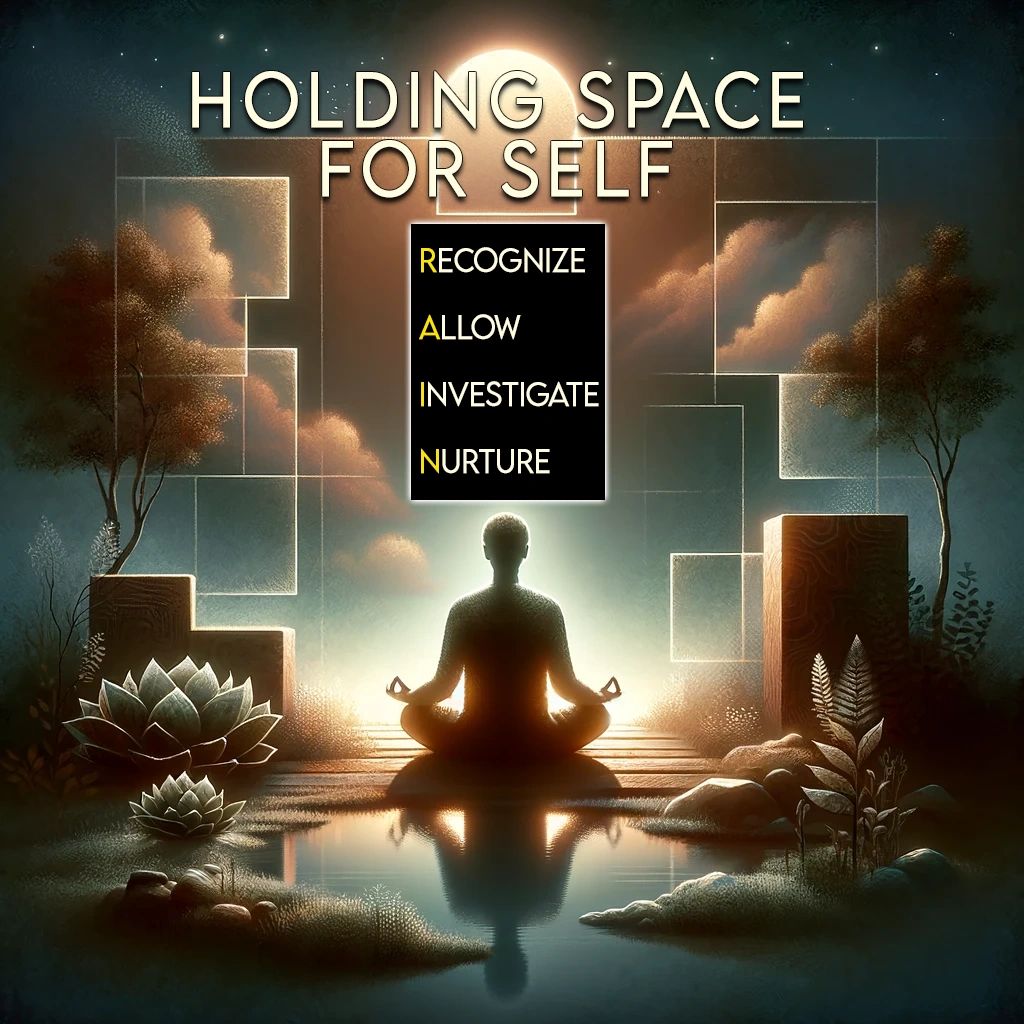
RAIN is the practice that meets shadow where it actually shows up — in the moment, in the body, in the middle of life. It is how a practitioner holds space for themselves when an old construct comes online.
The hardest place to do shadow work is not on the meditation cushion.
It is in the moment the charge arrives.
The conversation that turns. The email that lands wrong. The look across the room that pulls something old to the surface. The familiar ache that returns without warning.
This is where most personal growth language stops working. Frameworks live in calm. Shadow lives in activation. You need a practice that can meet you when you are already in the theater of the pattern, not waiting for you to be composed enough to study it from a chair.
That practice is RAIN.
Recognize. Allow. Investigate. Nurture.
In Turning Within, RAIN is not a generic mindfulness exercise. It is an in-theater integration process — a way of holding space for yourself when shadow is active, so that what has surfaced can be tended rather than buried or obeyed.
Why Holding Space Is a Skill, Not a Mood
In a fast-paced, productivity-oriented culture, the idea of holding space for ourselves — especially the parts of consciousness we would rather not look at — is undervalued and often misunderstood. We are taught to act, not to attend. We are taught to fix, not to feel. We are taught that negative emotion is a problem to solve rather than a window into something deeper.
So when shadow shows up, most people meet it with the only tools the culture gave them: suppress it, perform around it, or analyze it from a safe distance.
None of those are holding space.
Holding space is the deliberate practice of creating a safe, nonjudgmental inner environment where thoughts, emotions, memories, and the constructs running beneath them can be observed and engaged without immediate reaction.
This is a skill taught in the psychedelic space for those sitting with another person through a journey. The sitter learns that the mind will not surface more than it believes can be held. Set and setting determine what becomes available. The same principle applies inward. When you can hold space for yourself, the deeper material begins to come forward — because the system finally trusts that something present can meet it.
Holding space is not a personality trait. It is a capacity you build through awareness and practice.
RAIN is one of the most reliable ways to build it.
R — Recognize
The first move is recognition.
Before anything can be tended, the practitioner has to notice that something is active. Not the whole pattern. Not the entire story. Just the fact that a construct has come online.
The thought that is suddenly louder.
The emotion that arrived faster than the situation justified.
The body sensation that does not match the room.
The familiar reaction that you have had a thousand times before.
Recognition sounds simple, but it is not small. The default move of the constructed mind is to remain fused with what it is generating. You do not experience the identity as active — you experience it as what is happening. Recognition interrupts that fusion. It places a sliver of awareness between you and the construct.
You might simply say:
Isn't that interesting. The not-enough identity is here.
Isn't that interesting. The one-who-has-to-handle-everything just came online.
Isn't that interesting. Something just got charged.
Recognition is the first return of authorship. Once you can see that a construct is running, you are no longer entirely inside it. You have re-engaged both authority and agency.
Awareness is the threshold of the whole practice.
A — Allow
The second move is the hardest one in this culture.
Allowing means letting the experience be there, exactly as it is, without trying to change it, argue with it, or immediately understand it.
It is not agreement. It is not surrender. It is not the pattern winning.
It is the radical act of letting something difficult exist long enough to be worked with.
Most people, the moment something uncomfortable surfaces, do one of two things: they suppress it, or they entangle with it. Suppression buries the construct deeper. Entanglement amplifies it. Allowing breaks the binary. It says, this charge is here, and I do not need to obey it immediately.
In Turning Within, this is an act of self-compassion. It is acknowledgment that being human means carrying activations, residues, and old constructs that surface when we least want them to. Allowing is acceptance of our humaning — the willingness to meet ourselves where we actually are, not where we wish we were.
That pause matters more than it looks.
It is where awareness stops being a passenger and the practitioner stops outsourcing the moment to reflex.
I — Investigate
This is where RAIN deepens into the heart of the work.
INVESTIGATE is the acronym for Closing the Circuit, the integration process taught in Turning Within. It is the movement that takes the fruit — the visible pattern, the activated charge — and follows it back to the root where the construct was first stabilized.
This is not analytical probing. It is not interrogation. It is gentle, curious exploration.
What does this feeling have to say?
What identity has come online here?
What story is the mind telling?
What does this part of me need?
The investigation has direction. It moves from the recent trigger backward toward the earlier moment where the construct took shape. Awareness arriving at the root is what begins to loosen the grip.
Most importantly: this is not for the sake of self-judgment. Judgment is how the construct was formed. A practitioner who investigates with judgment will simply rebuild the cage they are trying to walk out of. Investigation is for self-awareness. The point is not to be right about the pattern. The point is to be present with what made it.
When investigation is done well, it can unlock a level of insight that defies rational thought. The construct begins to disclose itself. You begin to see how the identity that activated was a younger part of you doing the best meaning-making it could with what it had. Developmental psychology calls this a foreclosed identity.
Learn more about foreclosed identities
The Closing the Circuit process takes the fruit to root by taking the identity formed through your challenges and turning them inward — to tend the wound that has been projecting outward all along.
N — Nurture
The investigation will reveal a need underneath the construct. Often something simple and ancient.
Safety. Love. Permission. Protection. A voice. Someone to stay. Someone to see clearly.
Nurture is the act of meeting that need from within rather than chasing it from without.
This is the moment of self-compassion. It is offering the scared, hurt, or angry part of you the same kindness you would extend to a dear friend in distress. It can be a mental whisper of understanding. It can be a hand placed on the heart. It can be the simple, internal declaration that this part is welcome here.
It is not until we find the open charge and learn to nurture it from our own source that the healing journey actually begins.
This is the part of the practice the culture cannot teach us. We are trained to seek nurture externally — through validation, through achievement, through being chosen. RAIN inverts that orientation. The nurture has to come from within, because the source of the construct was always within. What was reached for outside was a projection of what could only be reclaimed inside.
Once the need is met, the practitioner closes RAIN by practicing one action from a truer place. Not a dramatic reinvention. One honest act. The new way of being is not affirmed — it is practiced into the world.
What This Practice Actually Builds
RAIN is more than a technique. Over time, it becomes a way of being with yourself.
It changes the relationship between you and what arises in you. It teaches that every reaction, every charge, every uncomfortable emotion carries information about a construct that wants to be tended. Light or shadow, bright or buried — it is all part of the same architecture you are learning to author.
Holding space for shadow is the foundation of every deeper practice in this work. Mental hygiene becomes possible when you can stay present with what surfaces. Shadow work becomes possible when you can hold space for the exiled material. Depth work becomes possible when you can investigate without judgment. Turning Within becomes a lived practice rather than a concept.
By learning to hold space for new insight to come through you, you open yourself to the genius that can only come through you. Engaging the world at this level unlocks a deeper story being told through all of us.
In a culture that prizes outward success and clean solutions, this work invites something else: slowing down, listening deeply, and honoring all parts of yourself. That is not weakness. It is the kind of courage the modern mind is starving for.
The practitioner who learns RAIN learns how to navigate life with more empathy, more resilience, and more self-awareness. The inner conflict stops being a problem to escape and becomes a gateway to walk through.
That is what holding space is for.
That is what RAIN makes possible.
For the full architecture this practice draws from — the Construct, the four rules of shadow work, the algorithm of Closing the Circuit — read Turning Within: Reclaiming Your Soul from Shadow.