Money Is a Mirror
The wealthy already know that more doesn't fix it. Here's what does.
The year I was earning close to half a million dollars, I was certain I was about to become a bum.
Not as a passing anxiety that eventually quieted. Not as the kind of imposter syndrome a good therapist talks you through in six sessions. It was a structural terror, a thing with teeth, and as I grew, it grew right along side of me. Every quarter I made more money, the internal calculations adjusted. The mental manifestations of my fear rose to meet every new number. The catastrophe the mind was rehearsing simply scaled. As income grew, the simulations grew with it. The scenarios my mind had to construct to get me from half a million a year to destitute became more elaborate, more extreme, more baroque in their specificity. But they always landed in the same place. And they always felt two steps away. As Tony Robbins always says,
Your ability to succeed is a direct reflection of your ability to handle uncertainty.
— Tony Robbins
What I was living was something more specific than that: the subjective experience of an overly certain mind. Certain of the worst outcome. Certain of its own inadequacy at the level of Intrinsic Worth. And using every new achievement as fuel to run that same simulation at a higher voltage. I thought that if I could make enough people better, make enough impact, make enough income, I would eventually feel differently about who I was at the root. What I did not understand then is that the mind anchored to a fixed sense of worth will adjust the worst case scenarios (WCS) before it will adjust the deeper programming that is generating them.
It will build a bigger catastrophe to match your bigger life. It will not simply decide you are enough because the evidence now says you are. I had spent 11 years working alongside Tony Robbins, standing in front of some of the largest personal development audiences in the world, helping people dismantle the survival-rooted programming that was quietly running their lives. I was also, every morning before they arrived, drowning in my own version of the same thing.
What I know now is that this is not irony. It is the mechanism itself, operating exactly as designed.

A recent piece in New York Magazine “What Does Extreme Wealth Do to the Brain?,” Lane Brown, a features writer, spent months interviewing people of extreme wealth, asking them how money had changed the way they think. He was patient and honest. They found what you might expect: hedonic adaptation, the isolation of private schools and private planes and private versions of reality, the restaurant check as a tiny theater of status and guilt and power. They also found something more interesting. Mark Cuban still gets furious about the price of milk. A former CEO with a high eight-figure net worth searches for cheap flights and winces at Prada. A software developer who sold his company for nine figures can no longer get the same pleasure from $500 sneakers because the pleasure was never in the shoes. It was in the irresponsibility of buying them.
What these people were describing, often without realizing it, was a worth structure that money did not rewrite. They arrived at wealth carrying whatever orientation to their own value they had built before the money came, and the money did not fix it. It revealed it. In some cases, it amplified it past the point where ordinary life could contain it.
The article landed on what it called the amplifier theory: wealth turns up the volume on whoever you already are. This is close. But it stops one layer too shallow, because the variable that determines what gets amplified is not personality. It is worth.
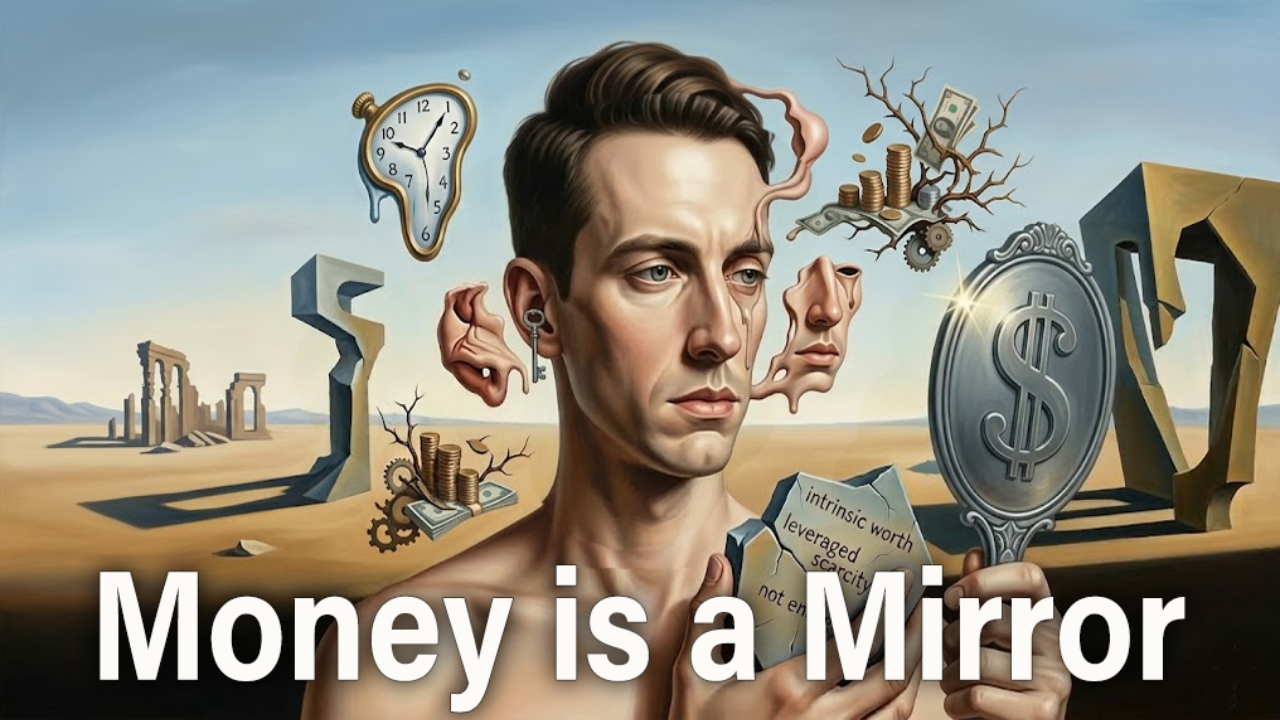
Money is a Mirror
Here is what I mean.
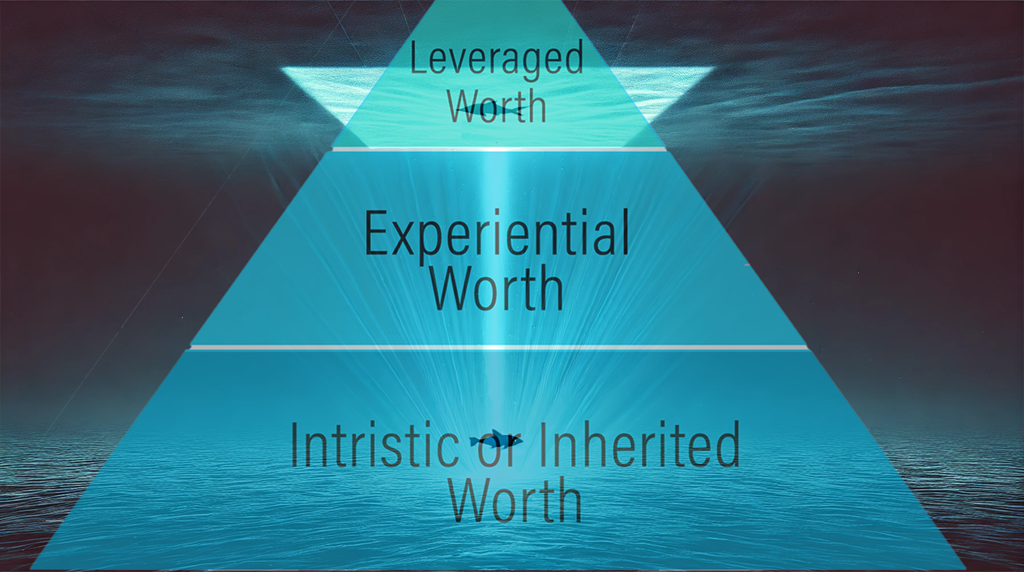
When money lands in a person's life, it does not project onto neutral ground. It refracts through a structure that already exists, one most people have never examined because no one ever told them it was there. That structure operates at three distinct levels, and they do not function independently. They stack. The foundation determines everything above it.
Suzy Ashworth, a UK-based coach and author of Infinite Receiving, calls this the Wealth Trifecta, and she arrived at a remarkably similar map from the opposite direction. Where most wealth psychology literature asks what money does to people, Ashworth asks what people are doing to money before a dollar ever changes hands. Her framework identifies three layers of worth that exist entirely independently of a bank balance: leverageable wealth, which is the relationship with resources; experiential wealth, which is the meaning assigned to what you live through; and intrinsic wealth, which is the foundational sense of self that either receives abundance or deflects it. The outer layers, she argues, will always reflect the inner ones. You can grow the resources and still experience scarcity, because the experience is being generated somewhere the resources cannot reach.
This is the diagnostic the New York magazine article circled without quite landing on. What it was watching, across hours of conversation with people worth tens and hundreds of millions of dollars, was the Wealth Trifecta in various states of misalignment.
The first level, Leveraged Worth, is your relationship with resources: money, time, access, opportunity. When there is a block here, you speak in the language of not enough. Not enough time in the day. Not enough capital to make the move. The resources are objectively present. Your orientation to them is not. The CEO in the article knew his bank balance to the dollar. He could not feel it as his. That is not a quirk of personality. That is a Leveraged Worth block. The data says abundance. The Construct says scarcity. The Construct wins every time, because the Construct is not working with data. It is working with meaning.
The second level is Experiential Worth. This is the meaning you assign to what you live through. When there is a block here, no experience can be fully inhabited. The European entrepreneur in the piece had studied hedonic adaptation. He understood it clinically. He could name it in your presence and explain how it operates. And then his expectations rose anyway. Knowing the mechanism from the outside is not the same as being free from it on the inside. These are different rooms. The Construct does not require your understanding. It only requires your orientation.
The third level, the foundational one, is Intrinsic Worth. This is the I am. Not what you have. Not what you experience. What you believe yourself to be at the root, before any evidence arrives either way. This is the inheritance you carry into every income bracket, every relationship, every room where your worth gets tested. This is the level where the real work lives, because if the block is here, it will always surface in your Experiential Worth. It will always impact your Leveraged Worth. No amount of money addresses it. You cannot reach satiation. Because the goal post is always moving.
Ashworth puts it plainly: the capacity to receive is not a financial condition. It is a practiced state of being. The person who cannot receive a compliment without flinching will not receive abundance without deflecting it either. The mechanism is identical. Only the currency changes.
What the wealthy people in that article were describing, often haltingly, often for the first time in their lives, was the tax that an unexamined Intrinsic Worth block levies on every level above it. The software says: not enough. The bank balance says: more than enough. The software wins. It always wins. Because the software is not a thought you can argue yourself out of. It is a meaning you are living inside of, and it is generating your experience of reality below the level of conscious participation.
Understanding Projected Worth
I spent 11 years in the rooms Tony built. The rooms were massive and they were loud and they were filled with people who had come because something wasn't working, and what I was watching, night after night, was not a crowd of different problems. It was the same Construct wearing different tax brackets. The executive convinced his success was an accident waiting to be exposed. The entrepreneur who could not stop acquiring because acquiring was the only evidence his I am found convincing. The woman in the third row who received a compliment with a slight flinch, as though the kind words had come from a direction she wasn't facing.
Same structure. Different costumes.
What Tony taught, and what I eventually came to understand at a depth I could only reach by watching it not work for myself first, is that certainty is the variable. Not certainty as a mood you manufacture. Not certainty performed for an audience. Certainty as an orientation. A settled relationship to your own worth that does not require external conditions to confirm it before it will function. When I finally stopped orienting from the story that I was one quarter away from being a bum, my impact didn't soften. It sharpened. What I had been calling fear of success was never really about what lay ahead. It was about the story I was carrying about what I deserved to have happen at all.
The article asked the right question near the end and then moved on. How many people really know who they are when there's nothing pushing back on them? This is the question. But knowing who you are when there is no friction is not the same as being oriented from a clear sense of worth. Plenty of people know exactly who they are, when nothing is testing them, and they are oriented from a Construct that was built for survival and never updated to account for abundance. Money does not fix this. Money makes it louder.
What the article called the amplifier, I call the magnifier. The distinction matters. An amplifier turns up the volume on the signal that is already present. A magnifier reveals what the signal is actually made of. When you remove financial friction, you are not just getting more of yourself. You are getting an unobstructed view of the worth structure you have been living inside without being able to see clearly. The anxiety that was kept manageable by ordinary constraint now has room to run. The generosity that was bounded by a fixed income now operates at a scale that changes other people's lives. Whatever was being held in check is now visible. It was always going to be visible. The question is whether you have developed the capacity to work with what you see.
Practicing Mental Hygiene
This is not psychological theory. This is mental hygiene.
Mental hygiene is not positive thinking. It is not the sparkly band-aid of deciding that everything happens for a reason and leaving it there. Mental hygiene is the practice of cleansing and maintaining the mind so meaning can be shaped consciously; rather than shaping your life from automation. It is the practice of stopping, in the moment the pattern is running, and orienting. Am I surviving this moment or living in it? Which level of worth is blocked right now? Is this a Leveraged story, a scarcity narrative I am telling myself has no solution? Is this an Experiential story, a conviction that no amount of presence will make this moment feel worth having? Or is this the oldest story, the Intrinsic one, the one that says I am not enough before any evidence arrives?
The practice is not about arriving at an answer and being done. It is about developing the capacity to stop before the Construct writes the next chapter automatically. It will write the next chapter. That is what it does. The question is whether you are awake to which page it is currently on.
This matters for wealth in a specific way. A person oriented from survival does not make decisions. They make maneuvers. Everything is a move against an impending loss. The moment the money comes, the mind simply locates a larger loss to protect against. I watched this run in myself with remarkable precision: every time I doubled my income, my imagination doubled the catastrophe it was holding at bay. The floor kept moving because the floor was never about the money. The floor was about the worth structure that was using the money as a mirror.
One of the more quietly devastating details in the New York magazine piece came near the end, almost as an aside. Several of the subjects said they had never discussed this topic with anyone before sitting down for the interview. Not with spouses. Not with friends. Not with therapists. The money, the meaning it carried, the way it had or hadn't changed them, all of it had been living below the surface, unspoken.
This is what happens when meaning lives below conscious participation with no witness. The Construct does not require language to run. But integration does. You cannot revise a story you have never told. You cannot work with a pattern you have not seen clearly enough to name.
The wealthy people in that article were not unusual. They were doing what most people do regardless of net worth. They were carrying a worth structure they had never examined, letting it govern their relationship to money and status and joy and loss, and calling the results their personality. Mental hygiene does not guarantee the money stays. It does not make the fear disappear. What it does is make the fear navigable. What it does is separate the I am from the pocketbook, so that what you have and what you are worth stop being the same sentence.
The floor stops moving the moment you stop needing it to save you.
That is not a motivational line. It is a description of the work.
Steven Twohig is the founder of Mastering Change and the Evolving Mind Project. He spent 11 years working under Tony Robbins and serves as a depth work guide and international speaker. His work centers on the Turning Within framework, a practice for examining and revising the meaning structures that govern human experience.