Evolving Through Integration: The Power of the Group
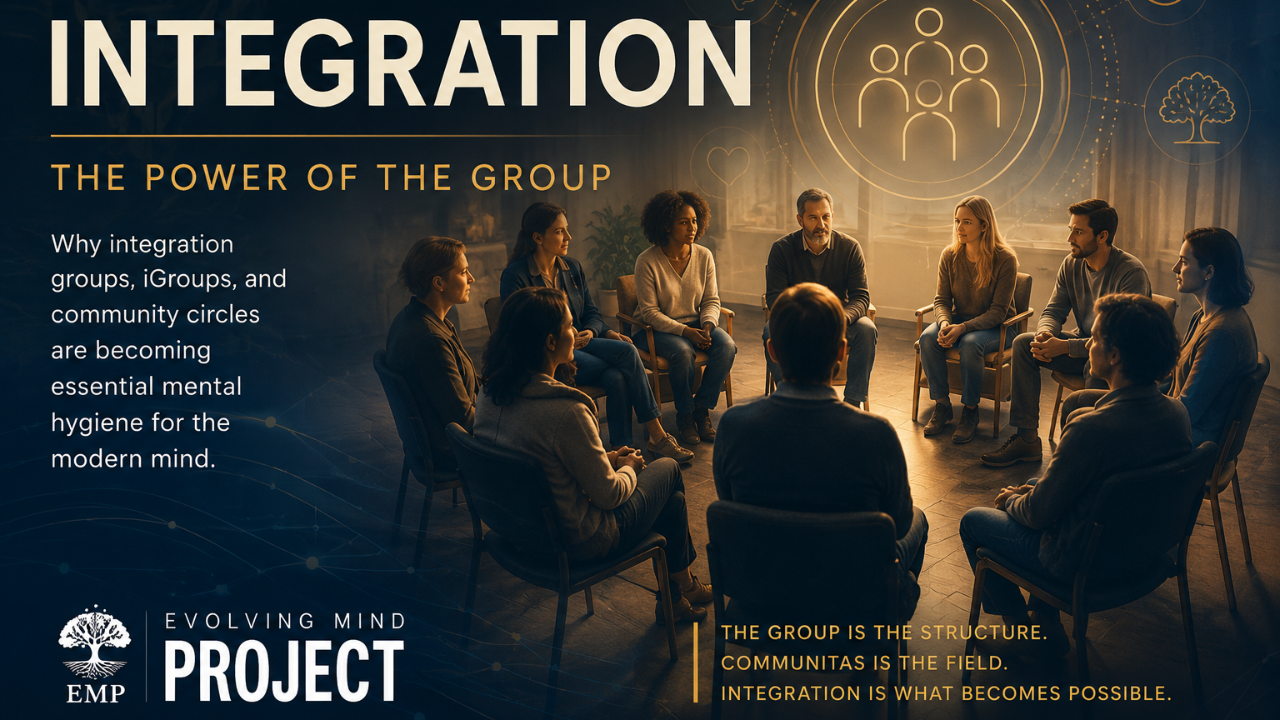
How integration groups, iGroups, and community circles are becoming essential mental hygiene for the modern mind.
Not every group is about healing a wound. Some are about staying human while the world accelerates around you. Others are about exploring what humaning really means.
Spend enough time around advanced minds and you begin to see the same paradox everywhere: many times, the people who can anticipate three moves ahead are often the least likely to be fully here. Their intelligence is not the problem.
It is the speed of it. The constant projection. The perpetual rehearsal of where things were, where they are, and where they might be going.
The modern mind does not simply think. It orients. It loads a construct, then filters reality through the storyline that construct imprints, often intelligently ignoring whatever does not fit. In EMP, this is not a defect so much as a human condition: meaning gathers, organizes, predicts, protects, and eventually becomes the atmosphere a person lives inside. The self is the spark this system generates.
The Social Infrastructure of a Mature Modern Life
The modern mind needs to develop effective mental hygiene to support the tending of the system. Not mental health, but hygiene. People are beginning to look at care for the mind from a different perspective. They do not always need fixing. This is where integration groups or iGroups come into play. (Learn more about iGroups)
Most people are not in breakdown. Many are highly functional, deeply responsible, creative, capable, and years beyond the crude self-help fantasy that one breakthrough will save them. But the world is moving faster, calling us to maintain parts of our inner landscape that were, up until now, left to either those in crisis, or those performing at high levels. What the modern mind needs is maintenance. Recalibration. A place where the nervous system, the narrative system, and the social self are not left to self-cannibalize in isolation. Not an emergency room for the psyche, but something more like mental hygiene for people whose inner life is always on, always scanning, always making meaning.
Public health has, quietly, been moving in this direction. The U.S. Surgeon General’s advisory on social connection argued that loneliness and isolation are not minor emotional inconveniences but serious health risks, and the World Health Organization now frames social connection as a core determinant of well-being, reporting that 1 in 6 people globally experiences loneliness. The strongest contemporary reviews go further: social connection helps prevent mental health problems, maintain good mental health, and support recovery. The point is not sentimental. It is structural. Human beings do better when they are held in meaningful forms of community.
But the more interesting research is not merely about being around people. It is about belonging to groups that become psychologically real. The social identity and “social cure” literature argues that the health benefits of groups are strongest when membership is meaningful enough to furnish support, purpose, collective efficacy, and a felt sense of “we.” Continuity matters too.
Studies of group-membership continuity suggest that staying connected to valued groups can reduce ill-health through social connectedness and hope. In other words, it is not just community in the abstract. It is the right group, over time, becoming part of the way a person lives.
Community is one form of group. But the deeper medicine is not just community. It is the properly held group field.

A Home Group for the Modern Mind
This is why the old recovery model still has something to teach the future. AA understood the home group decades before the wellness economy started selling curated connection. A home group is not simply a meeting. It is a returning place.
A place where your patterns are known, your language is understood, your edges are not exotic, and your life is witnessed over years instead of episodes.
All the evidence around AA and Twelve-Step Facilitation points in that direction: major reviews have found them at least as effective as other active treatments on some drinking outcomes, and stronger on continuous abstinence and remission. The deeper lesson, though, is cultural. Recovery communities normalized something the broader culture still resists: a human being may need an ongoing room, not because they are failing, but because they are human.
I was saved by the program.
I learned to walk again in the rooms. The genius freely shared with me is the lifeblood of Turning Within. The 12-step process was the first Transformation Integration Program (TIP) I was blessed to be part of. We supported each other in walking through the wreckage of the past and taking a personal inventory. One alcoholic and addict helping another. The community grew around the suffering shared, carried, and ultimately transmuted.
The suffering becomes sacred. The soul activates through dark nights of the soul, and our deepest work is done in community, in relationship.
That is what makes igroups feel less like a niche offering and more like an emerging social technology.
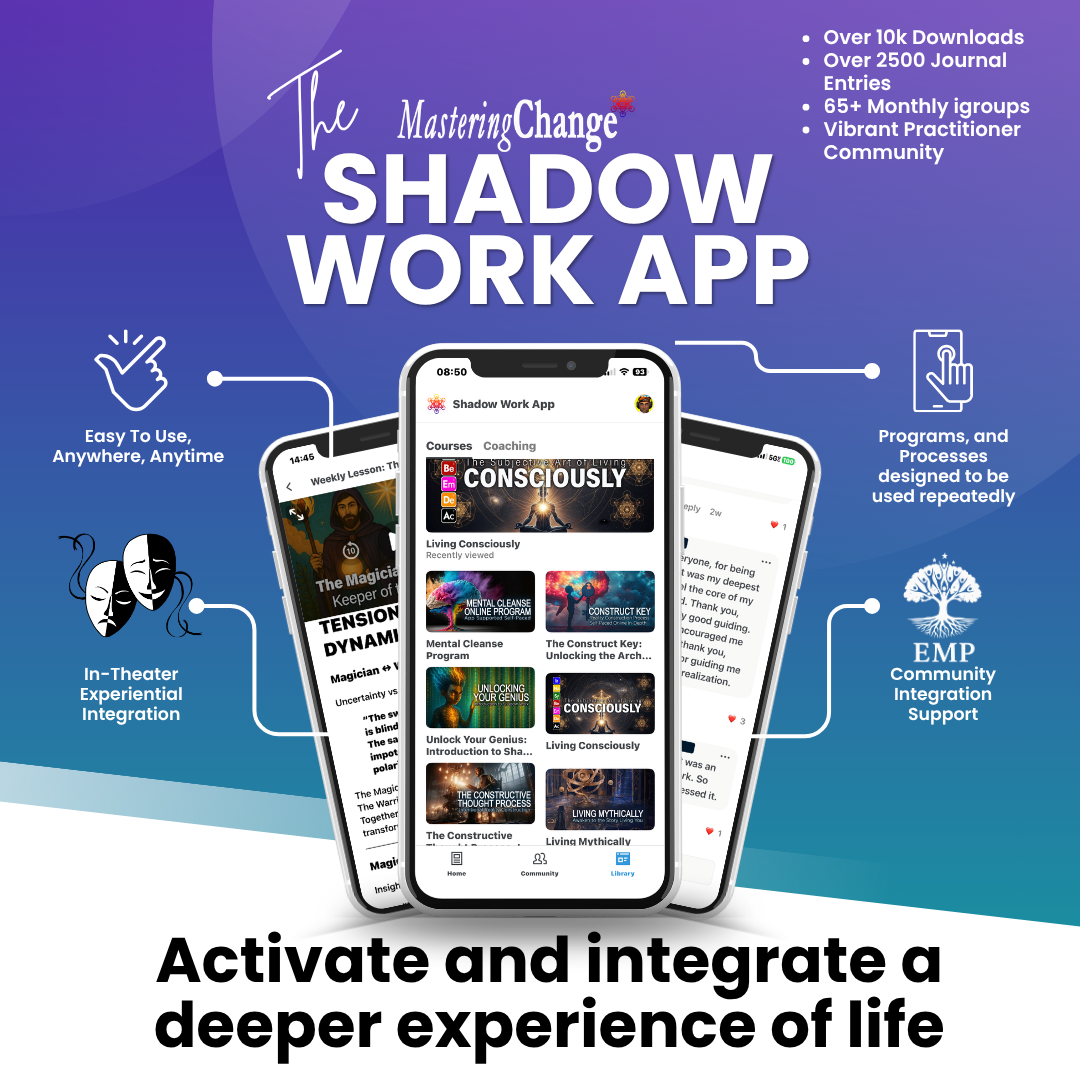
The EMP ecosystem currently supports 65+ integration groups a month with a wide variety of offerings: shadow integration, closed depth-work circles for advanced practitioners, Mental Cleanse integration, daily morning meditation and intention-setting through the 4:30 Club, Belonging Circle, caregiver support, circles for caregivers and parents of autistic children, and Creative Genius gatherings built around actual making, not merely talking. Integration can take on many forms, flavors, and styles.
It is a distributed community architecture.

We offer an innovative approach to integration. We leveraging small groups while working through one of the many online programs available through the website and the app. These Transformation Integration Protocols (or TIPs as we call them) turbocharge the programs by leveraging community and guided in-theater integration sessions. Transformation comes in many forms and from many angles. Having a guide who has experience walking a certain path has proven invaluable.
Seen up close, what is striking is how little this has to do with pathology.
-
One room is for integrating shadow work. The Turning Within Practice starts with a firm foundation in shadow work and shadow integration.
-
Another is for artists and makers who need a community in which intentional creativity is practiced, not just admired. Our Creative Genius circle is where artists celebrate milestones, collaborate, and spend the first half-hour crafting, all designed to exercise the genius in each of us.
-
The 4:30 Club is about meditation, presence, and intention. Starting your morning with intention gives you a powerful touchstone to guide you throughout your day.
-
We have an experiment regarding the feeling of belonging: the Belonging Circle is a space to be seen, heard, and part of a shared humanity.
-
Another is for supporting healthcare workers who spend their days holding everyone else together. Frontline Caregivers Support is designed as a confidential space for those carrying the weight of service.
The caregiver piece matters especially now. In 2025, AARP and the National Alliance for Caregiving reported that 63 million Americans are family caregivers, nearly 1 in 4 adults. CDC data show caregivers fare worse than noncaregivers on many health indicators; lifetime depression, for example, was 25.6% among caregivers versus 18.6% among noncaregivers in 2021–2022. That makes a caregiver integration group more than a nice add-on. It is a mental-hygiene intervention for the people a society quietly relies on to absorb its overflow. If we do not support the internal lives of caregivers, we eventually degrade care itself.
Our igroups are not organized around damage or problems, but around the spiritual breakthrough that shared experience can support. Our Creative Genius Circle is supported by research on arts engagement and arts-based groups suggesting that creative participation can support social connectedness, and that stronger identification with an arts-based group is associated with better mental well-being and stronger mental hygiene. That does not mean every knitting circle is medicine.
It means creation inside community does something that isolated consumption may not. It gives a person an identity larger than their stress, a rhythm larger than their rumination, and a place where expression is not a side effect of healing but part of being alive. Sharing our experiences deepens the return and widens our collective understanding.
This is the deeper cultural argument for igroups: they are not merely for the wounded, the addicted, or the desperate.
They are for the anticipatory mind.
For the over-responsible mind.
For the business mind.
For both the masculine and the feminine.
For the caregiving mind.
For the creative mind.
For the modern mind.
 A mind that keeps constructing reality at high speed and needs somewhere to lay that construction down in the presence of people who understand what is happening beneath the surface.
Research on online support groups suggests that smaller, more specific groups can foster a stronger sense of community, while occupation-specific groups provide the kind of support that generic spaces cannot. That feels like a clue, not a footnote. The future of support may be less about finding one giant audience and more about finding the room where your kind of humanity is legible. (masteringchange.com)
So perhaps the most important shift is this: stop thinking of integration groups as what comes after something dramatic happens. Start thinking of them as the social infrastructure of a mature life. A place to build relationships that are deeper than the surface story. A place where stages of development, patterns of projection, crises of meaning, and ordinary mornings can all be witnessed by people who are not meeting you for the first time.
A place where your humanity is not reduced to a symptom and your evolution is not outsourced to solitary insight.
The culture is full of people trying to become more conscious in private. That may be the very thing that stops them. Consciousness, like character, seems to ripen in relationship. Not in performative networking. Not in endless content. In community. In continuity. In the slow miracle of being known well enough that your story no longer gets to pretend it is the whole sky.