Dak Prescott’s Super Bowl XXX Shirt and the Cowboys Shadow
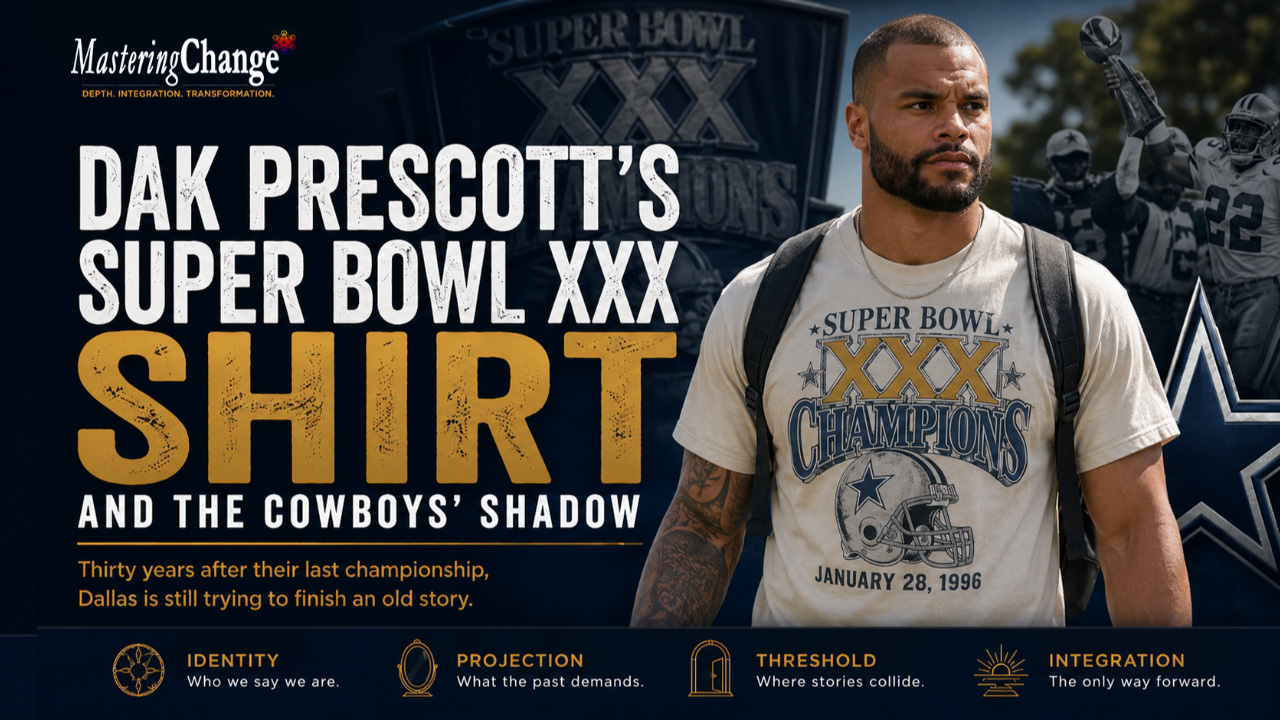
Thirty years after their last Super Bowl, the Cowboys are no longer merely haunted by their history. They're consciously carrying it into the room.
Last year, I wrote that the Dallas Cowboys were not cursed. Their own story haunted them and it was showing itself through their repeated failure to cross the threshold. This year, Dak Prescott arrived at training camp wearing the very ghost their story is battling.
Not just the losses. But as a Cowboys fan, I’ve been interested in the rhythm underneath them. The strange way a team with this much talent, money, attention, history, and organizational power can keep arriving at the doorway of completion and somehow fail to walk through it.
I don’t think Cowboys are cursed. Their own story haunts them.
Read last year's post
This week, Dak Prescott arrived at training camp wearing the very ghost of that story across his chest. A Dallas Cowboys Super Bowl XXX championship shirt.
The last Super Bowl the Cowboys won.
The last time they reached an NFC Championship Game.
The last time, the identity of “America’s Team” and the team's lived experience were telling the same story. That was thirty years ago.
I want to be clear about something before we go any deeper.
A shirt is not proof of anyone’s unconscious intention. I am not claiming to know why Dak chose it beyond the message he has already made public.
He's stated that he wants to win a Super Bowl and has called the coming season “Super Bowl or bust.”
He has said winning the championship is what remains for him. “It’s that or nothing.”
But symbols hold more than our conscious intentions.
They reveal a field of meaning already in motion.
Dak did not arrive wearing an image of the future.
He arrived wearing the same outfit the last time the Cowboys’ story reached completion.
And that is worth studying.
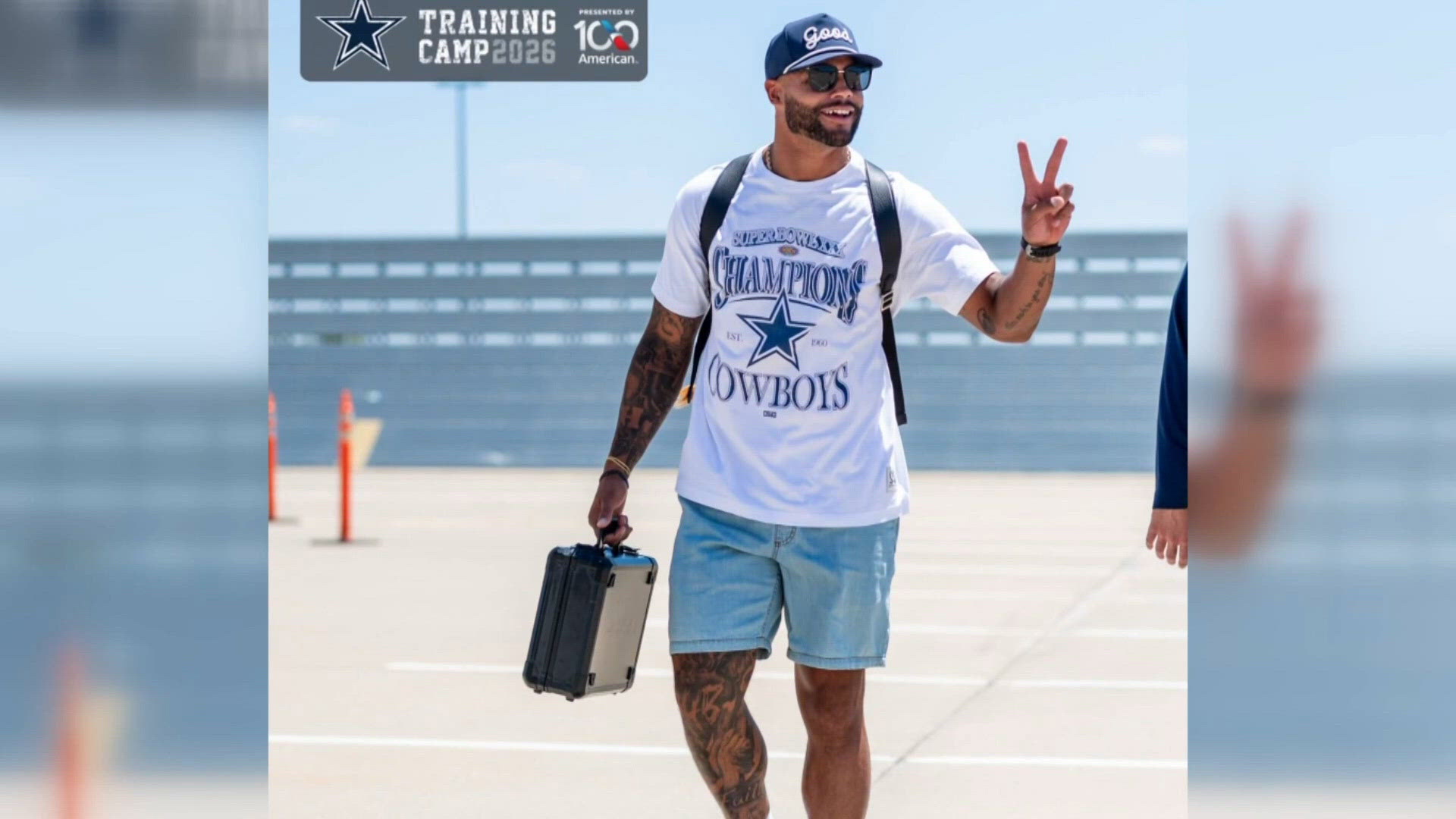
The Shirt: The Last Completed Version of the Cowboys
The Super Bowl XXX shirt is not simply old Cowboys merchandise. It represents the last completed version of the organization’s mythic identity. The shadow of which the players are called to account. Projecting into the particular experience of each member of the team.
Champions.
Dynasty.
America’s Team.
The standard.
A team that was expected to dominate on the game’s biggest stage and had the lived experience to support the expectation. That is not the experience of the current Cowboys.
The current organization has inherited the star. It has inherited a brand with a committed, expansive fanbase, including a domestic fanbase of 10-19.9 million people. The Boys consistently rank as the largest and most-followed team in the NFL. They’ve inherited the five Lombardi trophies, a $13 billion valuation, the television attention, all baked with the expectation that every season should end in a championship.
What it has not inherited is the lived experience of completion.
None of the players on this team participated in Super Bowl XXX.
Dak Prescott was two years old.
Brian Schottenheimer was beginning his coaching career.
The championship is part of their organizational history, but not of their lived experience as a team. Only a few players on the current Dallas Cowboys roster even have experience playing in or winning a Super Bowl, led by wide receiver Marquez Valdes-Scantling (multi-time champion with the Chiefs), wide receiver Tyler Johnson, and linebacker Dee Winters.
That difference matters. Belief is meaning that the system no longer questions. Some beliefs are formed through direct experience. Some are inherited, handed down like a family heirloom.
The modern Cowboys have inherited a championship identity without inheriting the experience that formed it.
That creates a split.
Who we say we are.
Who we have actually experienced ourselves to be.
The shirt makes that split visible.
The Numbers: A Team Caught Between Two Stories
The current reporting around the Cowboys reflects the same contradiction.
There are legitimate reasons for optimism.
Dallas finished the 2025 season at 7-9-1, but its offense ranked seventh in scoring and second in total yards. Dak played well. The offense was capable of producing at a playoff level.
The defense was the opposite.
It finished last in points allowed and near the bottom of the league in total defense. The Cowboys responded by replacing the defensive coordinator, changing the scheme, adding veteran players, and rebuilding much of the defensive roster around Christian Parker.
The betting markets are not dismissing Dallas.
As of early July, the Cowboys were at +2500 to win the Super Bowl, with a regular-season win total of 9.5, though bettors still slightly favored them missing the playoffs.
NFL analysts are split.
One analyst projects Dallas to finish 11-6, win the NFC East, and enter the playoffs as the second seed, while another projects 9-8 and no playoffs. Sporting News projects an 8-9 finish, pointing to the rebuilt defense and a difficult schedule as reasons for caution.
That split is important. Once again, the football world is not arguing about whether the Cowboys have talent. It is arguing about whether they can come together and become their own team rather than a reflection of 30 years. Whether a powerful offense and a reconstructed defense can become an integrated system. Whether all of this can be put together when it matters.
The Cowboys are standing in the space between two possible stories: The team that is destroyed by the weight of a moment carrying 30 years of destroyed hopes, or the team that finds its mattering in the space between snaps. A team that rises from the ashes of who they were, to find who they really are. There is no more poignant story.
“Super Bowl or Bust” Is More Than a Goal
“Super Bowl or bust” sounds like ambition.
It sounds like a competitor's mindset.
And at one level, it is.
Every serious NFL player wants to win a championship. Dak Prescott should want that. His teammates should want that. Cowboys fans should want that.
But language organizes meaning.
When the only available outcomes are Super Bowl or bust, an entire season becomes organized around a single threshold.
There is no becoming.
No emergence.
No room for a new team to discover what it is.
There is only completion or failure.
Champions or disappointment.
The inherited myth or another year of exile from it.
The problem is not the size of the goal.
The problem is the amount of meaning being placed onto it.
Every playoff game is no longer simply a playoff game.
It becomes a referendum on thirty years.
Every mistake begins carrying the weight of the mistakes that came before it.
Every red-zone possession becomes connected to every previous red-zone failure.
Every moment at the threshold becomes crowded by history.
This is how [mental projection] operates.
Meaning made in the past does not remain in the past.
It gets placed into the present.
The current moment becomes the projector screen through which the system encounters what it has not yet integrated.
This is why the Cowboys do not simply need to win football games.
They are being asked to carry decades of unresolved meaning while trying to win them.

The Past on Dak’s Chest. The Future on Jerry’s Table.
There is another part of this moment that may be even more revealing than the shirt.
Dak Prescott arrived wearing a ghost of the past.
At the opening of training camp, Jerry Jones said he would be willing to give up future draft capital to add a player who could help the Cowboys win now.
He said he feels enough confidence in this team to spend some of its future on the present.
On the surface, that is football.
Teams trade draft picks.
Owners see windows closing.
Dak is entering his eleventh season. Jerry Jones is eighty-three years old. The organization has assembled an offense it believes can contend, and has spent the offseason rebuilding the defense around it.
There is nothing inherently wrong with using future resources to pursue a championship now.
But at the level of meaning, the symmetry is difficult to ignore.
The past is being carried on the quarterback’s chest.
The future is being placed on the owner’s table.
The present is being asked to resolve both.
An organization can become so organized around completing its old story that it begins consuming its future to repair the identity of its past.
That does not mean Jerry should refuse to make a trade.
It means the question underneath the transaction matters.
Are we building what this team is capable of becoming?
Or are we trying to make this team repair what the organization has failed to complete for thirty years?
Those are not the same orientation.
One creates from what is here.
The other tries to use the present to settle an old account.
The Symbol Is Not the Source
The Cowboys should honor the teams of the 1990s.
They should remember Troy Aikman, Michael Irvin, Emmitt Smith, Charles Haley, Darren Woodson, Larry Allen, Jimmy Johnson, Barry Switzer, and the players and coaches who lived that era.
Those championships are part of the organization. But the 1995 Cowboys cannot carry the 2026 Cowboys across the threshold. The current team must find a way to cultivate an identity that pushes them through the meaning getting projected on the threshold.
That begins by allowing the truth of the present to exist alongside the myth of the past.
Five Super Bowl championships are true.
Thirty years without returning to the NFC Championship Game is also true.
A powerful offense is true.
A defense that finished last in points allowed is also true.
A roster capable of competing is true.
A roster that has not yet competed together is also true.
Integration does not require the organization to destroy the myth.
It requires the organization to stop exiling the truth that contradicts it.
Until both can be held simultaneously, the identity remains split.
And whatever remains split in identity will eventually become visible in action.
The Construct Enters the Game Before the Team Does
In The Construct, identity is the primary orientation point of reference.
It shapes what we recognize, what we receive, what feels threatening, and what becomes possible.
The Cowboys do not enter the season as a blank slate.
They enter through an inherited construct:
Identity: “We are America’s Team. We are champions.”
Plot: “This is finally the year.” Pointing back to the wins only adds the weight of the loss.
Story: “We have waited thirty years to return.”
Belief: “The season is successful only if we win the Super Bowl.”
Emotion: Hope, pressure, urgency, hunger, and the fear of another collapse.
Decision: Spend the future. Push harder. Raise the expectation. Make this season mean everything.
Action: “Super Bowl or bust.”
Learn about Constructive Thought Theory
None of those individual elements is necessarily wrong. Worse, they become hooks for the collective reflection of the individual constructs of deep-conscious meaning to project… The system calcifies at the symbolic level.
The question is: how do they support each other when their particular shadows are projected on the collective meaning they are carrying into the year?
Because action is meaning made material.
The slogan is not separate from the structure. “Super Bowl or Bust!!!” Carries a lot of weight.
The shirt is not separate from the story. It is a confirmation of a deep-conscious commitment to an identity that must wrestle with this past… So above, so below. What happens at the collective must be felt in the particular… and vice versa.
The roster decisions are not separate from the collective identity. They are the embodiment of it. Each player, at some level, has been brought to this moment to play out their story while contributing to the collective. There are no accidents.
The playoff freeze is not separate from what the system believes the moment means. It is the very call to adventure that has brought this very team together.
The Riverbed Must Be Tested
The Cowboys have made real changes. That matters. Depth work does not deny the surface of experience.
Personnel matters. Coaching matters. Scheme matters. Health matters. Talent matters.
Dallas has a new defensive coordinator: a new defensive structure and a large number of new defensive contributors.
An offense that already demonstrated it can move the ball and score.
The roster may be better.
The defense may become dramatically better.
The Cowboys may win eleven games.
But improvement in the waves does not automatically mean the riverbed has changed.
The riverbed will reveal itself when the season becomes charged. The statistics show that the thresholds always reveal the story playing at depth.
When the defense gives up an early touchdown in a playoff game.
When Dak throws an interception.
When the offensive line commits a penalty at the goal line.
When the crowd tightens.
When the broadcast reminds everyone that Dallas has not reached the NFC Championship Game since the 1995 season.
When the players are no longer responding only to the play in front of them.
The mind then wrestles with everything the play has come to mean. That is the threshold. The threshold is the moment when the old story becomes available again, and the system must decide whether to repeat it. This decision then manifests in the individual subjective experience of each team member.
What Integration Would Look Like
Integration doesn’t mean forgetting the drought, throwing away the past, or lowering standards. The goal isn’t to let go of the ghost of the past, to lower expectations, or to pretend that somehow the Boys are just an ordinary franchise. Integration means learning how to carry the story of who they may have been in a supportive but not defining way.
The Boys must honor Super Bowl XXX without asking it to tell them who they are now. When they are presented with the specter of the past- missed deals, fumbled third-down conversions- they can stop… allow the weight of the past to be felt without closing the door on the present.
This is a collective challenge that can only be met individually and subjectively.
I will be watching what happens when the meaning gets heavy.
- Does the system contract?
How does the team breathe through the contraction? - Does leadership tighten around control?
Or do they learn to hold on with necessary loose hands? - Do the players become careful?
Or do they meet impending doom ready to die on the line? - Does the play calling become organized around avoiding failure?
Or do they continue to keep their eyes on the horizon, the Lombardi, and the tempering that comes from breaking through at this level? - Does the team begin performing the history it is trying to escape?
Or do they write the next chapter in the team's story?
Can the current Cowboys remain present long enough to author something that has not happened before? We shall see
What This Reveals About All Organizations
This is not only a Cowboys story. Organizations do this everywhere.
A company has an extraordinary period of growth.
A founder creates an early breakthrough.
A movement experiences a moment when the mission, identity, people, and results align.
That moment becomes part of the story.
Then the organization changes.
The market changes.
The people change.
The conditions that produced the original success no longer exist.
But the old success remains the primary identity.
“We are the company that did this.”
“We are the team that created that.”
“We are the people who have always been known for this.”
Eventually, the organization stops creating from the present.
It begins trying to recreate the last time it felt complete.
It wears the old championship into every new season.
It uses the future to protect the meaning of the past.
It confuses the symbol of what it once created with the source from which creation must now emerge.
This is why some organizations can have tremendous resources and remain unable to move.
They are not lacking ambition.
They are organized around an identity that cannot evolve without confronting the distance between who they say they are and how they are actually functioning.
Until that truth is integrated, the organization continues trying to solve the future through repetition.
New people.
New plans.
New language.
The same riverbed.
Why This Moment Matters
Dak Prescott’s shirt may have been nothing more than a quarterback communicating the goal.
It may have been motivation.
It may have been respect for the last Cowboys team to finish the journey.
But symbols become powerful because of the field of meaning they enter.
Last year, I wrote that the Cowboys were haunted by their own story.
This year, the quarterback arrived carrying the last completed version of that story on his body.
At the same time, the owner announced that he may be willing to spend the future to win now.
And the football world sits divided between those who see an NFC East champion and those who see another team that will miss the playoffs.
The entire construct is visible.
The myth.
The contradiction.
The pressure.
The projection.
The threshold.
The Cowboys do not need to forget 1996.
They need to stop asking 1996 to tell them who they are.
Those Cowboys completed their story.
This team has to author its own.
The memory of the fifth cannot win the sixth trophy.
It cannot be won by “America’s Team.”
It cannot be won by the organization’s valuation, its history, or its expectation.
It has to be won by the people who are here.
In the moment that is here.
From an identity they have actually lived into together.
The real question is not whether the Cowboys can become champions again.
It is whether they can stop trying to become who they were long enough to discover who they are capable of becoming now.
That is the threshold.
And the whole world will be watching.

Dallas Cowboys 2026 Super Bowl chances, Cowboys training camp 2026, Cowboys playoff drought, Dak Prescott Super Bowl or bust, Dallas Cowboys collective shadow