The Shadow Tax: What Your Business Pays for What It Refuses to See
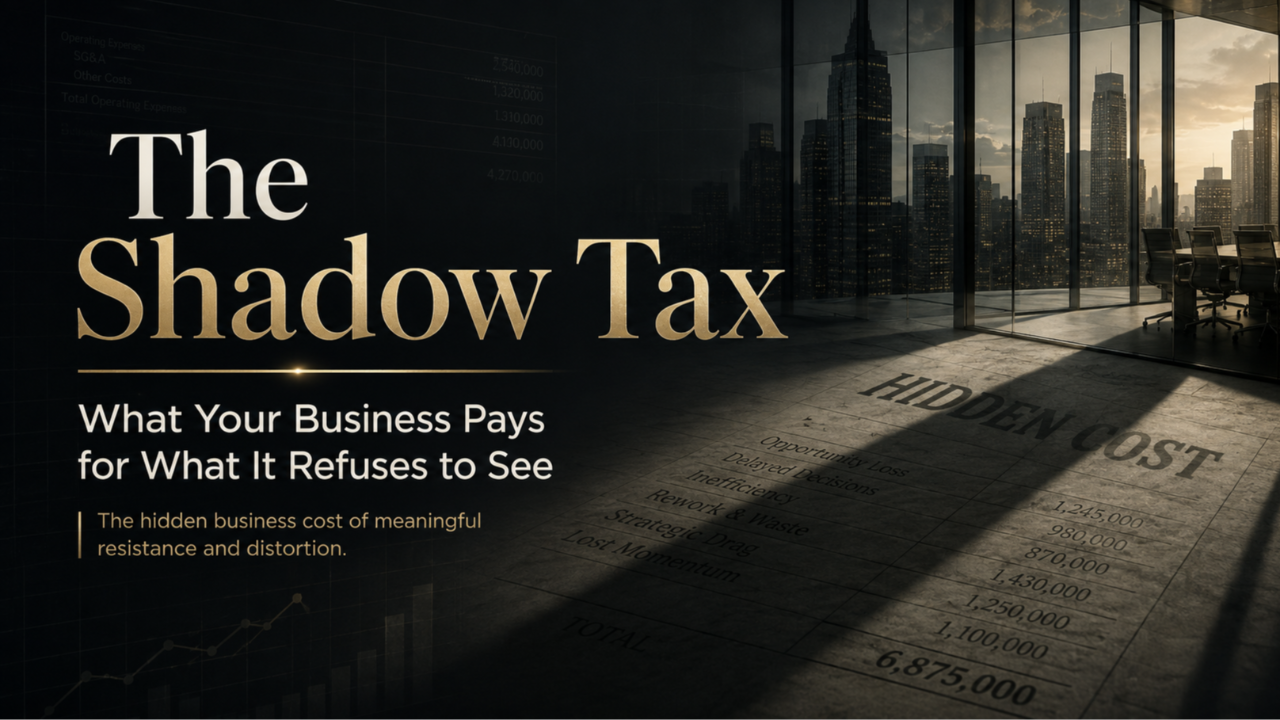
How meaningful resistance and distortion become lawsuits, lost trust, missed opportunities, leadership drag, and sometimes billions in avoidable cost.
This is for the leader who knows they’re here to do more than just manage what already is.
The shadow, as Carl Jung described it, isn’t just a personal concept. It’s everywhere in business. It lives in the unspoken assumptions, unconscious fears, unresolved tensions, and blind spots that influence strategy without ever being named.
First, let’s start with a more digestible understanding of shadow. Shadow is meaningful resistance or distortion. It is the smattering of mattering a person is unconsciously orienting from, shaping motives, self-defeating and unconscious behaviors, and distorted awareness around vital relationships.
A business is ultimately an organization of people, each bringing their own goals, values, beliefs, fears, rules, and psychology into the enterprise. The business becomes, in effect, an expression of how those individual psychologies are organized and led. When left unexamined, that resistance or distortion shows up in groupthink, ethical breakdowns, missed opportunities, leadership problems, bad strategy, cultural issues, and decisions that can look completely rational from inside the organization right up until reality presents the bill.
And reality eventually presents the bill.
I’ve started to define that bill as the Shadow Tax.
Most companies talk about innovation. Very few realize how much of what blocks innovation, growth, trust, and good decision-making lives inside the unseen architecture of the organization. Shadow will snuff out or misdirect the creative genius necessary to drive true innovation.
I spent over a decade working with business owners around the world. One of the things that became clear to me quickly was that a surprising amount of what gets called an execution problem isn’t really an execution problem at all.
It is a perception problem.
Paul B. Carroll and Chunka Mui found something similar while researching Billion-Dollar Lessons. They studied 750 of the most significant U.S. business failures over 25 years and found that nearly half could have been avoided. In most of those cases, the avoidable failures came from flawed strategies, not inept execution. Hundreds of billions of dollars were lost while, as the authors point out, much of the evidence needed to question those strategies was already available.
Think about that. These organizations weren’t necessarily incapable of execution. They were often implementing effectively from a distorted understanding of what was happening around them.
They were, in essence, headed East looking for a sunset.
It doesn’t matter how effective your implementation is if you’re moving in the wrong direction. Shadow-informed depth work addresses this by exercising our ability to see beyond what we are already programmed to see. Not because everything we don’t know is shadow. A blind spot is something you cannot see. Shadow is often the meaningful resistance or distortion interfering with your ability to see it.
That distinction has enormous implications for business because businesses don’t only compete on talent, capital, technology, execution, and information. They compete on their ability to accurately perceive reality.
Introducing the Shadow Tax
The Shadow Tax is the measurable cost a business incurs when meaningful resistance or distortion interferes with its ability to accurately see, interpret, or respond to reality.
Some of the tax is obvious.
A lawsuit. A failed acquisition. A regulatory fine. Turnover. A product recall. A leader who won’t exit. A customer you should have fired three years ago. The executive everyone knew was a problem until the impact became expensive enough to demand leadership do something about it.
AND, of course, some of the tax caused by shadow is elusive.
Lost trust at any level can have catastrophic impacts in a business. Management focused on KPIs that have zero business impact. Rebuilding a reputation. The opportunity you didn’t chase because it threatened your existing revenue model. Loss of talent due to cultural issues. Attitude reflects leadership. These are just a few places a Shadow Tax can be levied.
This is where studying shadow in business becomes particularly interesting. The impact of Shadow Tax can be extreme, but equally, what is creating that tax may represent one of a company’s greatest opportunities for growth.
We may never be able to calculate the Shadow Tax down to the penny. We don’t have to. We can get close enough to understand its impact.
And once you begin looking for it, you start seeing it everywhere.
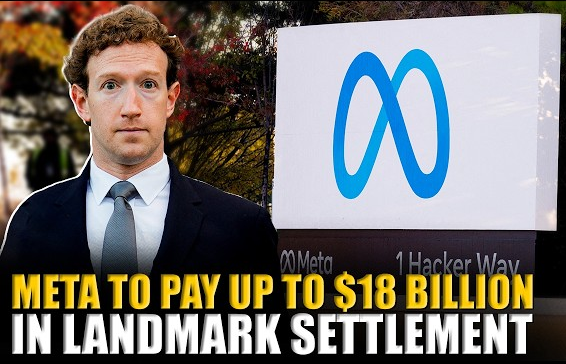
Meta just paid an $18 billion Shadow Tax. And that may only be the beginning.
In August, Meta agreed to pay up to $18 billion over the next decade to settle lawsuits brought by nearly every U.S. state over claims involving children’s use of Facebook and Instagram. Meta denied wrongdoing, but the settlement includes approximately $12.7 billion in guaranteed payments, with another $5 billion potentially due depending on what other social media companies do.
That is an extraordinary number. But from the perspective of Shadow Tax, the money is only the easiest part to calculate.
Meta also agreed to restrict how teenagers use Facebook and Instagram. That includes two-hour daily limits, overnight restrictions, limits on notifications during school hours, and additional protections around younger users. An independent auditor will also oversee elements of Meta’s compliance.
Now try calculating the rest.
What is the future cost of government oversight? What is the cost of redesigning and operating those systems? What does limiting engagement do to the lifetime economics of younger users? What does years of public attention around children’s safety do to trust in the brand? What does it cost when legislators, regulators, parents, investors, and the public begin viewing your business through a different lens?
We don’t know yet. That is part of the Shadow Tax too.
And here is where the story gets really interesting. The concerns weren’t new.
Shareholder activists had been raising child-safety issues at Meta for years. Michael Passoff, founder of the shareholder group Proxy Impact, told Reuters:
“Shareholder resolutions have a history of being an early-warning system, and Meta’s the perfect example of that.”
There it is. An early-warning system.
This is why shadow matters in business. The information can exist. The warning can exist. The data can exist. And the organization can still resist what that information means.
Reuters found that shareholder resolutions regarding child safety had repeatedly come before Meta, including proposals asking the company to report quantitative measures of harm reduction. Some eventually received majority support from independent shareholders, but Mark Zuckerberg’s controlling voting position meant he retained enormous power over the outcome.
Now, I’m not going to pretend I know Mark Zuckerberg’s shadow. I don’t. That isn’t how this work is done.
Shadow must be shown.
But we can look at the behavior of a system and ask a very useful question: What information was available that the organization was unable or unwilling to fully receive?
Because sometimes a business doesn’t have an information problem. Especially in today’s world. We are drowning in information and starving for wisdom. Facebook doesn’t have an information problem. It has a relationship-to-information problem.
And the Shadow Tax begins accumulating long before anyone writes the check.
Good Good Golf: When the culture can’t see what everyone else can

Another Shadow Tax became visible almost overnight. Good Good Golf had become one of the dominant brands in YouTube golf. More than two million subscribers. Major partnerships. Merchandise in national retailers. Television opportunities. A title sponsorship for a PGA Tour event. Things were looking great for Good Good.
It only takes a spark.
Then came one advertisement.
In August, Good Good and Callaway released a commercial promoting a golf driver. In the video, Good Good co-founder Garrett Clark shoves female colleague Alexis Miestowski to the ground when she reaches for the club. The criticism was immediate. The video came down. Apologies followed. But it was no bueno.
And then the tax collector arrived.
Callaway ended its partnership with Good Good. Good Good withdrew as title sponsor of the PGA Tour event in Austin. Dick’s Sporting Goods removed Good Good products from its stores. Golf Channel scrapped its Big Break x Good Good series. Callaway announced $1 million in donations to organizations working to prevent violence against women and said it had taken internal corrective action after acknowledging that it had approved the advertisement. Within roughly two weeks, Good Good’s CEO and president were also gone.
Try calculating that Shadow Tax:
The value of the Callaway relationship.
The PGA Tour sponsorship.
Retail distribution.
Television exposure.
Executive disruption.
Internal investigation.
Reputation.
Employee trust.
Customer trust.
What did I miss?...
Then there are future partnerships that may never happen and therefore never show up as a loss anywhere. We can’t put an exact number on it, but nobody looking at the situation can reasonably argue the number is zero.
Again, I’m not interested in diagnosing the people involved. The more useful question is: How did an idea travel through the process of conception, production, approval, and publication when people outside the culture identified the problem almost immediately?
Something was normalized inside the system that wasn’t being perceived accurately. Maybe it was the desire to be provocative. Maybe it was familiarity. Maybe it was the assumptions of the people making the content. Maybe it was a breakdown in approval.
We don’t know.
But that is exactly where shadow-informed investigation begins. Something about the way the organization was seeing created a distortion between internal perception and external reality.
Then reality corrected the distortion. And presented the bill.

Sometimes everybody already knows
The third example is much harder to discuss because the primary cost wasn’t financial.
It was human.
On August 28, the U.S. Chemical Safety Board released new findings concerning the catastrophic failure of a 1.2-million-gallon storage tank at the Nippon Dynawave Packaging mill in Longview, Washington. Eleven employees were killed and three others were seriously injured when the tank failed in May.
The new information released by investigators is what makes the case relevant here. According to the CSB, an inspection contractor examined the tank approximately ten months before the accident and found significant portions had thinned below the calculated minimum safe thickness. The report said the tank was “not fit for continued service” unless it was repaired and warned of a high likelihood and consequence of failure. Additional inspections were conducted in October and again in February.
The tank remained in service.
The recommended internal inspection and repairs were not completed before it catastrophically failed. The CSB investigation remains ongoing, so we do not yet know the complete story or why those decisions were made.
There are some costs we should be very careful not to reduce to a business metric. Eleven lives sit first in this story.
But there is a business teaching here that is almost impossible to ignore:
What do we already know that we have organized ourselves not to deal with?
Every business has something:
The leader everyone works around.
The customer everyone knows is costing more than they are worth.
The partnership that quit working years ago.
The product the market has already rejected.
The revenue stream everyone knows is dying.
The cultural problem that keeps showing up in exit interviews but somehow never makes it into the strategic planning meeting.
The information isn’t hidden. That is what makes this kind of shadow so interesting.
Everybody knows.
The distortion exists in our relationship to what we know. Maybe acting on it would require admitting we were wrong. Maybe the person involved produces too much revenue. Maybe the founder is too attached to the product. Maybe nobody wants to tell the CEO. Maybe too much has already been invested to turn around now.
Whatever the reason, the organization finds a way to live around the problem rather than engaging it. And the Shadow Tax continues to accrue.
With Nippon Dynawave, we do not yet know the complete sequence of decisions that led to the tank remaining in operation, and it would be irresponsible to pretend we do. But the question the case presents to every leader is difficult to avoid: What happens inside an organization between the moment reality delivers a warning and the moment the organization finally responds?
Sometimes the distance between those two moments is where the Shadow Tax lives.
So how does shadow actually show up in a business?
One of the primary ways shadow presents itself in an organization is through projection.
Projection is the delivery system for resisted, distorted, or unintegrated meaning.
We experience an event or stimulus. The translation of that experience often shows up before our awareness does, and then we begin responding to the meaning as though it is simply reality.
The employees don’t care anymore. The market is stupid. Nobody wants to work. Marketing can’t generate leads. Sales can’t close. Operations can’t deliver. Customers don’t understand the value. The competition ruined the industry.
Sometimes those statements are true. It’s the meaning leaders place on what is happening that often goes undetected. The deeper hidden belief driving the meaning the situation is being dressed up in.
Shadow work does not require us to pretend the outside world isn’t real. The market does change. Employees do underperform. Customers can be unreasonable. Leaders make mistakes. Competitors can absolutely create problems for you.
The investigation is into the meaning we add. The smattering of mattering that a mind develops to provide deeper context. The struggle doesn’t sit in the content. It shows up in the context.
That investigation might sound like:
What is the actual data?
What am I feeling in response to it?
What judgment have I made?
What am I making this mean?
Where might my own meaningful resistance or distortion be influencing what I believe I am seeing?
It matters because projection can quietly shape an entire organization.
A leader who believes people cannot be trusted builds more controls. Those controls communicate distrust. Good employees lose autonomy. Initiative drops. The leader sees the drop in initiative as proof that people cannot be trusted.
A business owner who orients from the fixer identity must have a problem to fix, so they swim in problem-rooted programming all day long. A business owner stuck in this loop will never be able to exit. Shadow won’t let them.
A company convinced its customers “just don’t get it” can spend millions trying to educate the market instead of asking whether the product actually solves a meaningful problem. A leadership team convinced the issue is execution can keep replacing people while never questioning the strategy they are asking people to execute. A founder whose identity is attached to being the visionary can unknowingly make disagreement dangerous, then wonder why nobody brings them new ideas anymore.
Shadow does not simply sit inside the individual. Once enough authority, money, structure, and people begin organizing around it, shadow can become operational.
And operational shadow gets expensive.
The Shadow Tax doesn’t always look like failure
Most businesses will only recognize Shadow Tax after something visibly goes wrong. The lawsuit arrives. The executive leaves. The acquisition fails. The story hits the news. The customer cancels.
But some of the largest Shadow Taxes may never announce themselves as failure.
They show up as the company that grows at 6 percent when it might have grown at 15. The talented employee who quietly takes their ideas somewhere else. The innovation that dies in committee. The customer feedback nobody acted on. The three hours every week a leadership team spends discussing a problem nobody is willing to name directly.
Nothing explodes. The business simply becomes heavier, slower, less creative, more political, and eventually leadership starts believing that this is simply what running the business feels like.
This is where Shadow Tax gets particularly difficult to calculate because we are measuring the cost of what did not happen. What is the value of the idea nobody brought forward? What is the cost of the person who left? What does it cost when employees stop telling leadership the truth? What does it cost when management spends years measuring KPIs that have almost no meaningful relationship to the health of the business? What is the cost of defending an old revenue model while the market is building the next one?
Those numbers may never appear cleanly on a financial statement, but they are not imaginary.
There is a cost.
AND there is another side to the Shadow Tax
This may be the most interesting part to me.
Wherever we find a meaningful Shadow Tax, we may also be looking directly at one of the greatest opportunities in the business because the tax is trying to tell us something.
It is showing us where energy is being consumed, where information is being resisted, where trust is breaking down, and where reality and our interpretation of reality have moved apart. That is useful data.
If a company discovers that one dysfunctional executive is creating $3 million a year in turnover, lost productivity, missed opportunities, and management attention, the discovery is not simply that the executive is expensive.
You have found leverage.
If an organization realizes it has spent three years defending a product customers continue telling them they do not want, the insight is painful, but it also creates space for innovation. If a founder recognizes that their need to control every significant decision has become the primary constraint on growth, that realization may expose the exact threshold the organization needs to cross to reach its next stage.
The shadow and the gold are often very close to each other. The thing we resist looking at may be precisely where the next opportunity is hiding.
How do you begin calculating a Shadow Tax?
I don’t believe we need to make this more complicated than it needs to be. Start with the obvious costs: legal fees, settlements, turnover, recruiting, failed projects, failed acquisitions, refunds, lost contracts, product recalls, consultants, severance, compliance costs, reputation repair.
Then begin following the impact outward.
How much leadership time has this consumed? What did that time cost, and what other work did not happen because management attention was pointed here? What did turnover cost beyond recruiting? What institutional knowledge walked out with those people, and what happened to the employees who stayed?
What did the breakdown in trust do to sales, referrals, employee engagement, recruiting, partnerships, or customer retention? What restrictions now exist because the business failed to regulate itself earlier? What opportunities were missed?
That gives us a very simple way to begin thinking about the Shadow Tax:
Direct Cost + Operating Cost + Trust Cost + Constraint Cost + Lost Opportunity
This isn’t accounting. It is investigation.
We are not trying to produce a number we can defend to the penny. We are trying to get close enough that leadership can understand the size of the problem. If your estimate tells you an unresolved issue is costing the company somewhere between $2 million and $4 million a year, debating whether the technically perfect number is $2.7 million misses the point.
You have learned enough to know the problem deserves attention.
That is already valuable.
How do we integrate shadow work into business strategy?
You don’t need to turn your executive meetings into therapy sessions. Shadow-informed depth work in business is about increasing the organization’s capacity to accurately see, interpret, and respond to what is happening.
That can include 360-degree feedback that leaders are actually willing to hear. Coaching that investigates reaction instead of simply optimizing performance. Pre-mortems that force the team to consider how the strategy might fail before everyone becomes emotionally invested in proving it right. Structured dissent that gives someone permission to challenge what the room already believes. Journaling and reflective leadership work that creates a little space between what happened and what we immediately make it mean. Effective conflict resolution, better communication, and engagement practices that help the company become more aware of where it may be blind.
It may also mean paying much closer attention to repeated patterns. Where do we keep having the same conversation? Where do we keep losing the same kind of employee? Which customer problem continues showing up? What decisions take far longer than they should? What subject changes the energy in the room? Who can nobody challenge? Where does the organization repeatedly spend money without changing the underlying problem?
Those are not proof of shadow. They are invitations to investigate.
Shadow must be shown.
The practice is not deciding in advance what the shadow is. The practice is developing enough curiosity and internal flexibility to follow the resistance and distortion when it appears.
Be careful not to turn this into another leadership performance
This is where organizations can get very good at appearing to do the work without actually doing any of it. You can run an employee survey and explain away every answer. You can create a feedback process and quietly punish anyone who gives honest feedback. You can spend hundreds of thousands of dollars on culture initiatives, consultants, leadership retreats, new systems, and executive coaching while carefully avoiding the person, belief, strategy, or conversation sitting at the center of the problem.
In fact, this may be one of the more expensive versions of the Shadow Tax. The company recognizes that something is wrong and begins spending money trying to fix it, but the meaningful resistance or distortion inside the system prevents the investigation from reaching the thing actually creating the problem. So now the business is paying for the original shadow AND paying for solutions that can never completely work.
A new CRM will not fix a sales leadership problem. More leads will not fix an offer the market doesn’t want. Another reorganization will not resolve a conflict nobody is willing to name. A leadership retreat will not repair the culture if everyone knows the person creating the problem is protected. You can keep improving execution around the distortion, but eventually you have to deal with what is creating it.
This is why I keep coming back to investigation.
Shadow work isn’t about walking into a business and announcing what the shadow is. That would simply be another projection. Shadow must be shown. We investigate the places where reality and our relationship to reality appear to be separating, where the same patterns keep repeating, where emotional charge begins influencing decisions, and where information consistently has difficulty moving through the organization.
The form isn’t the work. The willingness to investigate is.
Leadership has an outsized role in determining whether that investigation is possible. Attitude reflects leadership. What leadership rewards, avoids, tolerates, protects, attacks, and refuses to discuss eventually teaches the rest of the organization how to orient. A leader doesn’t have to stand in front of the company and announce, “Don’t bring me bad news.” People figure that out remarkably quickly.
Then the information changes on its way up.
Problems get softened. Data gets dressed up. Meetings become performances. People learn to bring leadership what leadership is willing to hear, and pretty soon the people with the most authority can become the people with the least accurate picture of what is actually happening.
The implications of that are enormous. The higher the authority, the more expensive the distortion can become because more of the organization is capable of orienting around it. One person’s shadow can become a team’s operating environment. A team’s shadow can become culture. Culture can become strategy.
Strategy eventually meets reality.
And reality doesn’t care what we meant.
So how do you measure whether the work is working?
Measure the business.
If Shadow Tax is the cost created when meaningful resistance or distortion interferes with the organization’s ability to accurately see, interpret, or respond to reality, then we should be able to look for evidence that the organization is getting better at doing those things.
Are problems reaching leadership sooner, while they are still relatively inexpensive to solve? Are people more willing to challenge assumptions before everybody becomes committed to them? Is unwanted turnover changing? Are recurring conflicts actually resolving, or are the names simply changing while the pattern stays exactly the same?
Look at the speed of truth inside the organization.
How long does it take bad news to travel? What happens to the information as it moves? Does an employee three levels down know something six months before the executive team finally admits it? How much distance exists between what people privately know and what leadership is publicly willing to engage?
I think that distance may become one of the more useful indicators of Shadow Tax.
You can also look at the places where the tax has already been showing itself. If turnover is part of the tax, track turnover. If management attention is being consumed by recurring conflict, calculate the time. If customer trust has been damaged, watch retention, referrals, complaints, acquisition cost, and reputation. If innovation is being suppressed, look at what happens to ideas from generation to implementation. If the company keeps making the same kind of strategic mistake, stop treating each event as isolated and investigate the pattern connecting them.
None of this requires us to pretend we can measure the unconscious with a spreadsheet. That isn’t what we are doing.
We are measuring impact.
Over time, I think a business can begin developing something close to its own Shadow Tax baseline. Where are we repeatedly losing money, energy, trust, talent, attention, or opportunity because of something we have difficulty seeing or dealing with? What does that appear to be costing us now? What changes when we engage it?
This creates another interesting possibility. Instead of only reviewing what made money and what lost money, leadership can begin asking what the business was trying to show them during the quarter. Where did we experience unusual resistance? Where did reality surprise us? What problem repeated? Where did something take dramatically more energy than it should have? What did we know that we did not act on?
Those are business questions.
They are also shadow questions.
The Shadow Tax can become an innovation map
There is another reason I think this concept matters, especially for leaders interested in innovation.
Earlier I said that Shadow Tax may point directly toward some of the greatest opportunities inside a business. I don’t mean that as motivational language. I mean it quite literally.
Innovation requires the ability to perceive something that the existing system does not yet adequately perceive. Sometimes that means seeing an emerging technology. Sometimes it means noticing an unmet customer need. Sometimes it means recognizing that the business model that created yesterday’s success has become the thing preventing tomorrow’s success.
That last one is particularly difficult because success creates its own kind of gravity. Once an organization has invested money, identity, people, status, compensation structures, expertise, and reputation around a particular way of doing business, information that threatens that model is not entering a neutral environment. It is entering a system with something to protect.
Now look back at the Shadow Tax.
The opportunity you didn’t chase because it threatened your existing revenue model. The employee whose idea never got through. The customer feedback you kept explaining away. The technology leadership dismissed because “that’s not how our industry works.” The founder who cannot release enough control for the company to become something larger than themselves.
The tax is trying to tell us something.
It may be showing us the exact place where the organization has reached the limits of its current way of seeing.
This is where shadow and innovation become deeply connected. Shadow-informed depth work is not simply a tool for fixing dysfunction. It can help create enough internal flexibility for a leader or organization to see beyond the identity, beliefs, assumptions, and successful patterns that got them here.
Because what got you here can absolutely become what keeps you here. And eventually what keeps you here can become what takes you out.
The real opportunity
When I worked in business strategy, I learned to look for leverage. Where could a relatively small shift create a disproportionately large result? Sometimes it was pricing. Sometimes marketing. Sometimes conversion. Sometimes the organizational chart.
I think shadow gives us another place to look for leverage.
Imagine discovering that the recurring conflict consuming ten hours of executive time every week isn’t actually five different problems. It is one unresolved pattern expressing itself through five different situations. Imagine learning that your turnover problem isn’t primarily a compensation issue but a leadership issue nobody has been willing to address. Imagine discovering that the market isn’t rejecting your product because customers don’t understand it. They understand it just fine. You are the one resisting what their response means.
Those discoveries can hurt.
They can also change everything.
Because once the distortion becomes visible, all of the resources previously being used to maintain it, defend it, manage around it, or compensate for it become available for something else.
That is why I don’t see shadow work in business simply as remediation. There is reclamation here. We aren’t only trying to reduce the Shadow Tax. We are looking at what becomes available to the organization when it stops paying it.
Better information. Faster decisions. More trust. Greater creative capacity. Talent that stays. Ideas that can actually make it into the room. Leadership attention freed from problems that should have been resolved years ago.
And perhaps most importantly, a more accurate relationship with reality.
Bottom line?
Every business pays taxes. Payroll tax. Property tax. Income tax. Sales tax. Those are easy to recognize because somebody has already created the category, calculated the amount, and told you where to send the check.
The Shadow Tax is different.
It is distributed throughout the business. It gets hidden in turnover, lawsuits, lost trust, management attention, missed opportunities, failed strategies, unnecessary controls, reputation damage, and the thousand small accommodations people make when the organization cannot deal directly with what is happening.
Sometimes the bill becomes spectacular enough that everybody can see it. Meta agrees to pay up to $18 billion. Good Good Golf watches partnerships, distribution, sponsorships, media opportunities, leadership, and reputation get hit in a matter of days. Sometimes, as with Nippon Dynawave, the consequences move far beyond anything that should ever be reduced to a financial calculation.
More often, though, the Shadow Tax is quieter. The business survives. It may even grow. It simply pays more than it should to get where it is going while leaving some amount of its creative genius, trust, talent, and opportunity sitting on the table.
That may be the part I find most compelling.
Because once we can name a cost, we can begin looking for it. Once we can begin looking for it, we can investigate what is creating it. And once meaningful resistance or distortion becomes visible, we have choices that were unavailable while it remained hidden.
The goal isn’t to create a business without shadow. Good luck with that. A business is made of human beings, and wherever human beings gather there will be things we resist, distort, project, protect, and have difficulty seeing.
The opportunity is to become better at recognizing the tax while it is still relatively cheap. To hear the warning before it becomes the lawsuit. To investigate the pattern before the best people leave. To question the strategy before another hundred million dollars gets committed to it. To hear what the customer is actually saying before spending another year explaining why they should want what you built.
And sometimes, to recognize that the thing creating the greatest resistance inside the organization may also be pointing directly toward its greatest opportunity.
That is the Shadow Tax.
The question isn’t whether your business is paying one.
The question is what it is costing you, and more importantly, what might become possible if you stopped paying so much of it.