The Truth Behind the Cowboys Threshold Collapse

I’m a lifetime Dallas Cowboys fan going back to the days of Troy Aikman and Michael Irvin. My uncle used to take me to practice games when I lived in Dallas. I watched Aikman and the boys capture three Super Bowls. I’ve lived through the ups and downs ever since.
Not just the wins and losses.
The rhythms.
The freezes.
The repeated failure to cross the line.
As someone trained in depth work and shadow analysis, I’m not watching “bad luck” or “choking.” I’m watching a collective shadow play itself out in real time: a systemic meaning structure using the Cowboys as its stage.
And with this year’s team on the rise, that shadow is more important than ever to name.
The Numbers: A Dynasty Persona with a Threshold Problem
On paper, the Cowboys are still a giant.
Five Super Bowl wins.
Eight appearances.
One of the best all-time regular-season records.
But since 1996, the truth has been brutal:
Playoff record since then: 5–13.
Only four playoff wins since 2002.
Thirteen straight playoff appearances without even reaching an NFC Championship game.
Zoom in further and you see the same pattern at a smaller scale:
By late in the 2024 season, the Cowboys were scoring touchdowns on only about 47.5% of their red-zone trips, ranking 28th in the NFL in red-zone TD percentage in one league-wide breakdown.
This is not random variation. It’s a stable pattern:
High performance across the season.
High investment in the roster and brand.
Repeated collapse at threshold moments.
As a depth-work practitioner, that’s the signal. Thresholds are where unintegrated meaning shows itself.

“America’s Team” and the Exiled Truth
According to a 2025 Forbes report, the Dallas Cowboys are valued at around $13 billion, making them the most valuable team in the NFL for the 19th consecutive year.
That valuation sits on more than football. It sits on a myth:
“America’s Team. The standard of greatness. Champions by birthright.”
But the lived reality since the mid-90s is:
“We haven’t delivered a championship in decades. Our playoff history is a string of exits.”
That split — what is claimed versus what is lived — is the birthplace of the collective shadow.
The system cannot tolerate that dissonance consciously, so it does what complex systems do: it preserves the myth and exiles the truth. The unprocessed meaning doesn’t disappear. It sinks below the surface and starts projecting itself at the exact moments where the story could change.
In Turning Within, I describe this as latent constructs shaping the flow of experience. The Cowboys are a textbook example:
Persona: “Dynasty. America’s Team.”
Exiled content: “Chronically incomplete. Afraid of what real completion would reveal.”
The result is a recursive loop: the team keeps finding itself “almost,” “so close,” “just one piece away” — and then failing to cross the line.
The Threshold Freeze as Shadow Mechanism
In depth work, thresholds — endings, completions, moments of reckoning — trigger the system’s hidden meaning to surface.
For the Cowboys, it looks like this:
Red-zone drives stalling.
Goal-line fumbles, penalties, or miscues.
Playoff games where a top-5 roster suddenly looks like a middle-of-the-pack team.
Our minds are always in projection of anticipated meaning. At every threshold, the psyche throws meaning onto the doorway:
“What does it mean if we cross this?”
“What does it mean if we fail here, again?”
When stakes rise, the collective nervous system of the team tightens. Survival-rooted programming caught in exile starts projecting onto the moment, calling for recalibration.
What is a team but a group of individuals?
So above, so below.
If individuals freeze at thresholds, organizations will too.
You see it in the Cowboys’ pattern:
They approach the playoffs.
The meaning held in the system gets projected onto the threshold.
The system contracts.
That contraction shows up as self-sabotage: conservative calls, mental errors, discipline breakdowns, red-zone failure, or inexplicable collapses.
It’s not fundamentally about a single bad play call, a missed block, or a tipped interception. It’s about what meaning the system is both projecting and protecting unconsciously.
The Riverbed, Not the Waves
The flow and direction of a river are controlled by the riverbed, not the waves on the surface.
Because awareness naturally sits on the surface of experience, we mistake the waves — the individual mistakes, the penalties, the coaching decisions, the fan meltdowns — as the cause of the flow.
But that is incomplete.
In the case of the Cowboys, the waves are:
blown coverages
dropped passes in crucial moments
red-zone inefficiency
strange clock management
contract drama and PR misfires
Underneath that is the riverbed: the meaning structure.
When a system refuses to examine its riverbed, it gets trapped in confusion and blame at the level of the waves. You can fire coaches, replace coordinators, swap quarterbacks, and still feel the same flow.
The Cowboys have done all of that. The river still runs the same way.

The Micah Parsons Saga: A Shadow-Tinged Business Decision
Look at the Micah Parsons contract saga through this lens.
A top-tier player.
A long, public negotiation.
A claim by Jerry Jones that a deal existed.
Ambiguity about agents and communication.
A leverage play that ends in Parsons being traded just before the season.
It looked and felt like the front office torpedoed its own position.
On the surface, it’s business. Contracts. Cap management. Roster calculus.
At the riverbed level, it looks like this:
Identity must be protected.
Control must be maintained.
Ambiguity must be denied, not felt.
So a core talent is sacrificed to preserve narrative authority.
That’s exactly how shadow works in organizations:
“We would rather lose real capacity than admit we mishandled meaning.”
Ambiguity breeds shadow, especially in systems that can’t tolerate vulnerability at the top. The Parsons trade reads like another red-zone fumble, just in the boardroom instead of the backfield.
“How We Do Anything Is How We Do Everything” (In a Holographic System)
In a holographic, fractal reality, patterns repeat at every level.
“How we do anything is how we do everything” is more than a self-help slogan. It’s a description of how meaning propagates.
The Cowboys’ red-zone freeze is not an isolated football problem. It’s an expression of the same construct that shows up in:
playoff collapses
contract sabotage
brand-first communication
fans oscillating between grandiosity and despair
In 2024, they finished near the bottom of the league in red-zone touchdown conversion; one late-season breakdown had them at 47.5% (28th in the NFL). That is not random variance. It’s meaning expressing itself in yardage.
The Cowboys are unable to change their story because the system lacks a clear, integrated definition of completion. They are unconsciously recreating the challenge they are trying to overcome:
They say: “We want to be champions again.”
The underlying construct says: “We are the team that almost gets there.”
Finishing the race — winning a championship, truly delivering on the myth — would force the system to confront decades of internal contradiction.
Failure preserves the myth.
Success would demand a rewrite.
And changing our minds is the hardest thing we do. New thought is more expensive than old thought. Recalibrating old meaning is the most expensive form of thought.
So at the very threshold of completion, the system pulls back into what is cheaper: the old reality.
Enter Schottenheimer: A Different Kind of Leadership Signal
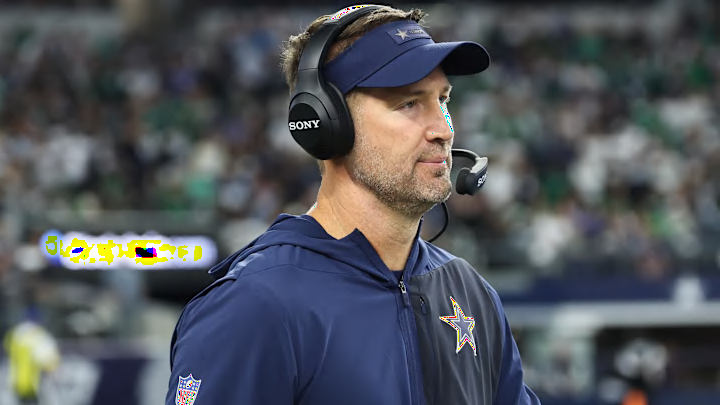
After a long NFL career, Brian Schottenheimer took over as head coach in 2025 after two years as offensive coordinator.
His early tenure has a very specific tone:
less rigid sternness, more human energy
locker-room reconfiguration
ping-pong tables and playful practices
visible celebrations and emotional expression
deep emphasis on connection and “playing with juice”
He is not just tweaking plays. He is attempting to retune the nervous system of the team.
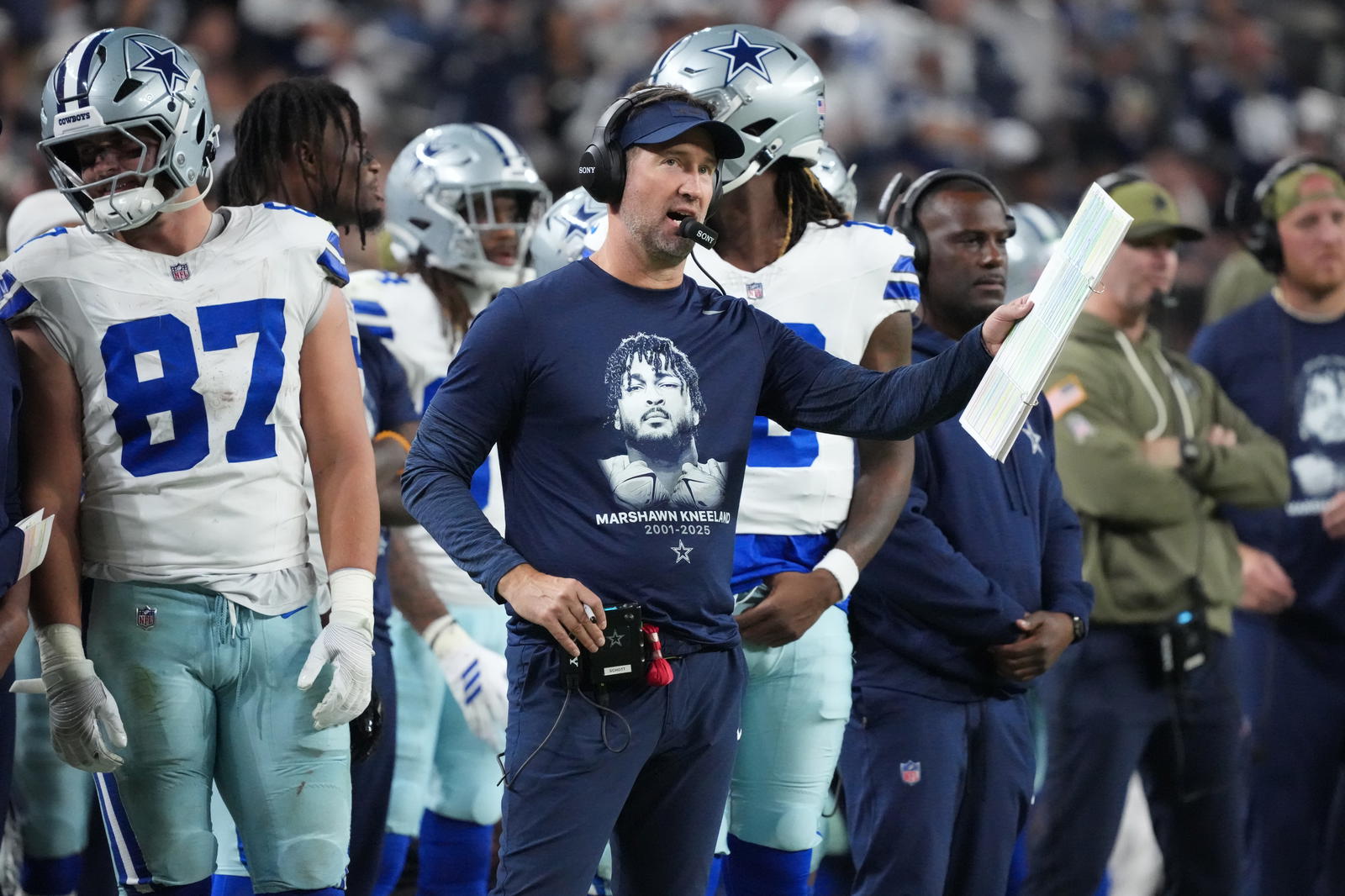
After the tragic death of young defensive lineman Marshawn Kneeland, Schottenheimer said:
“My heart is heavy. Our team’s heart is heavy. We don’t move on, but we do move forward.”
He described the locker room as “bonded more than any of us ever could be.” He acknowledged hurt. He refused to pretend nothing happened.
That is a very different stance from a “tough it out, next man up” persona.
He has also been clear after painful losses:
“That locker room is hurting. I’m hurting. You don’t point fingers. You look at the film. We’ll get them fixed.”
He organizes small-group dinners. Encourages off-field connection where football rarely comes up. He’s building identity around humans, not just helmets.
When productivity becomes God, every person is reduced to a function. When an organization reduces the individual to a function, it kills the very genius it depends on. The higher the stakes, the more a team depends on collective and individual genius.
Schottenheimer, whether consciously or not, is pushing the system back toward genius — back toward soul.
Culture Shift or Upgraded Ghost Loop?
From a depth-work lens, what he’s doing has real potential:
Naming grief and pain invites integration instead of suppression.
Rewriting identity through connection, not brand, opens room for truth.
Grounding players in shared humanity reintroduces what high-performance cultures often exile: vulnerability, belonging, emotional honesty.
But there are risks:
Many of the changes so far are environmental and relational — important, but not yet structural authorization to question the myth.
The old identity of “America’s Team” still looms, with fans, media, and ownership all invested in it.
Vulnerability is currently welcomed around tragedy and off-field events. Vulnerability under peak pressure — in the red zone, in the playoffs, at the brink of success — is a very different threshold.
If the deeper narrative of “we must be great, we must not fail publicly” remains unexamined, the old shadow can simply adapt. New coach, new culture surface, same ghost underneath.
What This Reveals About All Organizations
This isn’t just a Cowboys story. It’s a case study in how any organization can be run by a myth it no longer lives up to.
Every system has:
a mythic identity (“who we say we are”),
an exiled truth (“who we actually are”),
and a set of thresholds where those collide.
The Cowboys show us:
A powerful identity can overshadow actual functioning and block transformation.
Parts of a system will unconsciously collude to preserve meaning, even at the cost of success.
Red-zone failures, blown deals, and collapsed initiatives often express unresolved meaning, not incompetence.
Until a system integrates the truth it has tried to avoid, it will keep freezing at the exact points where evolution is possible.
If I were teaching this as a Turning Within module, the process would look like:
Identify the mythic identity the organization clings to.
Map the exiled truth that contradicts that myth.
Track the threshold freeze moments where performance collapses.
Ask: “What does keeping this myth alive protect us from feeling or admitting?”
Guide the system toward reclaiming meaning — not by shaming the myth, but by re-authoring the story with honesty, vulnerability, and alignment.
Why This Moment Matters
As a fan, I want to believe this is the year. As a depth-work practitioner, I’m watching a deeper drama:
Will this team finally integrate the meaning underneath three decades of “almost”?
Will leadership allow the myth to evolve into something more honest and human?
Will the nervous system Schottenheimer is building hold when they’re on the goal line, season on the line, history in the room?
The Cowboys are not cursed. They’re haunted by their own story.
If they break through and integrate it, they become more than champions. They become a living example of organizational transformation.
If they don’t, they’ll perform the same tragic opera with new actors, new schemes, and the same unresolved riverbed.
Either way, they’re telling us something important about how meaning runs through teams, companies, and cultures.
And that’s worth paying attention to — whether you care about football or not.