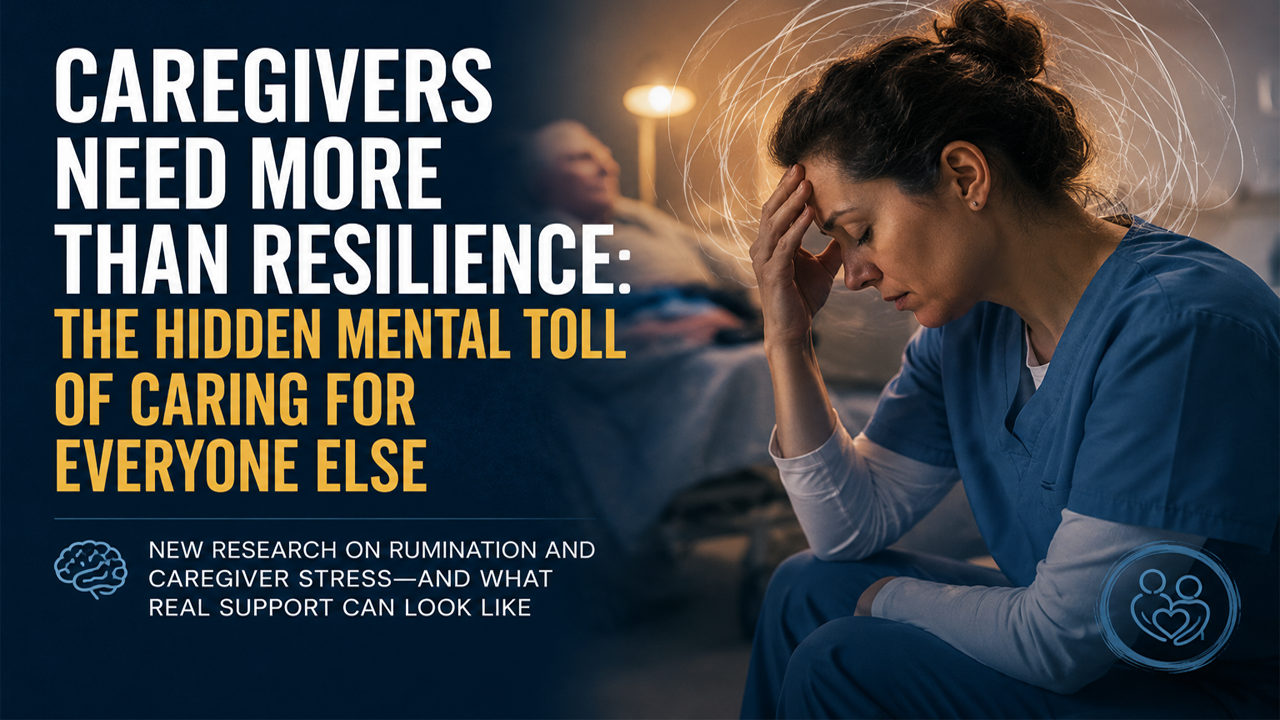
Caregivers Need More Than Resilience: The Hidden Mental Toll of Caring for Everyone Else
For Caregivers, Stress Isn't Only What Happens. It's What Keeps Happening in the Mind.
New research suggests repetitive negative thinking can turn caregiver anxiety into deeper psychological distress. The finding raises an important question: Who is caring for the caregiver?
Caregiving is stressful.
But new research suggests that what happens after the stressful moment, inside the caregiver's own mind, might be an important part of what determines how deeply that stress takes hold.
Researchers studying caregivers of people living with dementia found that rumination, the tendency to repeatedly revisit worries, problems and difficult experiences, helped explain the relationship between anxiety and both depressive symptoms and perceived stress.
In other words, the difficult experience might end.
The mind may not.
A troubling interaction with a patient. A decision that had to be made. Something a family member said. The possibility that something was missed. The patient who deteriorated. The moment that could have been handled differently.
The caregiver leaves the room.
The room does not always leave the caregiver.
That's significant because caregiving presents a particular psychological challenge. A caregiver isn't simply encountering stress. They are often required to remain functional inside of it.
They may have another patient waiting.
Another medication to administer.
Another family member asking questions.
Another person who needs them to remain steady.
The emotional processing frequently comes later, if it comes at all.
Rumination Can Keep the Stressor Alive
The study, published in The Gerontologist, analyzed data from 133 caregivers participating in a randomized trial involving dementia caregiving interventions.
Researchers found that rumination helped connect anxiety with depression and perceived stress. Interestingly, it did not explain caregiver burden itself.
That distinction matters.
A mental practice cannot make an aging parent suddenly require less care. It cannot eliminate a difficult diagnosis. It cannot shorten a 12-hour shift, adequately staff an understaffed unit or erase the responsibility of being the person everyone turns toward when something goes wrong.
There are real burdens.
But there is also the mind's relationship to those burdens.
And those are not necessarily the same thing.
A caregiver can spend 20 minutes dealing with an extraordinarily difficult situation and another six hours mentally revisiting it.
What did I miss?
Should I have noticed sooner?
Why did she say that to me?
What if I made the wrong decision?
How am I supposed to keep doing this?
Sometimes those questions contain information that needs attention.
Sometimes they have become a loop.
The challenge is learning to recognize the difference.
Mindfulness May Help, But Awareness Is Only the Beginning
The researchers also examined mindfulness training.
Their findings suggest mindfulness may influence the way caregivers cognitively elaborate anxiety, although the results were more nuanced than simply showing that mindfulness makes caregiver stress disappear.
Previous research has similarly linked greater mindfulness among caregivers with lower rumination, fewer symptoms of anxiety and depression and better quality of life.
That makes intuitive sense.
You cannot change a mental pattern you cannot hear.
But awareness raises another question:
Once you notice the thought, what do you do with it?
That is where mental hygiene practices may offer another layer.
One approach to this kind of mental hygiene is the Mental Cleanse, a Turning Within practice designed to help people notice and recalibrate the complaints, judgments, attack thoughts and repetitive internal conversations they may be rehearsing without realizing it.
Learn about Mental Cleanse
The practice is not built around forcing positive thinking.
It begins by becoming increasingly accurate about what the mind is actually rehearsing.
That can be particularly relevant for caregivers because many of the most damaging thoughts can masquerade as responsibility.
I should have done more.
I cannot let anybody down.
I have to hold everything together.
There is no room for me to fall apart.
Repeated often enough, these statements can stop sounding like thoughts. They start sounding like reality.
But the mind wants to right itself. By bringing awareness to the ruminating thought, we can recalibrate automated thoughts that have us caught in cycles of suffering.
Caregivers Don't Always Need Another Lesson in Resilience
There is another problem.
Caregivers are frequently praised for their strength.
That praise can sometimes become another burden.
The nurse is strong.
The hospice worker knows how to deal with death.
The physician has seen this before.
The paramedic is trained for emergencies.
The family caregiver knew what they were signing up for.
Except professionalism does not eliminate humanity.
Repeated exposure to grief, responsibility, uncertainty and suffering still has somewhere to go.
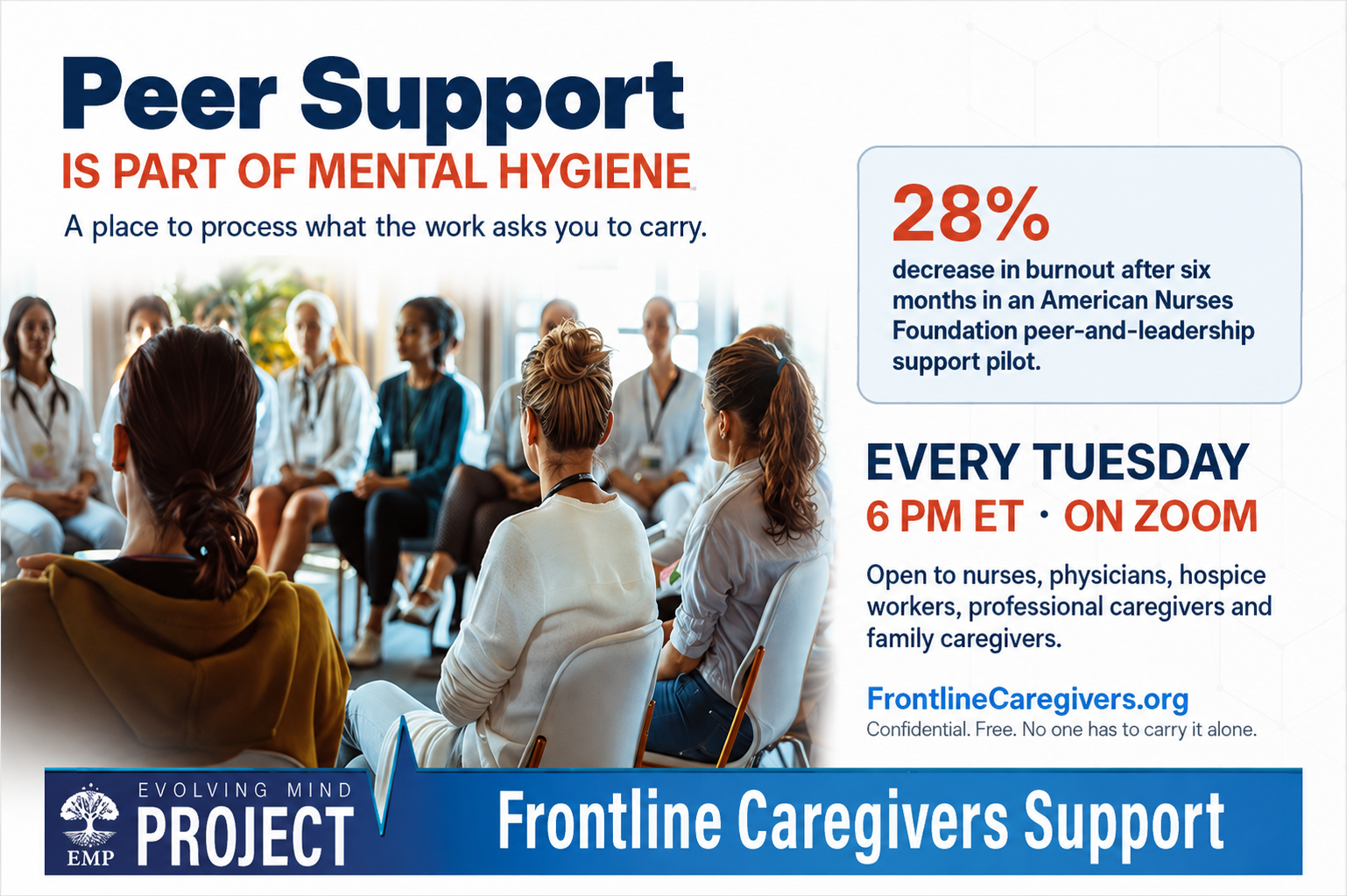
The Frontline Caregiver Support work offered through the Evolving Mind Project was created around precisely that reality. It provides a confidential integration environment specifically for healthcare professionals and caregivers navigating repeated exposure to trauma, responsibility and loss.
It is less about teaching caregivers how to endure more and more about providing somewhere for what they are already enduring to be metabolized. Think of it as healers healing healers. A place where the person who spends their day holding others does not have to keep holding everything alone.
Steven Twohig, founder of the Evolving Mind Project and creator of the Turning Within practice, puts the principle simply: "Healing the healers is one of the most important things we can do."
That idea becomes increasingly important when considering rumination.
Because repetitive thinking does not always require another coping technique.
Sometimes it requires somewhere safe for the experience to finish.
The Mind Keeps Meaning, Not Just Memories
Rumination is often described as repetitive negative thinking.
That is accurate, but for a caregiver it may be useful to look one layer deeper.
People rarely replay meaningless events.
The mind returns to experiences carrying significance.
I failed them.
I wasn't enough.
People cannot be trusted.
Something terrible could happen at any moment.
Everything depends on me.
Those statements are different from the event itself.
They are meaning made from the event.
And once meaning becomes established, the next difficult experience can begin to confirm it.
A caregiver who unconsciously carries the belief that "everything depends on me," for example, will encounter an understaffed shift differently from someone who does not.
The workload is objectively difficult for both.
But one person is also carrying an internal mandate.
That is where ordinary stress can begin becoming psychological architecture.
The caregiver is no longer simply responding to today's problem.
Today's problem has entered an older story.
Mental Hygiene Should Be Part of Caregiving
We understand physical hygiene intuitively.
Exposure requires cleaning.
The same principle may deserve greater attention psychologically.
Caregivers routinely encounter grief, fear, anger, helplessness, bodily suffering, family conflict, death and enormous responsibility.
Expecting a human being to absorb that material indefinitely without some form of psychological integration is a strange expectation when considered plainly.
This does not mean every difficult thought represents pathology.
Quite the opposite.
Some rumination may begin because the mind is attempting to understand something important.
The problem is when the circuit never closes.
The caregiver continues revisiting the experience but no new information is being generated.
That is no longer reflection.
It is repetition.
Mental hygiene practices can create a simple interruption:
What am I repeatedly cultivating here?
Is there useful information?
Is there an emotion that has not been acknowledged?
Is there meaning being assigned that should be examined?
Is this something that needs action?
Or is my mind simply running the same lap again?
Those questions do not eliminate caregiving stress.
They restore some agency in the caregiver's relationship with it.
Learn more about mental hygiene
Caring for the Person Who Cares
The Virginia Tech researchers cautioned that more work is needed to understand how mindfulness-based approaches affect different caregivers over longer periods of time.
But the finding around rumination points toward something immediately recognizable.
Care does not stop when the task is finished. Neither does stress.
Some of it follows people home.
Some of it wakes them at 2 a.m.
Some of it becomes the internal conversation they no longer realize they are having.
That suggests supporting caregivers requires more than helping them perform caregiving better.
It means giving them practices for noticing what the work is doing inside them.
It means spaces where they do not have to remain the strong one.
And perhaps most importantly, it means recognizing that the person holding everyone else also needs somewhere to put what they are holding.
The burden may remain real.
But the caregiver should not have to carry the burden and every unresolved meaning the mind has attached to it.
The burden may remain real.But burden and unresolved meaning are not the same thing.
Caregivers should not have to carry both indefinitely.
Caring for the caregiver means helping them put down what the work leaves behind.
That is where mental hygiene begins.