The Shadow Archetype of the Martyr
When contribution becomes shadow
Why can it feel so easy to care for everyone else, yet so difficult to let care reach us? Recognize signs like neglecting your needs or guilt when setting boundaries to identify your martyr patterns. This awareness helps you start transforming these habits.
This is one place we can begin to recognize the Martyr archetype. Everything goes out, but nothing seems to come in. We keep giving, and somewhere in that giving, resentment builds. Now the contribution carries another meaning: look at what I have given up, and look at how little anyone cares.
In Turning Within, we approach archetypes as patterns of meaning through which we experience life and are part of the makeup of our deep-conscious, beneath what we ordinarily notice. We don't have to consciously choose the same story every morning for it to keep running. We find ourselves in a different situation, with different people, having a very familiar experience.
Learn about archetypes
With the Martyr, that experience keeps returning to sacrifice. Suffering becomes more than something we are going through. It becomes how we know who we are.
The Difference Is in the Purpose
Contribution helps us become more than the small version of ourselves concerned only with what we're getting. We care about someone. We become part of something. We give because we want to contribute, and through that contribution, more of us comes into life. Giving beyond ourselves is not, by itself, martyrdom. It is liberation.
A mother who willingly gives her life to protect her children can be acting with an open heart. She is contributing the greatest part of herself because she loves them. Compare that with a parent who repeatedly reminds the children of everything they have given up, whose sacrifice becomes the reason the children should feel guilty for having lives of their own. The difference isn't how much was given. It's what the giving is serving.
The Martyr uses contribution to validate their personal suffering. Ask yourself: Do I believe my worth depends on sacrifice? Exploring this helps uncover hidden motives and shifts your perspective toward self-care.
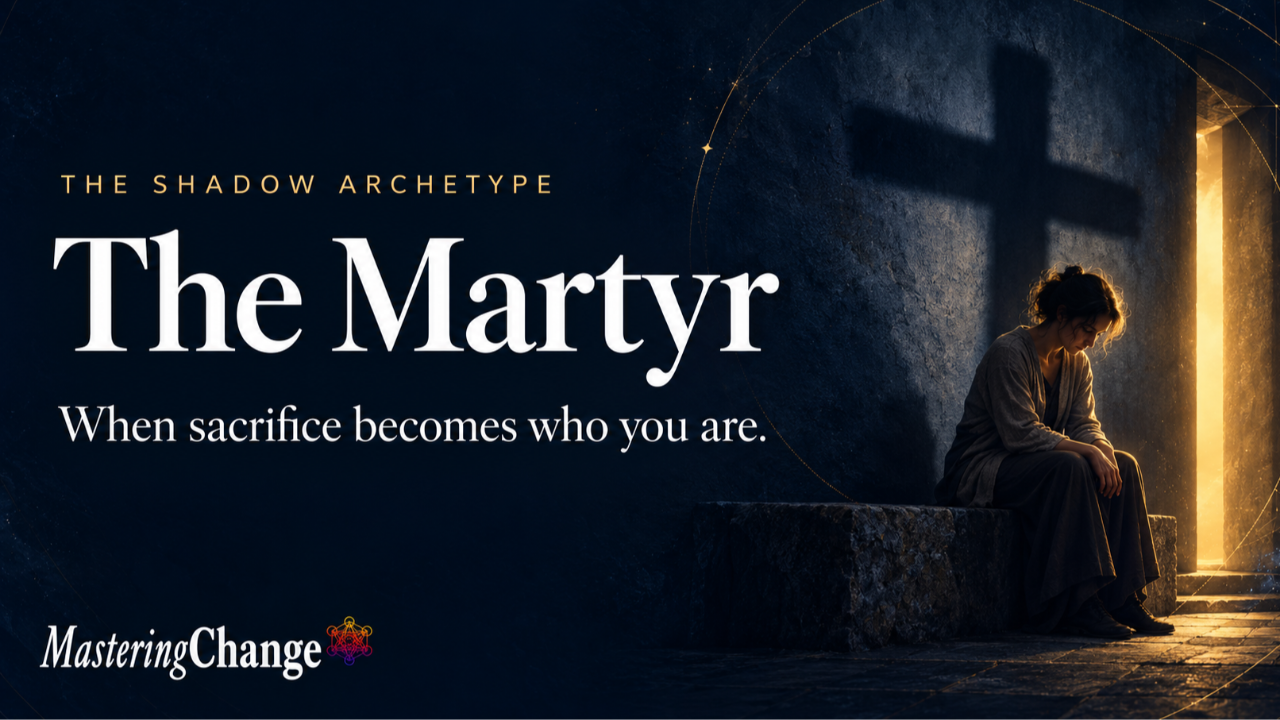
When the Cross Becomes Home
I remember joining the Army because some part of me had decided that dying on a battlefield was the most noble way to die. Consider the meaning in that. Somewhere in me, giving my life had become a way to make my life matter. I wasn't walking around consciously studying that decision. It was part of the story I was already living. Hello, Shadow.
When we are caught in this pattern, getting up on the cross can feel like the only meaningful response available. Someone needs more, so we give more. We are already exhausted, but we keep going. Help is offered, and we wave it away, then wonder why we have to carry everything ourselves. Eventually, the cross becomes home. We know how to experience life from there.
We don't even need other people to see us as a martyr. We can do this entirely on our own. We can privately keep track of everything we've sacrificed, refuse to acknowledge our own needs, and experience our life as proof that nobody cares. Someone may be trying to love us while we are too busy proving that we are unloved to let it reach us.
That doesn't make every burden imaginary or every relationship fair. People can ask too much of us. But when the same story keeps following us, there is something worth turning within to investigate. What happens in me when I consider putting this down? What would it mean about me if I no longer had to suffer this much?
The people around us can also become typecast in the story. If I am always the one who sacrifices, you become the one who takes. You may feel that accusation in how I speak to you, even when I insist that nothing is wrong. You defend yourself or pull away, and now I have more evidence that you don't care. Shadow begets shadow, and around we go.
Letting Care Reach You
When I guide people through this work, I ask them to notice where they leave themselves out. I can see the brilliance in you, but I won't allow myself to see it in me. I can encourage you to rest, but I have to keep earning my place. I can forgive what you are going through while punishing myself for being human. There is information in that difference.
I have had to do this work myself. I couldn't keep telling people to see their own brilliance while refusing to acknowledge mine. At some point, I had to notice that I was abandoning myself in the very thing I was asking others to practice.
So begin with something you can actually experience. Practice giving yourself small acts of care-like taking a break or accepting help-and notice your reactions. This builds comfort in receiving without guilt, supporting your growth.
You don't have to stop caring to find this out. You have to become interested in what happens to you while you care. Your contribution comes through you—your particular way of seeing, your love, your muchness. There is more available there than a lifetime spent proving how much you can endure.
Turning within begins right where that meaning is being lived. We start to discover why the cross became the place from which life made sense, and what becomes possible when we no longer have to return to it. We can contribute for the sake of contribution, with ourselves still present in the giving.