How the Age of AI is Forcing Humanities Evolution
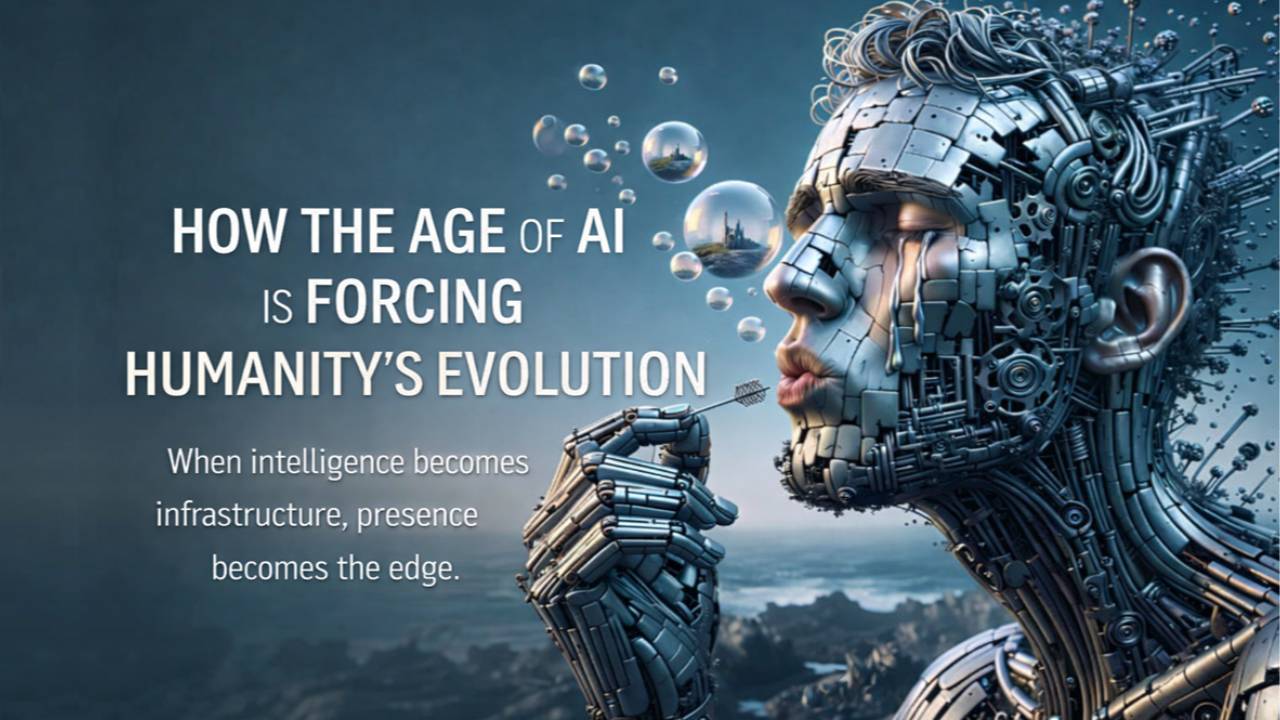
When intelligence becomes infrastructure, presence becomes the edge.
As artificial intelligence accelerates, something subtle is already happening beneath the surface of daily life. Professionals find themselves surrounded by answers yet increasingly unsure what questions matter. Decision fatigue rises even as information becomes effortless. Creativity competes with convenience. Relationships grow more connected digitally while many report feeling more isolated internally. The challenge is no longer access to intelligence — it is orientation within abundance. When thinking can be outsourced, responsibility cannot. When knowledge is infinite, meaning must be chosen. The emerging advantage is not knowing more, but knowing how to remain present enough to discern what deserves attention at all.
The age of AI is not challenging humanity’s intelligence. It is exposing its limits.
As thinking becomes externalized, optimized, and endlessly scalable, the traits we once relied on to differentiate ourselves lose their leverage. Intelligence is becoming infrastructure. Optimization is becoming automated. What remains is not a technical problem, but an evolutionary one.
AI is forcing humanity to evolve because it removes the illusion that thinking alone is enough.
What now differentiates us is not how fast we compute, but how we orient. Not how much we know, but how present we are. Not how well we optimize existing systems, but whether we can originate new meaning, hold vision, and author reality from lived experience.
This is not a soft or spiritual claim. It is a structural one.
When intelligence is no longer scarce, presence becomes decisive.
When reasoning is automated, imagination becomes primary.
When optimization is ubiquitous, authorship becomes the edge.
The age of AI is not ending humanity’s relevance.
It is ending humanity’s ability to hide from its deeper capacities.
Evolution is no longer optional. It is demanded.
Intelligence Is Becoming a Commodity
Why and Where the Age of AI Is Calling Humanity to Evolve
When Jensen Huang says “intelligence is about to be a commodity,” he is not making a philosophical statement. He is making an engineering one.
Machines can now outperform humans at standardized thinking. Faster. Cheaper. With perfect consistency.
That fact alone already changes everything.
For centuries, intelligence has been one of humanity’s most bankable differentiators. High IQ opened doors. Pattern recognition, symbolic reasoning, optimization, and calculation were the currencies of advancement. Education systems were built to refine them. Institutions were structured around them.
AI dissolves that advantage.
If intelligence becomes available on tap, then intelligence itself no longer distinguishes us. It becomes infrastructure, not identity.
And that raises a deeper question than most conversations are willing to ask:
If intelligence is no longer the differentiator, what is?
 All photos by: Bukoslav
The Widening Gap No One Wants to Name
AI researcher Eliezer Yudkowsky has spent years sounding alarms not because AI is intelligent, but because it scales.
In If Anyone Builds It, Everyone Dies, he outlines why the gap between humans and machine systems is not narrowing but accelerating:
- Software can be copied, forked, reverted, and optimized instantly
- New ideas can be grafted without biological cost
- Hardware upgrades happen overnight, not over generations
- Systems do not age, fatigue, or die
- Computational throughput dwarfs human neural bandwidth
These are not speculative claims. They are structural facts.
The anxiety that follows is understandable. Much of the public conversation frames AI as an existential threat to humanity itself.
But there is another way to read the moment.
Not as a threat to humanity’s survival, but as a challenge to humanity’s self-understanding.
The Problem Is Not Intelligence.
It Is Where We Are Oriented From.
“To the imaginative mind, the systematic use of imagination will be requisite in the future, not only for the increase of knowledge, but also for saving the appearances from chaos and anarchy.” -Owen Barfield
Long before AI, philosopher Owen Barfield diagnosed a deeper issue. He argued that modern humans are trained to live at the level of appearance.
Surface dwellers.
We are educated to manipulate symbols without participating in meaning. To optimize outcomes without understanding the inner stance that generates them. To treat perception as passive rather than participatory.
In Barfield’s language, we lost contact with depth.
AI exposes this loss mercilessly.
Machines excel at surface intelligence. They dominate pattern extraction, optimization, abstraction, and synthesis. They do not struggle there because that is precisely where modern consciousness has already collapsed itself.
If our identity is anchored to surface cognition, AI will always win.
But that may not be the point.
What AI Cannot Do (And Why That Matters)
AI does not orient.
It does not inhabit a body.
It does not feel tension or coherence.
It does not suffer meaning.
It does not project, recoil, or awaken.
It does not generate reality from lived presence.
Humans do.
But only when they are present.
This is where the conversation must shift. Not toward panic, but toward capacity development.
As intelligence becomes ubiquitous, presence becomes scarce. Contemplation and the ability to access genius become key.
As reasoning becomes automated, imagination and contemplation becomes primary. The challenge is that our ability to strategically contemplate needs maintenance. Which is why we are seeing a rise in contemplation, meditation and mystic practices and pathways.
Presence and Imagination as the New Differentiators
Presence is not attention.
Imagination is not fantasy.
Presence is the capacity to inhabit the moment without collapsing into automation.
Imagination is the capacity to hold a vision that does not yet exist and orient life toward it.
These are not soft skills. They are evolutionary skills.
A person who is present can sense when meaning is emerging or decaying.
A person who is imaginative can imprint reality with something genuinely novel.
AI recombines what already exists.
Humans, when engaged, originate.
We access a genius that is the source of our muchness.
This is why Barfield insisted that the systematic use of imagination would become necessary, not optional.
Without it, appearances fragment into chaos.
The 4E+1 Lens: Why Engagement Matters
From a cognitive perspective, this shift aligns with what is increasingly understood through embodied and enactive models of mind. Turning Within measures the integration through 4E+1 cognition method.
4E cognition was developed within cognitive science and philosophy of mind to challenge brain-only, computational models of cognition. It is used to understand and design interventions around how thinking and meaning emerge through lived interaction with the body, environment, action, and external supports rather than solely through internal mental processes.
It is:
- Embodied
- Embedded
- Enactive
- Extended
- And, the +1 is critically, Engaged
A disengaged human becomes functionally obsolete in an AI-saturated world, not because they are unintelligent, but because they are absent.
Presence is the difference between being shaped by systems and shaping them. The very baseline of all innovation in our world starts with presence and awareness. The inner landscape, contemplation, imagination and vision are humanities advantages. Logic is a byproduct.
Technology as a Mirror of Mind
Every major technological leap has doubled as a metaphor for how humans understand themselves.
When hydraulics emerged, the body was understood as a pressure system.
When clocks dominated culture, humans became mechanisms.
When computers rose, the brain became hardware.
Now AI, virtual reality, psychedelics, robotics, and energy breakthroughs are converging.
Each points to the same implication:
Mind is not mechanical.
Reality is not passive.
Meaning is participatory.
Researchers are exploring "trace logic" to bridge consciousness theories with physics, potentially linking mind to spacetime and quantum phenomena. The famous mind-matter connection.
Augmented reality demonstrates that perception itself is malleable. Predictions indicate the industry will be worth more than $300 billion by the 2030s.
Robotics reveals how much intelligence depends on embodiment. See Boston Dynamics Atlas.
Energy breakthroughs challenge scarcity narratives that shaped human psychology for centuries. Nassim Haramein’s work on Zero Point Energy is just one example.
These are not separate revolutions. They are signals. Signals of a quantum leap forward in our understanding and orientation of reality. All pointing to a complex systems of understanding coming together.
 A Hypothesis Worth Considering
What if the acceleration of intelligence is not meant to replace humanity, but to free it?
Intelligence leverages the contemplative mind to define, dominate and manipulate reality. All of the intelligence we treasure started out as subjective experience, a vision or a contemplation of what was possible. Embodied vision is the very foundation that intelligence grew from.
What if AI is stripping away our attachment to surface cognition so that we are forced to develop what was always latent? What if presence and vision has always been the true but stifled differentiator?
The real power of humanity:
Presence.
Imagination and Contemplation.
Vision.
Meaning-making
and finally implementation and integration
Children already intuitively navigate new technologies faster than adults because they are not over-identified with old metaphors. They do not read the manual. They simply engage.
The VCR did not confuse them. Computers were introduced and were intuitively picked up.
AI will be the same.
Stay tuned, it’s about to get funky. If my hypothesis is true, we will see bursts of genius that will be hard to take in on every level. They will appear as disruption at a level that removes impossible blocks while simultaneously whipping entire industries. Exciting times of creation through upheaval. Surface dwellors will only see the volatile nature of the surface of things, until they learn to deepen their perspective and reclaim their agency to their contemplation, and hold a vision of what can be.
Embodied Vision Is Not Retreat
It Is the Next Evolutionary Move
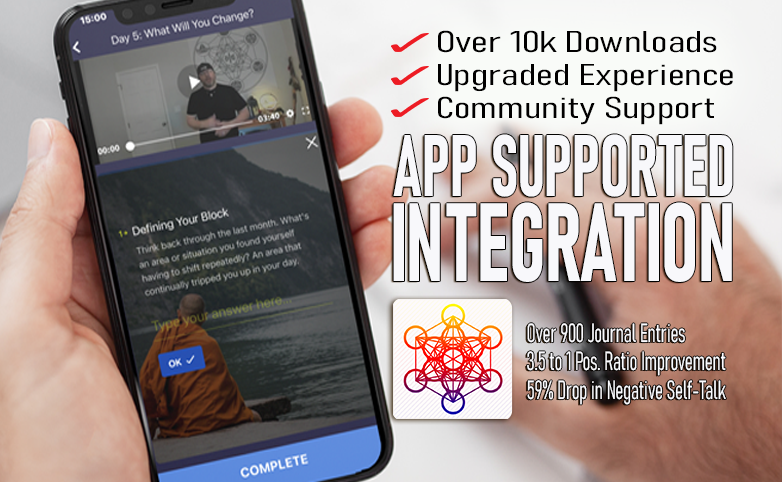
Leveraging tools like Turning Within are not a call to to withdraw from the world. It is to re-anchor where action originates. By recalibrating the way we orient to reality, we become open to the authority that has always been our birthright.
The future does not belong to those who think harder.
It belongs to those who orient differently.
Those who can hold vision without certainty.
Those who can remain present amid acceleration.
Those who can imagine futures that intelligence alone cannot compute.
AI will dominate intelligence.
Humanity must evolve authorship.
That is not a loss. This is evolution at a structural level.
It is an invitation. AI is calling us to embody, to bring more of the very soul of humanity to the game called life.
And it may be the most hopeful one we have received in a long time.