What ‘Thank You for Being My Teacher’ Actually Means
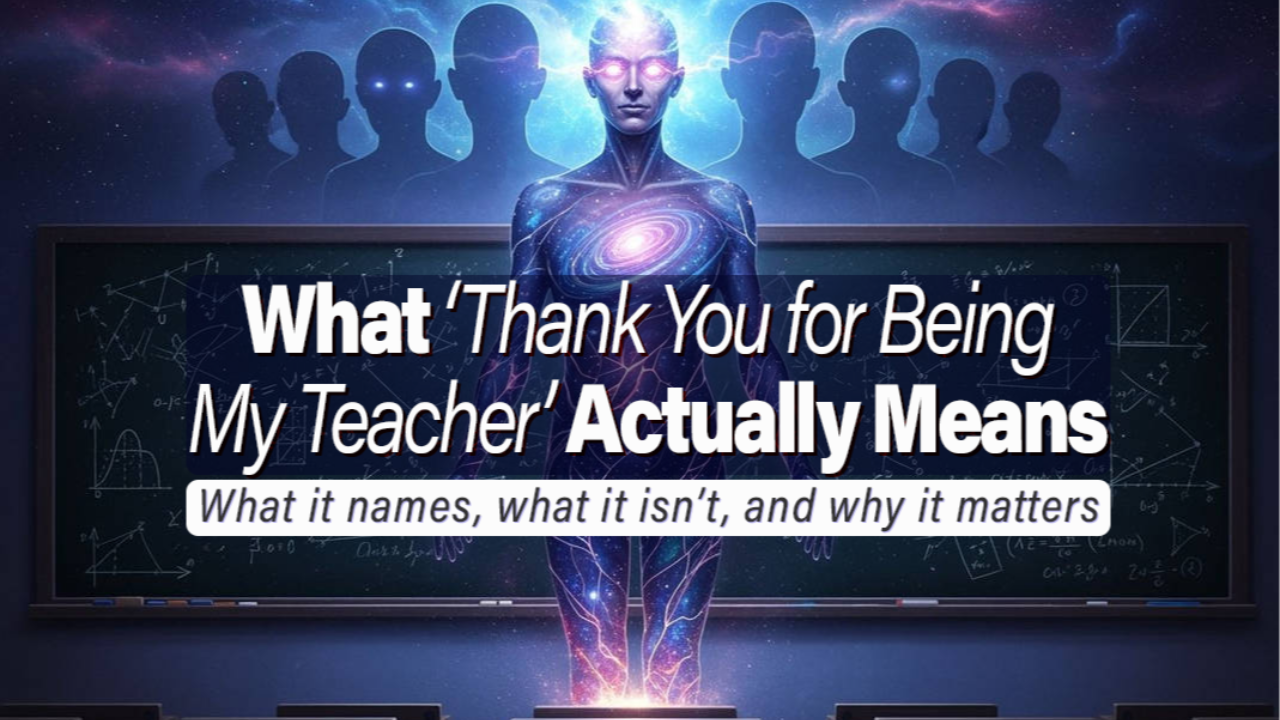
What it names, what it isn’t, and why it matters
Thank You for Being My Teacher
You may have heard the term used by someone who practices depth work and wondered what they meant.
At first glance, it sounds polite.
Spiritual.
Maybe even soft.
But it’s not.
What we mean by it is precise, embodied, and often uncomfortable.
When we say “thank you for being my teacher,” we are not thanking someone for being kind, wise, or benevolent. We are acknowledging that an encounter revealed something about ourselves that we could not see on our own.
And that revelation can come in many forms.
When the Teaching Comes Through Friction
Sometimes it comes through friction.
Someone says something that hooks us.
The body responds before the mind has time to narrate.
The heart rate increases.
Heat rises in the chest.
The jaw tightens.
There is an urge to defend.
To lash out.
To justify.
To withdraw.
The nervous system drops into a survival-focused orientation.
In that moment, “thank you for being my teacher” does not mean:
What you said was okay.
It means this:
Something in me was activated.
Something that was already here was revealed.
If I can tend to the part of me that was hooked, rather than projecting responsibility outward, I gain direct insight into a pattern I have been blindly carrying through my life.
The trigger did not create the response.
It exposed it.
That exposure is the teaching.
When the Teaching Comes Through Inspiration
Other times, the teaching comes through inspiration.
Someone accomplishes something extraordinary.
They move with clarity, courage, or mastery in a way that expands what feels possible.
Watching them reorganizes the internal landscape.
The mind begins to register a new reference point.
The human nervous system learns by example.
We do not just imagine what is possible.
We model it.
This is why the absence of good examples limits growth, and why the presence of them accelerates it. When we see someone embody a level of coherence or success we have not yet claimed, something in us quietly recalibrates.
In this context, “thank you for being my teacher” means:
You showed me what can exist.
You stretched my internal map of reality.
It is not worship.
It is orientation.
When the Teaching Comes Through Contrast
And sometimes, perhaps the most confronting form of all, the teaching comes through contrast.
Someone shows us what not to do.
Or where a boundary must be drawn.
Or how misalignment looks when it plays out over time.
Even here, the phrase holds.
Because the acknowledgment is not about agreement or approval.
It is about recognizing ourselves as practitioners.
Students of life.
Meeting the external world as curriculum.
Growing Out of Magical Thinking
We are not children anymore, waiting for life to be gentle in order to learn.
We are adults learning to stay present with what is.
Early in life, many of us operate from magical thinking.
We believe in simple stories.
Clean narratives.
Clear heroes and villains.
Most of us believed in some version of Santa Claus, not just as a figure, but as a structure.
The idea that goodness is rewarded, badness is punished, and meaning is externally administered.
As we mature, those structures dissolve.
Or at least, they are meant to.
The Problem With Plastic Spirituality
Yet many people replace childhood mythology with a more socially acceptable version of the same thing.
Plastic spirituality.
Overly positive language that denies anger.
Bypasses grief.
Mistakes emotional suppression for transcendence.
A smile pasted over a nervous system that is still running survival programs.
That kind of spirituality feels good until it does not.
And when it breaks, it breaks hard.
What the Phrase Is Actually Pointing To
The use of “thank you for being my teacher” is not about staying positive.
It is about staying honest.
It allows us to meet life without collapsing into blame or superiority.
Without pretending we are beyond being affected.
Without outsourcing responsibility for our inner world.
It is a way of saying:
-
This moment mattered.
-
Something in me responded.
-
I am willing to learn from it.
Holding Boundaries Without Losing Agency
This does not mean we do not hold boundaries.
It does not mean we excuse harm.
It does not mean we spiritualize abuse or minimize impact.
It means we distinguish between what happened and what it revealed.
That distinction is maturity.
The Practitioner’s Orientation
A practitioner does not ask:
How do I avoid being triggered?
They ask:
What is being shown to me right now?
They do not ask:
How do I stay positive?
They ask:
How do I stay present?
They do not confuse learning with liking.
Or insight with agreement.
They understand that life teaches through contrast as often as through comfort.
Precision, Not Politeness
When you live this way, the world becomes a field of instruction.
Not because it is trying to teach you, but because you are willing to learn.
Every encounter becomes a mirror.
Every disruption, a doorway.
Every moment, an opportunity to reclaim agency.
So when we say “thank you for being my teacher,” we are not being polite.
We are being precise.
We are acknowledging that something moved in us,
and that we are responsible for meeting it.